
14-Day Money-Back Guarantee
0
The short answer
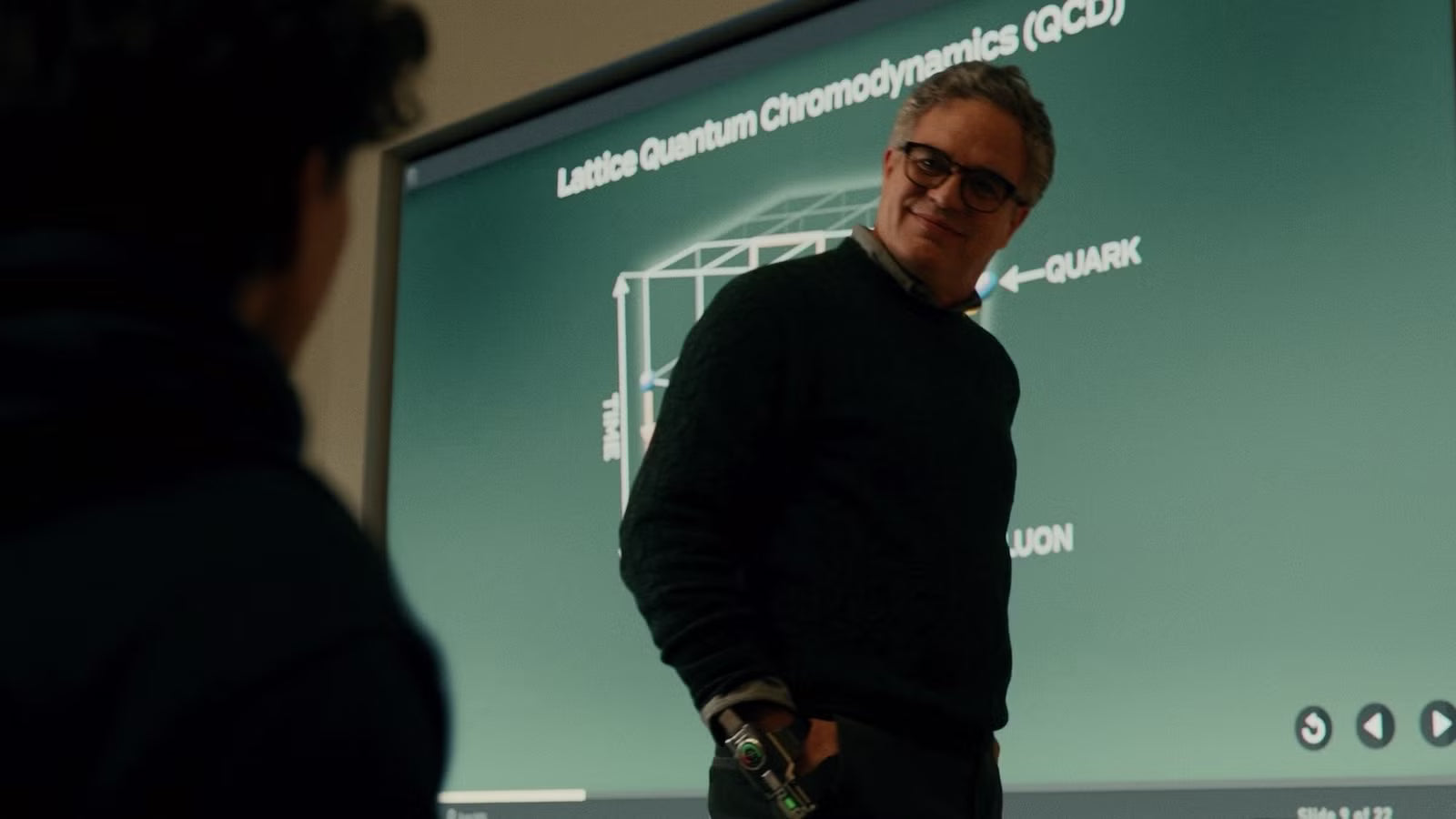
Bruce Banner teaches at Empire State University and wears an inhibitor on his right wrist, a prototype he built himself so he could become human again - his Professor Hulk form had become permanent. Jean Grey controls him telepathically and makes him destroy the device. Once free, he refuses any new chip, switches to Savage Hulk, and ends up in a psychiatric unit.
It is the appearance with the heaviest consequences in the film, and the one the trailers prepared us for worst. We expected a spectacular cameo; we get the fall of a man.
Here is exactly what Banner does in Brand New Day, why his inhibitor sits at the centre of the plot, and where he ends the film.
Banner the professor: what the film establishes straight away
We find him teaching at Empire State University. It is a meaningful writing choice: the most dangerous man on the planet gives lectures, and his students only ever ask him about the Avengers.
The visual detail that matters is on his wrist. He wears a small inhibitor unit on his right wrist - not a gauntlet, not an implant. A discreet device, one he designed himself.

Why he needs this device
Because his transformation had become permanent. His hybrid form, the one that combined his intelligence with the green giant's body, would no longer come undone. Banner could no longer become Banner again.
The inhibitor suppresses the effects of gamma radiation and gives him back his human appearance. It is a prosthesis of identity: without it, he no longer exists as an individual.
He has also miniaturised it. The earlier version was a bulky piece of kit; the one he wears here fits on the wrist, a sign that he has kept working on it in the meantime.

Spider-Man Tom Holland Figure
The Peter Parker who knocks on a scientist's door rather than charging in. The figure takes the silhouette of the web-slinger as played by Tom Holland, and you will find it in our Spider-Man figures.
View the product - 79.90 EURWhy Peter comes to find him
It is not a plot coincidence: he is the only man in the world who has solved the same problem as Peter.
Peter is going through a change in his spider DNA that he can no longer control. So he comes to ask Banner whether it is possible to suppress the monstrous part of a genetic make-up - and whether the inhibitor technology could be adapted to target one precise gene expression.
We go into that mutation, its symptoms and what it triggers in Peter in our article on organic webs and spider DNA.
The detail the film does not explain
Banner does not know who Peter Parker is. The spell in No Way Home erased his identity from everyone's memory, including those who fought alongside him.
Their conversation therefore takes place between two strangers who recognise each other only through the substance of the problem. It is one of the scenes where the character's loneliness is felt most keenly, without a single line of dialogue pointing it out.
How Banner loses control
What follows is a direct consequence of the main plot, and none of it is Banner's doing.
Jean Grey takes hold of him
She exerts telepathic control over him and uses him as an instrument: she needs to force a locked door in a Damage Control facility, and nothing she has can do it.
Under her control, Banner removes and then destroys his own inhibitor. He acts at first in his controlled form, the one that keeps his intelligence.
The refusal, then the switch
Free of her control, Peter offers him a solution: the universal chip he has designed, able to suppress any abilities at all.
Banner refuses. He says something inside him is broken. And he then switches into a form we had not seen from him in fourteen years: the Savage Hulk, no consciousness, no Banner.
That switch is what the second trailer hinted at without giving the cause - we analysed it at the time in our trailer breakdown, which reads very differently once you have seen the film.

Articulated Spider-Man Figure
An articulated figure for replaying the most one-sided fight in the film. The whole range is in our Spider-Man figures, and the new pieces tied to the film are in our Brand New Day merch collection.
View the product - 99.90 EURSpider-Man against the Hulk: the first clash on screen
A useful clarification, because it is circulating the wrong way round: this is not their first meeting - they have fought on the same side before. It is, however, the first time they fight each other in a film.
And the film settles the matter realistically. Peter cannot fit an inhibitor on him: the skin is too thick for the device to anchor. So he has no technical solution, only his webs and his mobility.
The clash is not a victory, it is a containment. Peter buys time, he does not win the fight - which is consistent with an opponent of that calibre.
Where Banner ends the film
This is the part audiences remember least, and it is the hardest.
We see him leave in an ambulance, dazed, asking whether he hurt anyone. He does not know what happened, he does not know what he did, so he asks.
He ends up in a psychiatric unit, for what is presented as a nervous breakdown. His reputation is destroyed and his university post is gone.
What that implies for what comes next
Several commentators read this as the explanation for his absence from the next big events: a man who is hospitalised, discredited and stripped of his inhibitor is in no state to join a team.
This is not confirmed. No studio announcement links the two facts, and it is a press reading, not information. We apply the same caution in our analysis of Spider-Man's role in Avengers Doomsday, where a character's absence from an announced cast does not mean absence from the film.
The inhibitor, the central object of the film
This device is worth pausing on, because it ties together the three plot strands of the feature.
What it does, technically
It suppresses the effects of gamma radiation on the body and gives Banner back his human appearance and physiology. It is not a sedative or an emotional brake: it is an intervention on biological expression itself.
That is precisely what interests Peter. He is not trying to calm himself down, he is trying to silence part of his own genetic make-up - the same problem put another way.
An object Banner miniaturised on his own
The earlier version was considerably bulkier. Moving to a wrist unit implies years of work, and it says something about the character: Banner has never stopped treating himself, he has made his own body a permanent building site.
It is also what makes its destruction so brutal. It is not a gadget being torn off him, it is the result of everything he built in order to stay himself.
From personal object to weapon
The film then crosses a line Banner had never crossed: Peter designs a universal version, able to strip anyone of their abilities.
Banner warns him on moral ground - who will decide what should be suppressed - and the film proves him right. The technology ends up leaving its inventor's hands, and an agency uses it to switch a detainee's abilities on and off.
This Hulk compared with the comics
The character has been through many forms in the comics, and the film draws on that history rather than inventing.
The savage form is not a gratuitous regression
The alternation between a conscious Hulk and a purely instinctive Hulk is a long-established motif. It is not a step backwards imposed by the script, it is a documented state of the character, one that returns regularly whenever his balance breaks.
What the film adds is the cause: the switch comes neither from anger nor from a wound, but from dispossession. His tool was taken from him, and the rest followed.
The motif of the scientist who treats himself
Banner belongs to a line of characters who try to correct a scientific accident with science. That is also what brings him close to Doctor Octopus and sets him radically apart from villains driven by ambition.
The film therefore places Peter in that same line, and the warning becomes explicit: this is where that road leads when you follow it all the way.
Why this treatment of the character divides opinion
Part of the audience found the sequence brutal, and the criticism deserves a hearing.
The criticism: a beloved character is broken
Banner goes through the film as a victim. He is controlled, stripped of his device, transformed against his will, then hospitalised. None of his actions are his own, and he gets no redress.
For a character who had taken years to find a balance, going backwards this way can feel gratuitous.
The defence: it is what the film is about
Brand New Day is about one thing and one thing only: what it costs to want to remove a part of yourself. Peter builds an inhibitor, Banner has worn one for years, and both end up in the same place - dispossessed.
The film therefore sets Banner up as a living warning: this is what becomes of someone who has spent his life holding himself back. Without him, Peter's final gesture - removing his own chip - would lose all its meaning.
The full ending is covered in our analysis of the ending and the post-credits scene.
The questions you leave the cinema with
How long is his appearance?
Considerably more than a cameo. He is present across several key beats spread through the film - the meeting at the university, the takeover, the destruction of the inhibitor, the switch and the fight. It is not a nod to the fans, it is a complete secondary thread.
Is it the same actor?
The character is given a deliberately more monstrous look than in his previous appearances, which surprised part of the audience. It is a staging choice consistent with the switch he undergoes: the more he loses Banner, the less he looks like him.
Do you need to have seen his previous films?
No to understand it, yes to feel its weight. The film explains in a single line why he wears an inhibitor. Without knowing the road the character has travelled, though, the relapse loses its emotional charge.
Our guide to what you should watch first sets out the bare minimum, and our article on how Spider-Man joined the Avengers retraces their past crossings.
Why was he not shown in the trailers?
He did appear, but framed in a way that suggested reinforcements. The second trailer showed the savage form without giving the cause, which steered the audience towards reading it as a spectacular fight rather than a personal fall.
It is a promotional choice consistent with the rest of the campaign, which undersold the film's melancholy. Part of the misunderstanding on release comes from there.
Can you follow the scene knowing nothing about the character?
Yes. The film sets out the essentials in two lines: this man transforms, this device stops him. A viewer discovering the character grasps the stakes immediately.
What they lose is the echo - the sense that a character spent years finding a balance that is taken from him in a single scene. That is the long-time viewer's advantage.
Will we see the character again?
Nothing has been announced. The film leaves him in a state that makes an immediate return difficult, but which also opens an obvious narrative door. Be wary of articles that confidently claim otherwise.

Spider-Man Mask
The web-slinger's mask, alone against an opponent out of his league. Discover it with our Spider-Man masks and our fancy dress and costumes.
View the product - 29.90 EURWhat his presence brings to the film
A cameo is judged on what it takes away from the film if it disappears. This one cannot be taken away.
He makes Peter's problem credible
Without Banner, Peter's mutation stays an oddity the viewer accepts by convention. With him, it becomes a documented scientific problem, with a precedent, a practitioner and a partial solution already proven.
It is a remarkably efficient shortcut for exposition: the film does not need to explain how an inhibitor works, it only needs to show someone who has worn one for years.
He supplies the physical obstacle the film lacked
The main antagonist is an agency: you cannot fight it with your bare hands. So the film needed an opponent Peter could not beat, to remind us what he is worth physically.
The Hulk fills that role without needing to be evil, which saves the film from adding yet another villain to an already crowded gallery - see our round-up of the antagonists.
He gives the film its saddest scene
A man on a stretcher asking whether he hurt anyone, just after being used as a tool by someone else. It is a moment nothing obliges the film to include, and it includes it.
That register is consistent with the feature as a whole, which the critics broadly praised for its avowed melancholy.
The parallel the film builds without saying so
The two characters are set up as mirrors, and every element of one answers an element of the other.
Both carry a part of themselves they see as a threat. Both build a device to contain it. Both have it taken from them by an outside force they do not control.
And it is at exactly that point that their paths diverge. Banner, dispossessed, collapses - that device was all he had to hold on with. Peter, for his part, removes his own by choice and finds in that gesture what no chip ever gave him.
The difference is not technical, it is human: Peter has someone he can open his mind to, Banner is alone. The film never says that sentence out loud, but its whole structure proves it.
What to take away
Banner teaches, wears an inhibitor on his wrist because his transformation had become permanent, and is stripped of that device by a telepath who uses him as a tool. Once free, he refuses to be held back again, switches, and ends up hospitalised.
It is not a fan-service cameo. It is Peter's mirror: two men who carry a part of themselves like a threat, and who take the opposite decision. One refuses the chip and collapses. The other removes his own and comes through.

