
14-Day Money-Back Guarantee
0
The short answer
It’s not glue. Marvel explains Spider-Man’s wall-crawling as an amplification of the inter-atomic attractive forces between his skin and the surface he touches — the same principle that lets a gecko hang on a pane of glass. Peter controls it without thinking, it works through the thin fabric of his suit, and it fails on almost anything oily or soaking wet.
We accept the web-shooter because it’s mechanical, and the strength because it’s commonplace in a superhero. Wall-crawling, though, remains Spider-Man’s strangest power: a seventy-five-kilo man hanging horizontally beneath a glass ceiling.
The good news is that Marvel has given a precise explanation, and that it rests on a perfectly real physical phenomenon. Here’s how it works, how far it goes, and why it sometimes fails.
Marvel’s official explanation
Unlike other powers deliberately left vague, this one has been set down in black and white.
Amplifying a force that already exists
The Official Handbook of the Marvel Universe describes Peter’s ability as the power to increase the inter-atomic attractive forces between the layers of molecules in his skin and those of the surface he touches, which hugely increases the coefficient of friction between the two.
The wording matters. Peter produces nothing: he secretes no substance, generates no magnetic field, creates no suction. He amplifies an attraction that already exists between all surfaces in contact, and which is simply far too weak in an ordinary human being to have the slightest effect.
An unconscious control
The second key point is that this control is involuntary. Peter doesn’t switch his grip on: it responds to intent, the same way you close your hand without thinking about each muscle.
That explains a detail the stories use again and again: when Peter is injured, exhausted, drugged or psychologically shaken, the grip gives way. It’s one of the few powers an emotional shock is enough to cut off — and one of the most elegant ways to put him in danger without sending a stronger opponent after him.
Why it works through the suit
The question keeps coming back: if it’s skin contact, how does Peter stick to walls with gloves on?
The answer lies in the nature of the phenomenon: the effect reaches over a very short distance and passes through a thin layer of fabric. That’s also why the suit is consistently described as extremely thin — thick clothing cuts the grip off, which happens regularly when Peter climbs in his street clothes.

Spider-Man Figurine
The character frozen in his most recognisable pose, braced on four points. The whole range sits in our figurines.
View the product — €69.90The real phenomenon behind the fiction
It’s one of the few Marvel powers whose explanation rests on genuine physics, known and measured.
Van der Waals forces
Between two very close surfaces there is a weak electrostatic attraction, called the van der Waals force. It acts at the scale of molecules, over tiny distances, and it is present everywhere — including between your hand and the table.
It is simply too weak to be noticeable, because two apparently smooth surfaces actually touch over only a minuscule fraction of their area. So the whole trick is to multiply the points of contact.
The gecko’s solution
That’s exactly what the gecko does. Its feet are covered with millions of microscopic hairs, themselves split into even finer structures at the tip. The result: an enormous real contact area, and a cumulative van der Waals force strong enough to hold several times the animal’s weight on perfectly smooth glass.
Spiders use a comparable arrangement, with tufts of bristles at the ends of their legs. In both cases there is no glue and no suction: only contact physics.
What the fiction adds
Transposing this to a human body runs into a problem of scale: mass grows far faster than the available contact area. A man covered in gecko bristles wouldn’t hold on a wall — he would need an absurdly large contact area.
That’s where Marvel makes its single leap: rather than adding hairs, Peter amplifies the force itself. The solution is elegant because it sidesteps the physical limit while keeping the real mechanism. We look at this kind of trade-off in our article on the scientific plausibility of Spider-Man’s powers and in our feature Spider-Man and science.
The competing versions
Not every incarnation of the character has kept the same explanation, and the differences say a lot about each era.
The microscopic hairs version
Several stories, notably in the Ultimate continuity, take the most directly biological route: micro-structures on the skin of the hands and feet, modelled on spider anatomy.
The first film adaptation, in 2002, picks up this idea and gives it a shot that has stayed famous, in which a young Peter watches ridges appear on his fingertips. It’s the most visually readable choice, and the easiest for a viewer to grasp.
The electrostatic version
This is the reading kept by the Handbook and by most of the main storylines: nothing grows on Peter’s skin, it is the force itself that is amplified.
It has a clear narrative advantage: it explains why the grip works through the suit, why it can be cut off by a state of mind, and why Peter can also make an object stick to him rather than the other way round.
The totemic version
A third reading, developed from the 2000s onwards, ties all of Peter’s abilities to a mystical dimension — the idea of a spider totem connected to a web of destiny that runs across the universes.
From that perspective, the question of mechanism loses its meaning: wall-crawling is no longer a physical phenomenon but an attribute. We devote a full feature to this reading, the web of destiny and the Spider-Totems.

Spider-Man Canvas Poster
The silhouette braced against a wall, printed on stretched canvas. Find it among our posters and our tapestries.
View the product — €16.90How far it goes
The power is strong, but it has precise limits that get used again and again.
The whole body, not just the hands
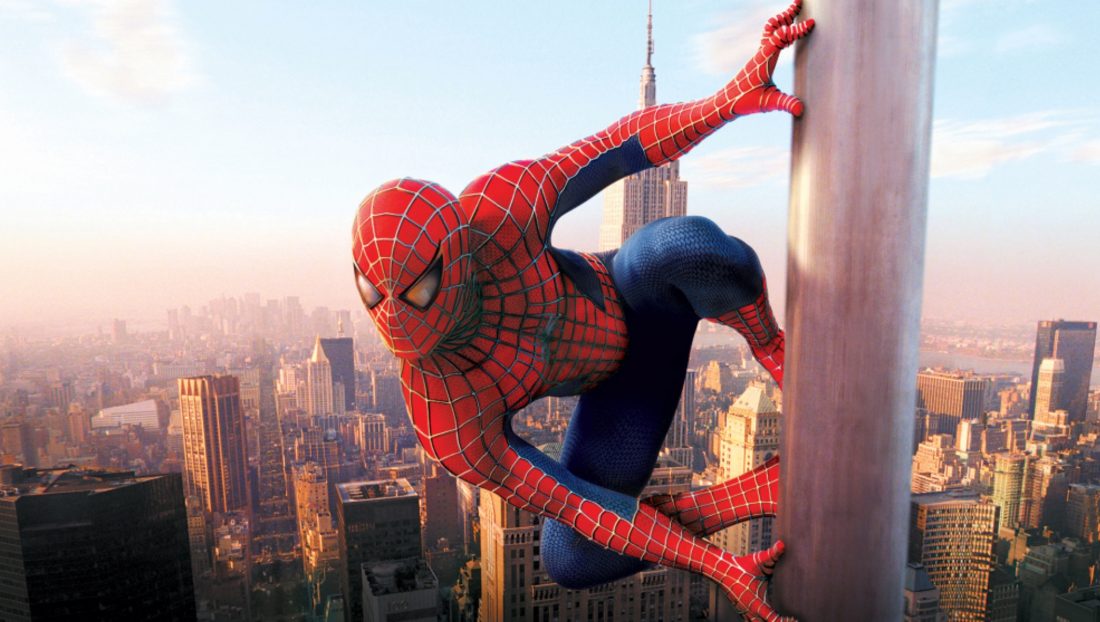
Wall-crawling isn’t limited to palms and soles. Peter holds on with his back, with a shoulder, with a forearm — that’s what makes possible the impossible poses that are his graphic signature.
It’s also what lets him carry loads in positions where an ordinary climber would have no purchase at all: he isn’t holding on to the wall, he becomes one with it.
The weight he can hold
The practical limit isn’t the grip itself but the surface. If Peter amplifies the attraction to the point of holding several times his own weight, it’s the brick, the plaster or the glass that gives way first — a visual device the stories often use, tearing off a chunk of façade.
That limit forces him to choose his holds like a real climber, and explains why he consistently favours concrete and steel over crumbly materials.
Sticking, but also letting go
The power works both ways. Peter can hold an object against his hand without gripping it, and above all let go instantly — without that second faculty, every hold would become a trap.
It’s this control of the release that makes fast movement across a façade possible: sticking and unsticking dozens of times a second, without thinking about it.
When it doesn’t work
The failures of Spider-Man’s grip have become plot devices in their own right.
Oily and slippery surfaces
This is the most exploited flaw. A layer of grease, oil or adhesive substance comes between the skin and the surface and prevents the close contact the whole mechanism depends on.
Several opponents have built their entire strategy on it, either coating Peter or treating surfaces in advance. It’s one of the few weaknesses a villain with no powers can exploit with nothing but a canister.
Extreme cold and water
A soaking, icy or frost-covered surface poses the same problem: direct contact is no longer possible. Stories set in freezing environments regularly put Peter in trouble for that reason alone.
Fatigue and shock
Since the control is mental, anything that alters Peter’s state alters his grip. Exhaustion, concussion, poison, psychic manipulation: the fall that follows is one of the character’s most powerful images, because it brings him brutally back to his condition as an ordinary man.
Thick clothing
Finally, the most mundane limit: in a coat, in winter gloves or in protective gear, Peter no longer sticks. It’s a detail writers sometimes forget, but it stays consistent with the official explanation.
Among the other web-slingers
Wall-crawling is the most stable common thread across the whole spider multiverse, with a few notable variations.
Miles Morales has the same ability, plus two powers of his own that completely change the way he moves — see our introduction to Miles Morales.
The Spider-Man of 2099 works differently: his hands and feet have retractable talons that anchor physically into surfaces. It’s a mechanical grip, more brutal, and it leaves marks — we go into it in our profile of Miguel O’Hara.
Symbiotes, for their part, stick using their own substance. That’s what makes Venom able to climb without sharing Peter’s mechanism, and one of the reasons he is such a hard opponent to shake off in a chase — see Spider-Man and the symbiote.

Spider-Man Web Shooter
The character’s other great mechanism, this one entirely technical. Find it in our web shooters and our toys.
View the product — €34.90What wall-crawling changes in the storytelling
A power doesn’t exist only to be explained: it shapes the way the stories are told. This one has very concrete consequences.
A permanent verticality
Spider-Man is the only major urban hero for whom a façade is a floor. He doesn’t need to fly or to jump: he walks, stops, turns round, talks, fifteen metres above the pavement.
That freedom has immense visual consequences. It allows framings impossible for any other character, and it’s one of the reasons he works as well in comics as in video games, where the city becomes a playable space in all three dimensions.
An intimacy with the city
Where other heroes fly over New York, Spider-Man touches it. He clings to the bricks, sits on the cornices, rests on the shop signs. The setting stops being a backdrop and becomes a partner.
That tactile relationship with the city is inseparable from the character: he is a neighbourhood hero, not a hero of the sky, and his quietest power is the one that anchors him most concretely in his environment.
A built-in vulnerability
Finally, a power that depends on a state of mind is a power that can give way at the worst moment. Writers therefore have a permanent lever of tension, available without having to invent an extra opponent.
It’s the same logic as with his other great sensory ability: the more reliable the power is day to day, the greater the effect when it fails just once.
Wall-crawling and web-shooters: two separate systems
The confusion is common and worth clearing up, because it changes the way you read the character.
Wall-crawling is biological: it comes from the bite, it belongs to Peter, and it can’t be taken away from him except by altering his state. The web-shooters are mechanical: they are devices he designed and built, which break down, run empty and can be stolen.
It’s precisely that duality that makes the character: half his equipment comes from an accident, the other half from his intelligence. We go into how the shooters work in our dedicated article and the different formulas in the types of web.
One notable exception: some versions give Peter organic glands, which removes that duality — and, in the view of many readers, part of what makes the character so endearing.
The questions people ask
Does it work on every surface?
On almost every dry, clean surface, glass included. The failures come from surfaces that are oily, soaked, frosted or too crumbly to take the pull.
Can he stick to a living being?
Yes, and it is used regularly: he clings to an opponent, to a moving vehicle, or holds someone against him during a fall.
Does he sleep on the ceiling?
Several stories do show him hanging there, which implies the grip persists without conscious attention. That fits an involuntary control, but writers mostly use it as a character trait.
Could this be reproduced for real?
The mechanism, yes: dry adhesives inspired by the gecko exist and work, particularly in robotics. The scale, no: holding an adult would demand a contact area out of all proportion with that of a human hand. That is exactly the limit Marvel sidesteps by amplifying the force rather than the area.
Can he unstick what he has stuck?
Yes, and instantly. The release is as controlled as the grip, otherwise every hold would freeze him in place. It’s that constant switching between the two states that makes moving across a façade as fast as running on the ground.
Does the advanced suit change anything?
Not for the wall-crawling itself, which remains an ability of the body. The technological suits add side functions without replacing the mechanism — we review them in our feature on the Iron Spider armour.
What to remember
No glue, no suction cups: Spider-Man amplifies an inter-atomic attractive force that already exists between all surfaces in contact, and that the gecko exploits in nature by multiplying its points of contact.
That mechanism explains everything else: why the grip works through thin fabric but not through a coat, why it fails on an oily surface, why it gives way when Peter is at the end of his tether. It’s the character’s most spectacular power, and also the most fragile — a combination that sums Spider-Man up rather well. Our full overview of his powers puts this one back among the rest.

