
14-Day Money-Back Guarantee
0
The short answer
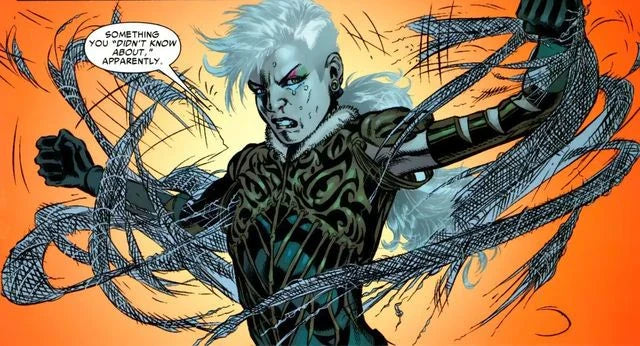
Born to Sergei Kravinoff and Sasha, Ana owes her danger to three things: strength partly inherited from her father's serum, tracking drills from early childhood, and the fact that she hunts as a pack. In Grim Hunt, she stalks the bearers of the Spider-Totem to bring her father back from the dead. Her major arcs are laid out below.
Ana Kravinoff is not just one more name on the long list of Spider-Man's enemies. She is proof that hatred can be handed down like an inheritance. Daughter of the legendary Kraven the Hunter, she grew up in the shadow of a father obsessed with beating the wall-crawler, and she made that obsession her reason for being. She is not trying to exist alongside the Kravinoff myth: she wants to prove she is its rightful heir, right down to the cruelty.
To understand Ana properly, you first have to get to grips with the world of the Kravinoff clan. The family tree is dense, the internal rivalries are many, and every member brings a different shade to the hunt. For the full picture, a detour through Kraven the Hunter, the next great villain of Spider-Man's world and through Kraven the Hunter, the most dangerous enemy of them all gives you the context you need. Without that family web, you miss what makes Ana truly frightening: it isn't her talent, it's her absolute loyalty to a family name.
Origins: born in blood, raised in the hunt
Ana was born of a late union between Sergei Kravinoff (Kraven) and his second wife, Sasha. Where the first Kravinoff generation, Alyosha's, was marked by a certain drifting, Ana was raised to a rigid code: tradition, blood, vengeance. Her mother Sasha gave her no respite. To understand how that upbringing shaped Ana, it is worth revisiting Kraven's Last Hunt, the arc that redefined the hunt — the elder brother from whom Ana inherits both the name and the frustrations.
From a very young age, Ana was trained in tracking, hand-to-hand combat and strategy. Her senses are razor-sharp, and her superhuman strength — partly inherited from Kraven's serum — makes her a formidable opponent. From her very first appearances in the comics she stands out for a brutality never seen before, an almost clinical coldness, but also for a hidden fragility: that of a child who never had a childhood. She doesn't play at being a hunter, she is one. And when the target is Spider-Man, the line between filial duty and personal obsession becomes almost impossible to draw.
That extreme family loyalty is exactly what makes Ana so different from other enemies. Where the Green Goblin or Mysterio work as individualists, Ana works as a clan. To grasp what that changes for Peter Parker, a detour through the Green Goblin, Peter Parker's worst nightmare is illuminating: Ana never acts alone, she acts as a network, and that makes every confrontation far harder to anticipate.
The Gauntlet and Grim Hunt: Ana enters the legend
Ana Kravinoff enters the web-slinger's legend in two major arcs: The Gauntlet, the arc that breaks Peter Parker in order to rebuild him and Grim Hunt, the bloody manhunt that haunts Spider-Man forever. In both stories Ana plays a central role: she helps her mother orchestrate her father's resurrection, and she relentlessly hunts down the other bearers of the Spider-Totem.
The Gauntlet: setting the pieces of the trap
The Gauntlet is a pre-Grim Hunt arc: the Kravinoff clan lays out its pieces methodically, waking or orchestrating attacks from several of Peter Parker's classic enemies — from Vulture to Rhino, by way of Electro and Sandman. To appreciate the scale of the coordination, a detour through the Sinister Six, the cult team and Return of the Sinister Six, the explosive alliance sets the frame. Ana is the organiser in the shadows: she doesn't attack Peter head-on, she wears him down.
Grim Hunt: the final hunt
Grim Hunt is the arc that confirms Ana as a major threat. This is where she hunts the Spider-Totems — Madame Web, Arachne, Mattie Franklin — not to defeat them, but to offer their blood to her father's resurrection ceremony. It is one of the darkest stories ever published around the wall-crawler. To better grasp the mystical framework underneath it, the origins of Madame Web and Mattie Franklin, the Spider-Woman heir are essential reading.
Ana doesn't simply act. She watches, she listens, she files everything away. When Sasha orders her to kill, she doesn't kill for pleasure: she kills to sign off a protocol. That clinical coldness is what terrifies Peter most, because you cannot reason with her. She doesn't hate Spider-Man — she has filed him away as identified prey.
Why Ana is more dangerous than Kraven himself
The idea may come as a surprise: how could Ana, a young teenager, be more dangerous than Sergei Kravinoff, the legendary hunter? The answer comes down to three points.
First, Ana doesn't carry the weight of the past. Where Kraven drags his own psychology behind him — the pride, the shame of defeat, the rivalry with other hunters — Ana is younger, more direct and therefore more effective. She isn't chasing the glory of the hunt, she is chasing the completion of a family mission.
Next, Ana has learnt from her father's mistakes. Kraven failed against Spider-Man again and again, and ended up resorting to psychological extremes — see Kraven's Last Hunt, the masterpiece arc of Spider-Man mythology. Ana, for her part, does not forget those lessons. She plays as a team, she uses proxies, she conducts the whole Kravinoff clan like an orchestra.
Finally, Ana was born into a multiversal context. She grew up knowing that the Spider-Totems exist, that the hunt has a mystical dimension, and that beating the wall-crawler means understanding that system. To get the theory straight, a detour through the Spider-Verse explained simply is illuminating: Ana is one of the first hunters to have taken that on board from childhood.

Spider-Man caught mid-escape
Articulated Spider-Man Figure
This articulated figure of the classic hero lets you replay the scenes of Grim Hunt at home: the web-slinger cornered, pulling himself up, dodging. Movement — exactly what saves Peter against Ana.
€99.90
See the articulated figure →Ana and the other key women of the mythology
Ana's arrival belongs to a mythology in which women take up more and more space. Beside her stands her mother Sasha, but also figures such as Calypso and Yuri Watanabe. To understand where each of them sits, a detour through Calypso, the voodoo priestess who hunts Spider-Man and through Wraith, when New York law tips over into vengeance is essential. Ana is different from all of them: she isn't mystical, she isn't legalistic, she isn't in love. She is pure family execution.
Ana's singularity shows up even more clearly when you compare her with the other female figures in Peter's destiny — such as Black Cat, between love, tension and double identity. Black Cat is a rival who ends up becoming an ally. Ana never will. She is defined by a mission she agreed to carry before she was even able to refuse it.
The Kravinoff legacy after Grim Hunt
What becomes of Ana after Grim Hunt? The arc ends on an ambiguous note. She survives, she carries on bearing the Kravinoff name, but the clan has lost the cohesion it once had. Her mother Sasha is no longer the absolute matriarch. Kraven, resurrected, doesn't follow exactly the script his family had written for him. Ana therefore finds herself in a strange position: the daughter who succeeded at everything, inside a clan that no longer quite exists.
That nuance opens up rich narrative ground. Several recent arcs enjoy showing a more ambivalent Ana, sometimes a temporary ally of other anti-heroes. This growing complexity is part of a wider movement: Spider-Man's classic enemies are becoming less black and white. If you want to take the analysis further, a detour through the blurred line between justice and vengeance for Spider-Man puts that ambiguity in perspective.
Ana's other important legacy is that she legitimised a new generation of hunters in Marvel mythology. Where Kraven was a loner, Ana sets a precedent: she proves you can be a hunter without being a romantic anti-hero. That cold, clinical stance has inspired several supporting characters who have appeared since Grim Hunt.

The mask of the hunted
Premium Electronic Full-Face Iron Man Helmet - from Spider-Man Homecoming
When the Kravinoff clan hunts the wall-crawler, the mask becomes the cornerstone. From the classic red mask to the black mask of the darker arcs.
€299.90€349.90
See this mask →Ana Kravinoff on screen and in games
Ana hasn't had her major film adaptation yet, but she is gradually making her presence felt in the Spider-Man video games and in a few spin-off projects. Sony has long floated the idea of bringing the Kravinoff clan into its parallel Marvel universe. If you want to follow Spider-Man's film chronology, the complete list of MCU films in chronological order gives you a framework, and the likely release of a Kraven-centred film opens the door to an appearance by Ana in direct descent.
On the video game side, Ana turns up in several forms — temporary ally, mini-boss, secondary antagonist. Her presence stays limited but recurring. That fits her nature: she isn't looking for the spotlight, she hunts in the shadows. That narrative discretion is also what makes her so effective in the comics: you never know exactly where she is, until she strikes.

Become the hero the Kravinoffs want to beat
Adult Spider-Man 2099 Miguel O'Hara Costume
The full Spider-Man costume for cosplay, Halloween or a themed night — every detail that makes you a target worthy of the most dangerous clan of all.
€79.90
See this costume →Why Ana still fascinates in 2026
Fifteen years after Grim Hunt, Ana Kravinoff still fascinates readers. Why? Because she embodies a rare form of antagonism: inherited hatred. Many of Spider-Man's enemies have a personal reason to loathe him — Norman Osborn, Otto Octavius, Eddie Brock. Ana never had a personal reason. She hates Peter Parker because she was taught to hate him. That nuance changes everything.
The other reason is that Ana is young. She still has several decades of potential stories ahead of her. Where enemies such as Doctor Octopus or the Green Goblin have been worn thin by dozens of arcs, Ana is still relatively untouched ground. She can evolve, grow more complex, perhaps one day even rebel against the Kravinoff legacy. If you want to picture that evolution, a detour through Kaine, the tragic clone finally rehabilitated offers an interesting precedent: a character everyone thought was condemned to the role of enemy ends up becoming a far more nuanced figure.
Whether Marvel will make the most of that potential remains to be seen. Ana deserves better than the status of second heir — she has everything it takes to become a major antagonist of the next decade. For collectors and fans, now is also the ideal moment to take an interest in her, before she goes mainstream. One thing is certain: as long as the Kravinoff name exists, Spider-Man will never have any peace.

