
14-Day Money-Back Guarantee
0
The short answer
Behind the mask is Lorina Dodson, born into a wealthy family, who killed her husband and siphoned off part of his fortune to turn crime into theatre. A machine-gun umbrella, exploding carrots, unlikely team-ups with the Walrus or Frog-Man: the threat stays minor, the narrative interest does not. Full breakdown just below.
Contents
In the world of Spider-Man, villains come in all kinds. Some embody tragedy, others revenge, and then there are those who, like White Rabbit, go for excess and the absurd. Zany on the surface, this criminal is both whimsical and formidable, and she draws directly on the novel Alice's Adventures in Wonderland by Lewis Carroll — but her madness has far deeper roots than it looks.
First appearing in Marvel Team-Up #131 (1983), White Rabbit quickly established herself as an atypical figure in the web-slinger's rogues' gallery. Behind the white rabbit costume and the surreal gadgets sit a sharp mind, a dark sense of humour and a biting critique of the society that cast her out.

A high-society heiress turned criminal out of boredom
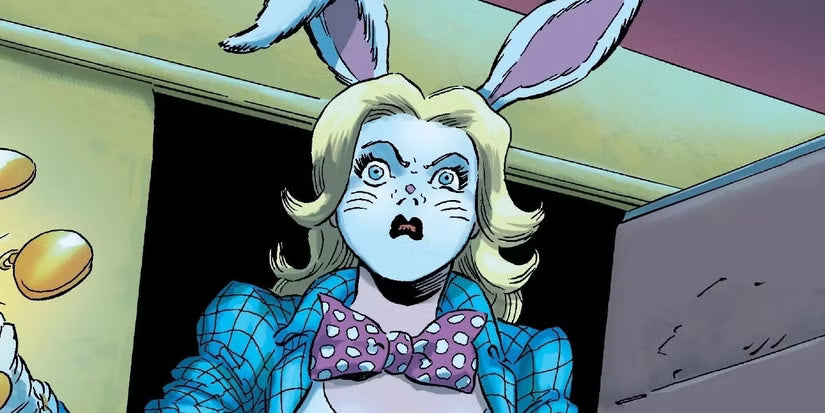
Her real name is Dr Lorina Dodson, and she was born into a wealthy family. Raised in stifling luxury, she grew up surrounded by privilege but with neither love nor freedom. Married very young to a man far older than her, Lorina found herself locked into a flat, meaningless life. That frustration is what pushed her over the line: she murdered her husband, siphoned off part of his fortune and reinvented herself as a flamboyant criminal, determined to turn crime into theatre.
Her transformation is total: she takes on a white rabbit costume inspired by Lewis Carroll's character, armed with absurd gadgets such as a machine-gun umbrella, exploding carrots or even a rabbit-shaped helicopter. Her whole world revolves around satire and irony, a way of mocking both the heroes and the elitist world she fled.
This aesthetic and psychological choice recalls the eccentric antagonists of other Marvel heroes, such as Mysterio or Jack O'Lantern: villains who turn crime into visual and psychological art.
A satirical figure in a tragic universe
White Rabbit is often treated as a 'second-tier villain', but her presence brings an essential nuance to Spider-Man's mythology. Where others embody suffering or hatred, she embodies the total derailment of reason in a world that likes to think of itself as logical. Her absurd humour, her baroque staging and her detachment from danger make her a living caricature of the traditional supervillain.

And yet, under the comic varnish sits a strong message: that of a woman in total rupture with a patriarchal system, who seizes chaos to assert herself. A theme that resonates with other complex female characters in the web-slinger's world, such as Black Cat or Mary Jane Watson.
You can find that same offbeat, daring energy in our Spider-Man fancy dress and Spider-Man masks, perfect for playing the hero... or the villain for one night.
Machine-gun umbrella
An absurd accessory that captures her taste for crime turned into theatre.
Exploding carrots
Gadgets inspired by Lewis Carroll's white rabbit, halfway between satire and irony.
Rabbit-shaped helicopter
The peak of her extravagant world, mocking the heroes and the elitist set alike.
A madcap rival for Spider-Man
White Rabbit has never been a serious threat to Spider-Man. And yet her clashes with him have become cult favourites, precisely because they cut so sharply against the usual dramatic tone of the web-slinger's adventures. Where other villains want to destroy New York or avenge a tragedy, White Rabbit just wants to have fun. Her crimes are absurd performances, built to deliver laughter and chaos in equal measure.

In their early encounters, Spidey is often thrown by her offbeat style. Her habit of reciting passages from Alice's Adventures in Wonderland mid-fight, or of driving a giant rabbit-shaped tank, turns every confrontation into a circus act. But beneath the humour, Spider-Man senses real pain — that of a woman on the run from a life empty of meaning.
Some readers see her as an inverted mirror of Peter Parker: two clever, funny, misunderstood people, who chose opposite paths. Where Peter channels his wounds into doing good, Lorina Dodson turns hers into a parody of evil.
Unlikely alliances and a place of her own in the underworld
White Rabbit has sometimes teamed up with other second-string criminals of the Marvel universe, forming unlikely and hilarious crews. She works in particular with the Walrus, a supervillain as ridiculous as he is incompetent, or with Frog-Man, in arcs where comedy matters more than any real threat. These appearances often act as comic relief between two darker web-slinger stories.
But make no mistake: behind the parody, these stories enrich Spider-Man's urban mythology. They show how alive New York is as an ecosystem, orbited by gods, monsters and small-time crooks alike. In that sense, White Rabbit is every bit as legitimate as a Shocker or a Rhino: she embodies the tonal range of Spidey's world.
Her dark-humoured adventures also echo the web-slinger's permanent duality — a hero who can face cosmic threats one day and clowns armed with improbable gadgets the next. A narrative flexibility that makes Spider-Man a universal character, as at home in drama as in comedy.

You can also find that retro, colourful touch in our Spider-Man figurines and our Spider-Man posters, perfect for recreating the iconic clashes between the web-slinger and his most unexpected opponents.
Modern appearances and growing popularity
Long written off as a mere curiosity, White Rabbit has been given a real place in New York's criminal landscape by modern Marvel writers. Her absurd tone and caustic humour are now fully owned, making her a cult character among Spider-Man fans. It was in the 2010s, with series like Superior Foes of Spider-Man and Sinister Syndicate, that she was fully rehabilitated as an icon of 'comic criminality'.
In these arcs, White Rabbit becomes the leader of a small band of underrated female villains — a girl gang that includes Black Cat, Beetle and Lady Octopus. Together they upend the codes of New York's male underworld with irony and panache. Their motto: never be taken seriously, always stay in control.
This shift marks a successful modernisation of the character: White Rabbit becomes a kind of Deadpool in female form — aware she is a fictional character, mocking, unpredictable and impossible to pigeonhole. Her madness is no longer a handicap but a narrative strength that draws in more and more writers and readers.
A pop icon between satire and feminism
White Rabbit's modernity also lies in the way she subverts the clichés. Where many female villains are hypersexualised or reduced to seduction roles, she claims her eccentricity and her independence. Her unhinged-aristocrat look hides a subtle critique of the latent sexism in the superhero world.
Through her cynical dialogue and far-fetched schemes, she throws light on the absurdity of power and hierarchy — heroic or political. In a sense, White Rabbit embodies the revenge of the outsiders: that of a rich, educated, intelligent woman who deliberately chooses madness so she no longer has to endure the social straitjacket.
That turn has won over a new generation of readers, who now see her as a liberated anti-heroic figure. Marvel has also pushed her forward in several recent comedic arcs, where she crosses paths with characters like Deadpool or Miles Morales.
You can find that offbeat, colourful aesthetic in our Spider-Man T-shirt collection and our Spider-Man jumpers, perfect for wearing your own superhero (or supervillain) style every day.
A rehabilitation in the 2010s
With Superior Foes of Spider-Man and Sinister Syndicate, White Rabbit becomes the leader of a girl gang of underrated villains.
A satire of society and a promising future in the Spider-Verse
White Rabbit is not just a visual joke. Her very existence in Spider-Man's world works like a distorting mirror held up to our society. By parodying authority figures, the aristocracy and heroic morality, she exposes the absurdity of a world where everyone is playing a role. Behind the mask and the madness sits an uncomfortable truth: evil can be born of despair and rejection, but also of emptiness and boredom.
That sociological subtext has won over several recent writers, who have given Lorina Dodson more depth without ever taking away her whimsy. She stands for both the critique of capitalism (a rich heiress bored of luxury) and women's liberation (a woman who breaks the codes of heroic patriarchy by becoming her own chaos).
Fans now hope to see her turn up in the modern Spider-Verse adaptations, especially after the explosion in popularity of eccentric characters like Spider-Ham or Peni Parker. Her flamboyant personality and dark humour would fit perfectly into an animated series or a spin-off film where the Marvel universe blends satire and fantasy.

A touch of humour the web-slinger's mythology cannot do without
Spider-Man has always been a hero with a caustic sense of humour, but also a deeply human one. Against depressive, monstrous or destructive villains, White Rabbit brings a welcome breath of air: she reminds us that Spidey's world is not only tragic, but also teeming, absurd and full of contrasts.
In that, she stands out as a cult figure: not the most powerful, nor the most dangerous, but arguably one of the most memorable. She embodies the streak of madness sleeping inside this universe, the one that stops hero and reader alike from sinking into pathos.
And if you want to bring a little of that offbeat spirit into your own day-to-day, take a look at our Spider-Man pyjama collection or our Spider-Man lamps, inspired by the iconic villains. Perfect pieces for celebrating the humour, the creativity and the legacy of the web-slinger.
Critique of capitalism
A rich heiress bored of luxury who parodies aristocracy and authority.
Women's liberation
A woman who breaks the codes of heroic patriarchy by becoming her own chaos.
White Rabbit: the madness the myth needs to stay balanced
In a world dominated by seriousness and drama, White Rabbit embodies elegant madness and creative subversion. She proves that even the most absurd characters have a part to play in Spider-Man's great web. And perhaps that is why she still fascinates readers so much: because she sends us back to a universal truth — sometimes you have to lose your reason to understand the world.
The elegant madness of the myth
White Rabbit proves that even the most absurd characters have a part to play in Spider-Man's great web.

