
14-Day Money-Back Guarantee
0
The short answer
His spider hormones take over from his human ones. The trigger is twofold: Spider-Man full time, and the shock of realising that the people closest to him have moved on without him. The result: silk glands in his wrists that produce an organic web, strength and senses turned up several notches, and a temper that gets away from him. So he builds an inhibitor chip and implants it in the back of his neck.
It is the thread running through the whole film, and it is also the part most viewers leave the cinema without quite grasping. Peter is not simply getting older: his biology is changing.
Here is what sets it off, what exactly it changes, and why the device he invents to protect himself is probably the most dangerous thing in the film.
What triggers the mutation
The film does not present this as an accident. It is an evolution that had been building, and two factors bring it to a head.
The biological factor: the spider hormones take over
The spider DNA Peter has carried since the bite never went away, it simply coexisted with the rest. The film establishes that this balance breaks down: the spider hormones take precedence over the human ones, and his body tips towards the animal side.

It is an idea the comics call a secondary mutation: not the acquisition of a new power, but an existing power running out of control. The body does not gain an ability, it stops holding back.
The human factor: isolation
The other trigger is not biological at all. Peter devotes himself to Spider-Man full time, because it is all he has left — and he takes the full force of the realisation that the people around him have moved on without him.
So the film explicitly links the emotional collapse and the physical drift. The less he is Peter Parker, the more ground the spider gains. That fits the portrait drawn in our article on the Peter Parker of this film: a man the world has forgotten and who has no reason left to stay human. Worth reading alongside it: Bruce Banner in Brand New Day: the professor, the chip and the relapse.
What the mutation actually changes
Organic webs
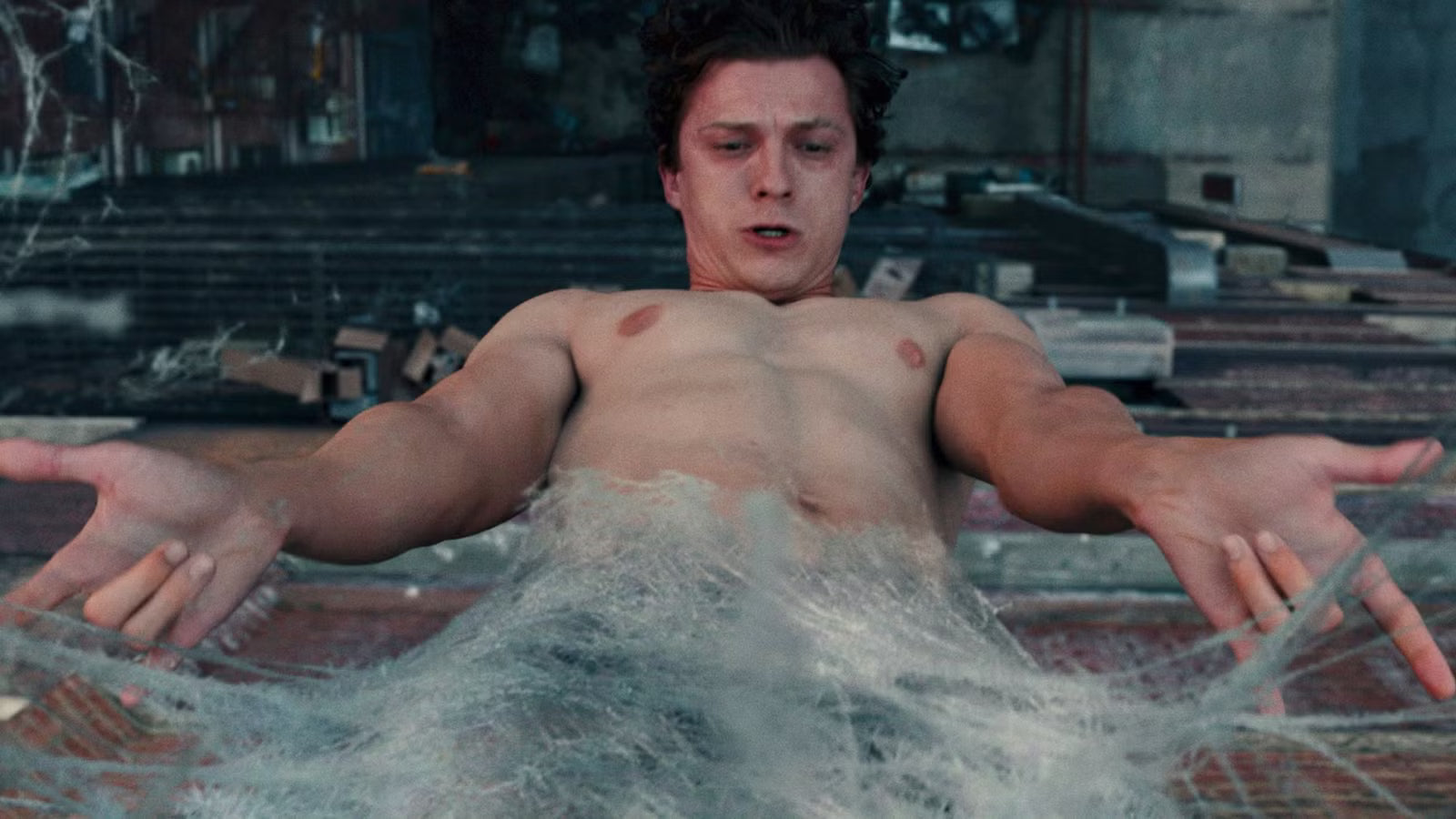
The most visible change. Peter develops biological silk glands in his wrists, which produce a web with no mechanical device at all.
It is a heavily loaded shift for this character. Ever since his screen debut in this version, his web was a feat of engineering: a fluid he formulated, shooters he built himself. It becomes a secretion.
Strength, speed, stamina
Strength, resilience, speed and sensory perception all shoot up. It is not a gradual progression: the film shows a jump, and Peter has no time to recalibrate the way he moves.
That gap is what makes what follows so dramatic. A body more powerful than its own reflexes expect is a body that hurts people.
The spider-sense in overload
His spider-sense no longer simply warns him of danger: it saturates. The advantage becomes a nuisance, and part of his exhaustion comes from that.
His temperament
This is the least spectacular change and the most serious one. His personality shifts. He becomes more aggressive, more impulsive, less able to stop himself — and the film takes the time to show it before drawing the consequences.

Spider-Man Web-Shooter
The very object his mutation makes obsolete on screen. The web-shooter remains the character’s signature accessory, and you will find ours among our Spider-Man web-shooters.
View the product — 34,90 €The scene that tips everything over
The film could have settled for announcing the danger. It stages it instead, and that is what gives weight to everything else.
Peter loses control
During a confrontation with Scorpion, his unstable genes take over. Peter falls into a blind rage. He manhandles Mac Gargan with a brutality that has nothing of the character left in it, grabs him and throws him.
He even tears off his mechanical tail. This is no longer a hero neutralising an opponent, it is a predator.
The police officer
And the film grants him no mitigating circumstances. In throwing Scorpion, Peter smashes him into a police car and seriously injures the officer sitting inside. It is only by chance that he does not kill him.
For a character whose entire identity rests on refusing to do harm, that is the point of no return. The fault is neither an outside accident nor a manipulation: it comes from his own body.
The shame, and the worse part
When he comes back to himself, he is horrified by what he has done. And the film adds a cruel layer: Scorpion was acting under mind control. So Peter brutalised a man who was not in control of his own actions.
It is that scene, and not a scientific revelation, that pushes him to look for a way to stop his own transformation.
The inhibitor chip
Where he implants it, and the echo that creates
Peter designs a chip meant to suppress his spider DNA, and implants it at the back of his neck.
The placement is not incidental, and attentive viewers picked up on it: that is exactly where a comparable device had been fitted on Doctor Octopus. The film therefore puts Peter in the position of the one who has to be kept in check.
Why he goes to see Banner
To design this thing, Peter goes to the one man in the world who has spent his life containing what his own body produces: Bruce Banner. He asks him how he managed to keep his transformations at bay.
The conversation quickly moves beyond Peter’s case. He is no longer talking about a personal chip but about a principle: a device capable of altering someone’s biology to strip out unwanted mutations.
Banner’s question
And Banner then puts to him the only question that matters, the one that tips the film from a medical problem into a moral one: how will you decide what is right and what is wrong?
Who decides that a mutation is unwanted. By what standard. And above all: who is holding the device. Peter has no answer, and neither does the film — that is precisely the point.

Tom Holland Spider-Man Figure
The Peter Parker of this period, the one learning to keep himself in check. The whole range is in our Spider-Man figures, and the new arrivals from the film are in the Brand New Day merch collection.
View the product — 79,90 €The universal inhibitor, or the most dangerous thing in the film
Peter does not stop at his own chip. He develops a universal version, capable of stripping any enhanced individual of their abilities.

What this object represents
A hero has just created a tool that can take anyone’s powers away. Not neutralise them temporarily: strip them. And he did it with the best intentions in the world, to protect himself.
The specialist press called it an Oppenheimer moment, and the comparison holds: a scientist solves a real problem and builds, along the way, a weapon whose use he will not control.
What the agency does with it
Because the technology ends up leaving his hands. The Department of Damage Control studies it, reproduces it and modifies it.
And the agency puts it to a use Peter had not imagined: no longer removing powers, but switching them on and off at will in someone being held in custody. The protective tool becomes an instrument of control.
That is what makes the ending of the film possible, and it is also what turns this invention into a narrative thread set to reach well beyond this one feature.
The move nobody talks about: he takes his chip out
In the final act, facing Jean Grey, Peter does the opposite of everything the film has built. He removes his inhibitor.
He does not win by becoming stronger again, and he does not win by staying restrained either. He wins by stopping hiding — from his opponent and from himself. The detail of the resolution is in our analysis of the ending and the post-credits scene.
That is the film’s real thesis, and it is almost absent from the commentary. For two hours, Peter looks for a technical device to fix a problem that is not technical. The answer was not to remove the spider, it was to stop being alone with it.
Where this idea comes from in the comics
The film does not invent Peter’s spider mutation. It draws on existing material, and knowing which material helps you understand where all this could lead.
Turning into a creature
The comics have pushed Peter towards the animal more than once, as far as states where he stops being human. The idea that the spider could win is therefore not a fancy dreamed up by screenwriters, it is a motif that has been in place for a very long time.
What those stories establish, and what the film picks up, is that the bite was never a closed event. It left something active in his body, liable to take over again.
The organic web is not new either
One period of the comics gave Peter biological silk glands, exactly like the film. It was not a continuity slip but a deliberate editorial choice, one that divided readers for years before being dropped.
So the film takes up a proven idea, but it reverses its charge. Where the comics made it a practical upgrade, the film makes it a worrying symptom.
What the film genuinely adds
The new element is the inhibitor. No earlier version had made Peter the inventor of a device capable of taking anyone’s powers away — still less shown that invention slipping out of his hands.
That is where the film stops adapting and starts writing. And it is also what makes this storyline potentially more consequential than any fight in the feature.
Organic webs or web-shooters: the old debate, settled
The subject has divided readers for decades, and the film takes a side without saying so.
What each camp argues
Mechanical shooters make Peter an inventor: his success comes from his intelligence, not from the bite. That is the argument of the purists of the original comics, and it is also what makes running out of web fluid work as a dramatic device.
The organic web, for its part, makes the character more biologically coherent and removes one implausibility: a secondary school pupil synthesising a polymer that an entire industry has failed to produce. We have gone through every on-screen version in our comparison of the web-shooters from Tobey to Tom Holland.
The film’s position
Brand New Day makes a clever choice: it gives Peter the organic web, but as a symptom rather than a gift. What ought to be an upgrade is presented as a sign that he is losing his footing.
So the aesthetic debate becomes a dramatic stake. It is no longer ‘which one is better’, it is ‘what does it cost Peter to stop needing his own inventions’.

Spider-Man Mask
The web-slinger’s mask, the one he keeps on even when everything else is slipping away. Discover it with our Spider-Man masks and our fancy dress and costumes.
View the product — 29,90 €The questions you leave the cinema with
Does Peter keep his organic webs at the end?
The film does not close the question, and that is deliberate. What it shows is that Peter stops treating his biology as a problem to be deleted. The mutation is neither cancelled nor presented as definitively stabilised.
Be wary of articles that come down firmly on one side or the other: nothing has been confirmed beyond what is on screen.
Do his mechanical shooters become useless?
In practical terms, the organic web removes the constraints of reloading and formulation. In terms of character, it takes away what made him an inventor as much as a hero — and the film treats that loss as a loss, not as a gain.
Does that explain his behaviour throughout the film?
Only in part, and that matters. The mutation amplifies, it does not cause. Peter was already isolated, already exhausted, already retreating into Spider-Man before his biology ran away with him.
The film is careful not to hand him the convenient excuse of ‘that wasn’t me’. What he does to the police officer, he carries.
Could another character go through the same thing?
Nothing in the film suggests it. On the other hand, the existence of a device able to modulate anyone’s abilities opens the door to the reverse: not other spontaneous mutations, but abilities controlled from the outside. That is already happening on screen.
Does Peter become a mutant?
The question stirred up discussion as soon as the film came out, and it deserves a careful answer.
Fundamentally, no: in Marvel terminology, a mutant is born with a particular gene. Peter was transformed by a bite — he belongs to another category, that of beings altered after the fact.
But the film deliberately borrows the vocabulary of the mutants. The idea of a secondary mutation comes straight from that corner of the universe, and it arrives in a film where a telepathic character sits at the centre of the plot. The association is intended.
What the film does not say: it never states that Peter is a mutant, and no official announcement points that way. Articles that present it as settled are extrapolating. We set out what the film actually establishes and what it leaves open in our article on Sara Grey’s message.
Why this storyline matters beyond the film
Because it leaves an object behind it. The fights end, the villains are neutralised, but a device capable of removing or restoring powers is still out there, in the hands of a government agency.
That is rare in this kind of story, where dangerous inventions are usually destroyed in the final act. Here, it stays in circulation. And the use an institution has already made of it on screen — switching a detainee’s abilities on and off — gives a fairly clear idea of what it could become.
What to take away
Peter’s spider DNA was never something outside him: it was waiting. Isolation and exhaustion break the balance, the spider hormones win out, and his body starts producing its own web — with a strength he can no longer control.
What follows is a relentless chain. He injures an innocent man. He invents a chip to keep himself in check. The chip becomes a universal tool. The tool falls into the wrong hands. And at the end, he takes it off.
A superhero film where the hero spends two hours trying to get rid of his powers, and where victory means agreeing to keep them by no longer being alone: that is a good deal more ambitious than the marketing campaign suggested, and it is what the critics most often praised.

