
14-Day Money-Back Guarantee
0
The short answer
Three main families stand out: the mechanical shooters built by a gifted teenager, the biological secretions of the Raimi trilogy, and the tech devices worn by Miles Morales or Spider-Gwen, sometimes paired with a bio-electric charge. The video games add even more exotic variations on top. We break down each one below.
Since his creation in 1962, Spider-Man has fascinated fans with his spectacular acrobatics and his famous spider-webs. But did you know there are several types of web depending on the version of Spider-Man? From Peter Parker to Miles Morales, from the comics to the big screen, web-shooters have evolved, each with its own quirks and unique abilities.
Peter Parker’s mechanical webs (the classic universe)
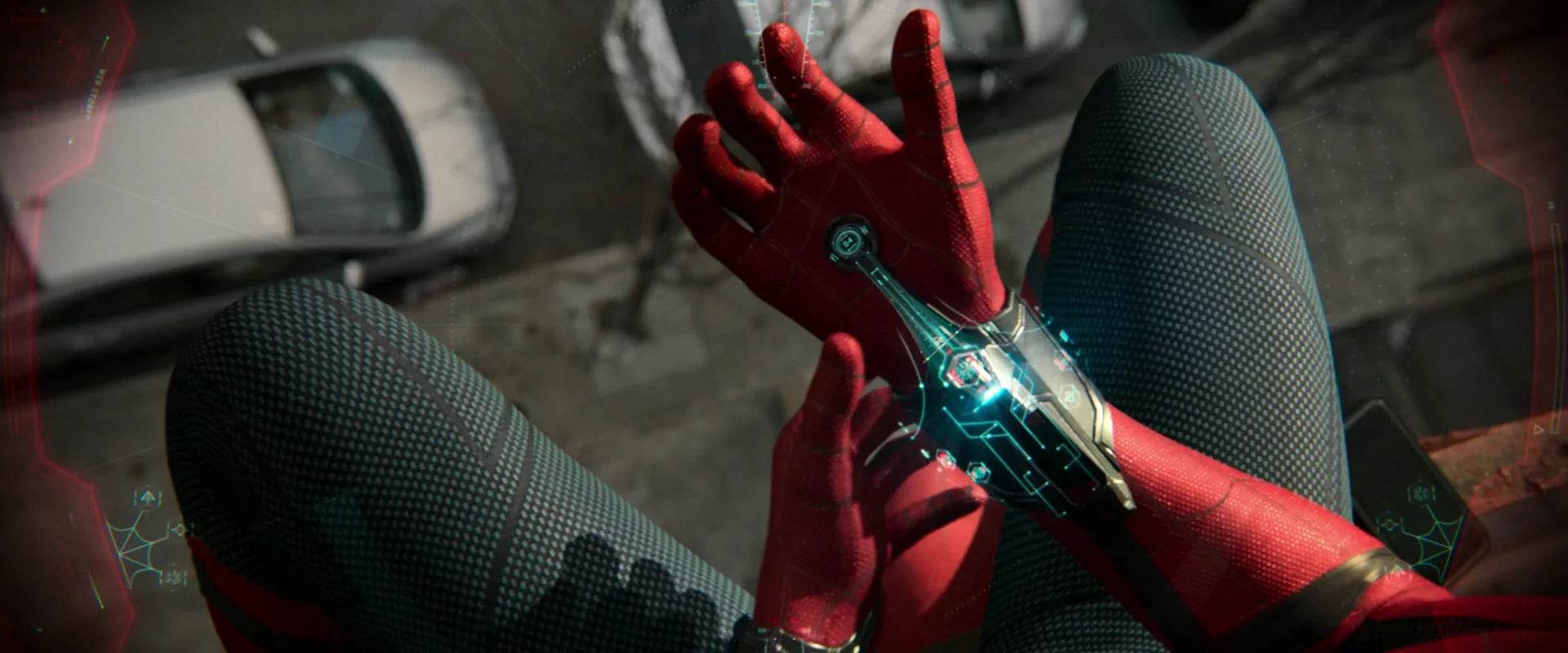
In the original version created by Stan Lee and Steve Ditko, Peter Parker is a scientific genius. He builds his mechanical web-shooters around a patented adhesive fluid of his own invention. This version stays true to the idea of a gifted teenager who makes up for his physical limits with his intellect.
Mechanical webs allow precise control: shape, intensity, direction, speed… They are used to swing, to create shields, to grab objects or to pin enemies down.
🎯 Seen in the films with Andrew Garfield and Tom Holland.
Organic webs (Sam Raimi’s films)

One of the biggest changes introduced by the trilogy from Sam Raimi with Tobey Maguire was the arrival of biological webs. Here, Peter produces his webs naturally, straight from his wrists, just like a real spider. We follow that thread in Organic webs: why Peter’s spider DNA takes over in Brand New Day.
That narrative choice was meant to reinforce the “metamorphosis” side of the teenager. More animal, more instinctive, this power still divides fans but left its mark. It removes the manufacturing constraint, yet leaves Peter vulnerable when he is stressed, injured or exhausted.
Miles Morales’s bio-electric webs
Unlike Peter Parker, Miles Morales does not create his webs himself. He is handed a piece of technology by S.H.I.E.L.D. in the Ultimate universe. Above all, though, he has one unique ability: the Venom Blast.
This bio-electric power sometimes travels along the web, electrocuting his opponent. That makes him formidable in close quarters. On top of that, in the Into the Spider-Verse films, his webs are visually stylised and far more fluid.
Special webs in the comics and video games

In certain story arcs and games, Peter or other Spider-Men develop web variants: acid, sticky, incandescent, water-resistant, or able to form far more complex structures (parachutes, nets, cages…).
For example, in the game Marvel’s Spider-Man (PS5), Peter can use:
- Shock webs
- Impact traps
- Web drones
- Gravity webs
These upgrades answer the idea of a Spider-Man always looking to innovate against enemies who keep getting stronger.
What about the other Spider-Men?
A few other characters also use their own versions of webs:
- Spider-Gwen uses tech bracelets to fire her webs.
- Spider-Man 2099 has organic webs, but also claws and a stabilising cape.
- Spider-Punk sometimes uses sonic webs in the modern comics.
The limits and weaknesses of the webs, version by version
While webs sit at the heart of Spider-Man’s identity, they are not infallible. In the mechanical versions, Peter can run out of fluid, as we see in several comics and films. That flaw makes the fights tenser and more realistic, forcing the hero to improvise without his best weapon.
The organic webs, for their part, depend on the hero’s physical and mental state. Stress, fear or fatigue can stop them working, as in Spider-Man 2, where Peter temporarily loses his powers. These weaknesses humanise the character and strengthen his emotional bond with the audience.
To become your own Spider-Man, discover our products inspired by the web-slinger’s world: web-shooters, costumes and Spider-Man masks are all available in our shop.
Webs and symbolism: more than a gadget
Behind their practical side, webs are also a central symbol of the Spider-Man philosophy. They embody:
- The invisible link between the hero and everyone else (family, city, responsibilities)
- The fragile balance he has to keep between his ordinary life and his duty
- The creativity and ingenuity of a teenager who invents his own solutions
Every variation on the webs across the multiverse illustrates a different facet of the web-slinger myth, whether that is rage, technology, instinct or legacy.
Towards constant evolution across the multiverse
In a universe expanding as endlessly as the Spider-Verse, webs evolve as fast as the people using them. Between futuristic gadgets, organic abilities, dimensional webs and film special effects, the possibilities are endless.
Conclusion: a symbol in constant evolution
Spider-Man’s web is far more than a simple tool. It represents the balance between strength, intelligence, responsibility and agility. Whether it is organic, technological or hybrid, it follows the evolution of every Spider-Man through time.

