
14-Day Money-Back Guarantee
0
The short answer
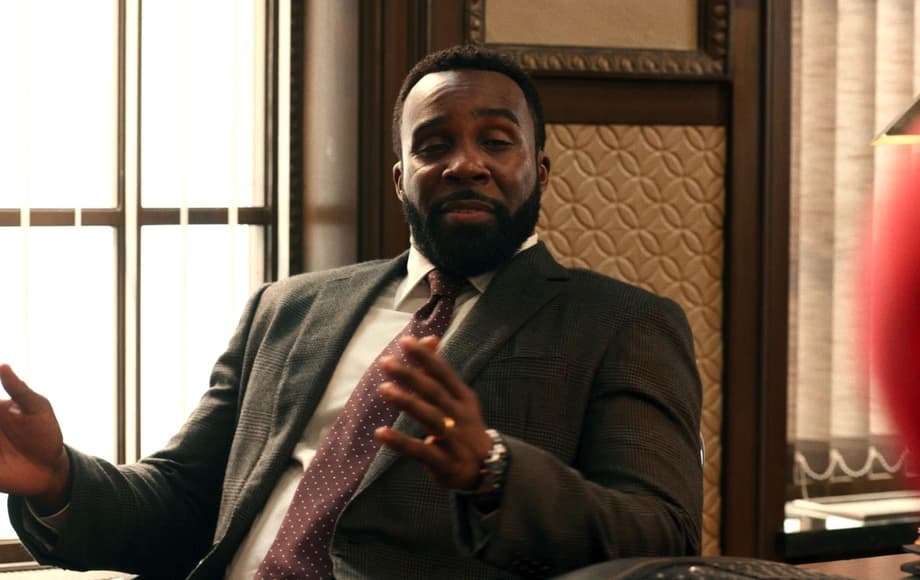
It's Tramell Tillman, the actor who broke through with the series Severance, who plays Bill Metzger, the head of Damage Control. That outfit, which first appeared in Marvel comics in the late 1980s, repairs the damage caused by super-hero clashes. What we really know about the role, and what is still rumour, below.
In the very first footage from Spider-Man: Brand New Day, a man in an immaculate suit with a calm gaze immediately catches your eye. He wears no mask, no cape, no exotic armour. He has no mechanical tentacles and no scorpion tail. And yet something in his bearing suggests he carries real weight in the plot. This character is called Bill Metzger, he runs a government agency called Damage Control, and he is played by Tramell Tillman. Three names most British viewers are discovering for the first time, and which could well become central to the wall-crawler's new era on the big screen.
The film is released on 29 July 2026 in France, two days before the United States. As that date approaches, fans are picking apart every shot of the trailers to identify the new faces. Metzger is one of the most intriguing, precisely because he looks nothing like a classic Spider-Man enemy. This article takes stock of what we really know about him, the actor behind him, that mysterious Damage Control agency, and above all what still belongs to rumour and speculation. Because with Marvel, telling the confirmed from the supposed is the only serious way to approach a film that hasn't come out yet.
Tramell Tillman, the actor on the rise behind Bill Metzger
If the name Tramell Tillman means nothing to you yet, remember it: he is one of those actors whose career suddenly accelerates after years of patient work. Born in the United States, trained in the theatre and holder of a master's in drama from Yale University, Tillman spent a long time on stage and in supporting television roles before the wider public finally noticed him. His acting stands out for a rare mix of gentleness and contained menace, that ability to stay polite and smiling while letting an unsettling tension hang in the air. A perfect profile for a government agency character you can never quite read as ally or adversary.
From Severance to the Marvel universe
Tillman's breakthrough came with the series Severance, where he plays a company manager who is affable and chilling at once, the zealous keeper of an underground floor with absurd rules. That role earned him considerable critical recognition and fixed him in the public imagination as an actor able to make an ambiguous authority figure fascinating. It is easy to see why Marvel Studios turned to him to play the head of an agency tasked with handling the fallout of super-hero battles. There is an obvious continuity between the man of the sterile corridors in Severance and the suited executive at Damage Control: in both cases, he stands for an institution, a system, a bureaucracy that watches and judges without ever raising its voice.
This kind of casting is never accidental. By handing a potentially recurring role to an actor on the rise, the studio is sending a signal: Metzger is probably not a bit-part destined to vanish after one scene. Marvel is used to recruiting quality performers for characters it intends to deploy across several films, and everything suggests Tillman falls into that category. The way a studio picks its supporting roles often says a great deal about its long-term intentions, and choosing a performer as acclaimed as he is unsettling is no accident.
A deal that goes beyond a single film
Several sources suggest that Tramell Tillman has signed a deal covering several films, not just an appearance in Brand New Day. If that is confirmed, it radically changes how you read his character. An actor hired for a single feature plays a closed role, whose arc begins and ends within the film. An actor tied to a multi-film agreement, by contrast, is a seed being planted, a figure meant to resurface in other studio productions. Given the character's anti-mutant leanings in the comics, that continuity naturally fuels theories about a part in the Marvel Cinematic Universe's future mutant saga. Keep a cool head, though: a deal like this is an industry clause, not a story promise. It allows future appearances without guaranteeing them.

FULL COSTUME
Cosplay Costume - Spider-Man Brand New Day
Pull on the full bodysuit from the new film and become the hero the moment it hits cinemas. Fitted cut, comfortable fabric and a faithful look for your parties and conventions.
View the product — 109,90 €Damage Control: the agency that cleans up after the super-heroes
To understand Bill Metzger, you first need to understand the organisation he runs. Damage Control, exactly as the name suggests, is an agency whose mission is written into it: to manage, repair and oversee the colossal damage caused by fights between super-heroes and super-villains. When a building collapses under a creature's blows, when a whole neighbourhood is flattened by a cosmic battle, someone has to clear the rubble, secure the dangerous technology left behind and handle the compensation claims. That is exactly what this outfit does, half civil-engineering firm, half crisis administration.
In the Marvel comics, Damage Control has existed since the late 1980s. The idea was clever and faintly satirical: what if, in a world full of invincible heroes, there were a company devoted entirely to the post-battle clean-up? The agency let writers explore the very concrete everyday life of an extraordinary universe, with its labourers, its insurers, its contracts and its paperwork. A down-to-earth counterpoint to the spectacle of titanic clashes, giving the whole thing an almost documentary flavour and reminding us that every spectacular fight carries a very real cost.
From Chitauri debris to the Department of Damage Control
On screen, in films and series alike, the Marvel Cinematic Universe has gradually established this organisation. Attentive viewers will remember that Damage Control already appeared in Spider-Man: Homecoming, where the agency collected the alien debris left by the great battle of New York. It was that clean-up operation that pushed one Adrian Toomes, robbed of his contract, into crime and turned him into the Vulture. The loop is almost poetic: a clean-up agency accidentally manufactured a villain in the first Spider-Man film of the Tom Holland era, and now it returns to the foreground for the character's new era.
The organisation then took on a more institutional and at times unsettling dimension in other studio productions, where it appeared as a federal body keeping a close watch on individuals with powers. That evolution matters if you want to grasp the version Metzger carries: under his leadership, Damage Control does not merely pick up rubble. It hunts, it monitors, it regulates. It keeps an eye on everyone who falls outside the human norm. And that is precisely where the character becomes interesting, because he turns a logistics agency into an instrument for controlling the superhuman.
Bill Metzger: what do we really know about his role in the film?
Now to the heart of the matter. What exactly does Bill Metzger do in Brand New Day? The confirmed elements, drawn from the trailers and official communications, sketch a portrait that is still partial but coherent. Metzger heads the film version of Damage Control. He does not come across as a masked villain in the traditional sense, but rather as a figure of authority whose goals may cross, or collide with, Spider-Man's. According to the early information doing the rounds, his agency is engaged in the hunt for an individual with powers, a young metahuman whose exact nature has not yet been revealed.
The hunt for a young metahuman
It is this narrative thread that makes the character so stimulating to analyse. A government agency pursuing a person with extraordinary abilities is not just an action device: it is a theme rooted deep in Marvel's history. The question of controlling those who are different, of the fear they inspire in institutions, of the line between protection and persecution, runs through decades of storytelling. By putting Metzger at the head of such a hunt, the film seems to want moral tension rather than a purely physical confrontation. Spider-Man could find himself torn between an official authority claiming to act for public safety and a target whose only offence may be to have been born different.
These elements should be handled with care, though. The precise description of the target, their powers, their motives and the outcome of this hunt all remain unconfirmed for now. Trailers are built to intrigue without revealing everything, and it would be reckless to present as certain what is only a cluster of clues. What can be stated is the general direction: Metzger embodies the institutional arm that monitors the superhuman, and that function naturally places him as a potential rival to the hero, without necessarily making him a declared enemy.

FULL MASK
Spider-Man Brand New Day Mask
Finish off any outfit with the mask from the new suit. Crisp lenses, breathable mesh and a comfortable fit so you can play the web-slinger without ever overheating or losing that iconic look.
View the product — 36,90 €William Metzger in the comics: an anti-mutant past
To anticipate where the character is heading, a detour through the page is essential. In the Marvel comics, William Metzger is a relatively obscure figure, far from the great names of the pantheon. He is not a historic Spider-Man enemy, which explains why his name means nothing to most readers. His distinguishing feature lies elsewhere: in the comics, Metzger is tied to the anti-mutant movement. He appears as the leader of a militia hostile to mutants, a group organised around the rejection and fear of beings born with abilities beyond the norm.
This detail is crucial. It means the character's source material has nothing to do with spiders or the skyscrapers of New York, and everything to do with the world of the X-Men. By choosing to import Metzger into a Spider-Man film, the studio is dipping into a corner of its catalogue historically bound to the mutant theme. That unusual crossover between two families of characters is rarely accidental. It suggests a desire to build bridges between worlds kept apart for a long time, as if every piece laid down today were preparing a picture far bigger than the film hosting it.
The quiet bridge to the mutant saga
The theory that emerges, widely relayed by observers, is that Metzger could serve as a gateway to the wider introduction of mutants on screen. For several years now, fans have been waiting for that family of characters to join the Marvel Cinematic Universe properly. The head of a government agency with an anti-mutant past, placed in a position to hunt a young being with mysterious powers, is an ideal narrative vehicle for quietly starting that turn. The Spider-Man film would then become, on top of its own plot, a cog in a far larger machine.
Once again, rigour demands some nuance. This reading is appealing and coherent, but it remains an interpretation based on the character's comics origins and on staging clues. Nothing officially indicates that Brand New Day openly embraces the word 'mutant' or that it formally launches a dedicated saga. The studio could just as easily use Metzger as a simple thematic colour, without making him the trigger for a bigger project. The difference between 'the clues point towards' and 'the film confirms that' must stay sharp in the mind of any demanding viewer.
Ally, rival or villain? The character's strategic vagueness
One of the most debated questions around Metzger concerns his true nature. Is he a bad guy? An ally of convenience? An ideological opponent who believes he is doing the right thing? The available footage deliberately keeps the doubt alive. We see him talking, observing, giving orders, but nothing shows him committing an openly malicious act. That ambiguity is probably a deliberate writing choice rather than an accident, a way of delaying the moment when the viewer finally knows who they are dealing with.
The most interesting characters in the Spider-Man stable are not always the ones wearing a costume and throwing punches at the hero. Sometimes the real stakes come from an institution, an administrative logic, an authority acting in the name of security while trapping the innocent. Metzger looks cut out for that kind of role: a man who is not necessarily evil, but who serves a system whose goals collide with young Peter Parker's morals. If the film works that seam, Metzger could prove a far subtler antagonist than a classic villain, precisely because he believes he is on the right side.
This is where Tramell Tillman's talent makes complete sense. His knack for playing polite, unsettling authority, already proven elsewhere, fits perfectly a character you can never tell is holding out a hand or closing a trap. It is the kind of role that can steal a few scenes without ever raising its voice, and that stays with you long after the closing credits.
Metzger in the Brand New Day character galaxy
Bill Metzger does not turn up alone. Brand New Day has a cast unusually rich in new faces, and it helps to place the head of Damage Control within it. The film lines up a gallery of adversaries and ambiguous figures drawn from different corners of the Marvel universe, making it one of the most densely populated entries in the arachnid saga. To understand Metzger's place, you have to see him as one piece among others on a carefully arranged chessboard.
We have devoted a full feature to all the antagonists announced for this film. If you want an overview of the threats waiting for the web-slinger, from the most physical to the most elusive, our article on the villains of Spider-Man Brand New Day goes through each character, their origins and the actor playing them. Metzger holds a place apart there, precisely because he does not fit the traditional villain box: he represents the institutional dimension of danger, where others embody the raw threat.
Among the other faces fuelling discussion, that of a much-watched young actress draws particular attention. Her character, its nature and its possible links to the mutant world are the subject of intense speculation, exactly as with Metzger. We set out that trail in detail in our analysis of Sadie Sink and the Jean Grey rumour, where we carefully separate confirmed facts from theories. The parallel between these two characters is instructive: in both cases, a comics past tied to mutants feeds the idea that Brand New Day could be laying groundwork for the future. And in both cases, caution remains the rule until the film is out.

OFFICIAL T-SHIRT
Official Spider-Man Brand New Day T-Shirt
Show your passion every day with this official film t-shirt. Soft cotton, a crisp print and a modern cut to carry the Brand New Day spirit everywhere, at the cinema or around town.
View the product — 34,90 €Confirmed or supposed? The summary table
With the flood of information circulating before such an eagerly awaited release, it is easy to mix up what is established and what remains hypothetical. Here is a clear reference point for telling the two categories apart when it comes to Bill Metzger and his immediate surroundings.
| Element | Status |
|---|---|
| Tramell Tillman plays the character | Confirmed |
| The character is named Bill Metzger | Confirmed |
| He heads the Damage Control agency | Confirmed |
| The character's anti-mutant comics origin | Confirmed (comics source) |
| The hunt for a young metahuman | Reported, not detailed |
| Gateway role to the mutant saga | Speculation |
| Ally, rival or villain status | Unconfirmed |
This table sums up the healthiest attitude to take before 29 July: welcome the confirmations with enthusiasm, treat rumours as rumours, and resist turning an appealing theory into a certainty. It is also what makes the wait so enjoyable. A character whose true nature is still unknown leaves all the room in the world for surprise in the cinema, and denies no one the pleasure of discovery.
Why Metzger could leave a lasting mark on the Spider-Man era
Beyond Brand New Day alone, Bill Metzger's presence illustrates a deep trend in the way Marvel builds its stories. The great threats are no longer automatically armoured colossi or gods from elsewhere. Sometimes they take the shape of a man in a suit, calm and polite, speaking in the name of order and security. That shift towards institutional antagonists reflects very current concerns: surveillance, the filing away of people who are different, the temptation to control in the name of the common good.
For a young hero like Peter Parker, wrestling with power and responsibility from the very start, this kind of adversary opens up fertile moral ground. How do you respond to an authority that claims to protect while hunting down an innocent? Where do you draw the line between law and justice? These questions give the Metzger character a potential that goes far beyond his modest comics origin. An obscure villain from the page can, in the right hands and with the right actor, become a memorable figure on screen.
That, in the end, is the whole point of following a character like this closely. He embodies an unknown, a promise, a door left ajar onto future developments. Whether the film makes him a simple administrative cog or the first link in a long chain, Bill Metzger and Damage Control will have achieved one thing from the trailer onwards: making you want to know more. And in the delicate art of preparing an audience for a new era, that is already a great deal.
In summary
Bill Metzger is the head of Damage Control in Spider-Man: Brand New Day, played by the hugely talented Tramell Tillman, who became known to the wider public through his roles as ambiguous authority figures. Damage Control is the agency tasked with handling the damage left by super-hero battles, already glimpsed in the Marvel cinematic universe. What we know of his role revolves around surveillance and the hunt for an individual with mysterious powers, while his anti-mutant comics origins feed the idea of a bridge to the world of the X-Men. But the essentials are still to be discovered, and that is exactly what makes the wait so delicious. See you on 29 July 2026 to separate fact from supposition once and for all.

