

14-Day Money-Back Guarantee
0
The short answer
Staged by Julie Taymor to music by Bono and The Edge, this New York production holds the record for the most expensive show in Broadway history: roughly 75 million dollars, serious injuries among the performers, and a final curtain in early 2014. Here is the full story of how it unravelled.
Contents
The Ambitious Project: Julie Taymor Wants to Reinvent Spider-ManThe Music of Bono and The Edge: The Trump Card That Was Meant to Save EverythingThe 9 Accidents That Marked Broadway HistoryJulie Taymor's Departure and the Complete RewriteThe Official Opening in June 2011: The Final VerdictThe Closure in January 2014 and the ReckoningWhy Adapting Spider-Man for the Stage Remains So DifficultThe Legacy: Why Turn Off the Dark Is Still Fascinating in 2026
Spider-Man has been through a lot in his career: an alien black costume, having his body stolen by Doctor Octopus, his own death, and a career as a cannibal zombie across the multiverse. But none of those fictional disasters comes close to what happened to the web-slinger in real life between 2010 and 2014: his Broadway musical, Spider-Man: Turn Off the Dark. A project that cost 75 million dollars (the most expensive in Broadway history), caused 9 serious on-stage accidents, and got a legend of American theatre fired. It is probably the greatest industrial catastrophe in the modern history of live performance - and hardly anyone ever tells the story in full.
This article traces the whole Turn Off the Dark saga, from the ambitious initial project to its closure in January 2014. Scored by Bono and The Edge of U2, directed by Julie Taymor (the woman behind The Lion King on Broadway), produced on a record budget with stage effects unlike anything theatre had seen before, the musical should have been Marvel's triumph on stage. Instead, it became a legendary nightmare whose backstage story is every bit as gripping as Peter Parker's darkest comics.
The Ambitious Project: Julie Taymor Wants to Reinvent Spider-Man
The story begins in 2002, when Julie Taymor, fresh from the acclaim for her groundbreaking staging of The Lion King on Broadway (which had been playing to sold-out houses for five years by then), was approached by Marvel and Sony to adapt Spider-Man for musical theatre. The project was enormous from the outset: Taymor wanted a show that combined theatre, aerial circus, digital projection and pyrotechnics. She imagined Spider-Man literally flying above the audience, right across the auditorium, on a rigging system never before seen on Broadway.
Taymor's narrative vision was as bold as her staging. She invented a new character and placed her at the centre of the show: Arachne, a Greek spider goddess said to have inspired Spider-Man's powers. This mythological creature, a conceptual cousin of characters such as Shathra in the comics, becomes Peter Parker's mystical guide and antagonist. It was a radical creative choice that pulled the show away from the classic Spider-Man comics, and it would become one of the main sources of the disaster to come.
The initial budget was announced at 35 million dollars in 2007 - already colossal for Broadway. As the production took shape and the technical complications exploded, that budget more than doubled, reaching 75 million dollars by 2011, making Turn Off the Dark the most expensive Broadway show of all time. For comparison, the previous record (Shrek The Musical in 2008) stood at 25 million. Spider-Man tripled it the moment it opened.
The Music of Bono and The Edge: The Trump Card That Was Meant to Save Everything
The show's central commercial argument was the music. Marvel and Sony handed the score to Bono and The Edge, the two main members of rock band U2 - one of the biggest groups in the world at the time. Bono himself had been an absolute Spider-Man fan since childhood, and he took the project on to explore a new dimension of his art. With The Edge, he wrote 28 original songs for the show, blending U2's trademark arena rock with dramatic ballads suited to musical theatre.
On paper, it was the perfect alignment: music from a legendary band, direction from an award-winning film-maker, and Marvel's most popular source material. The songs 'Rise Above' (the show's signature number, released as a Reeve Carney single in 2011) and 'Boy Falls from the Sky' are genuinely well written and well sung by talented actors. The problem is that music alone cannot carry a show whose staging, script and basic performer safety are fundamentally broken.
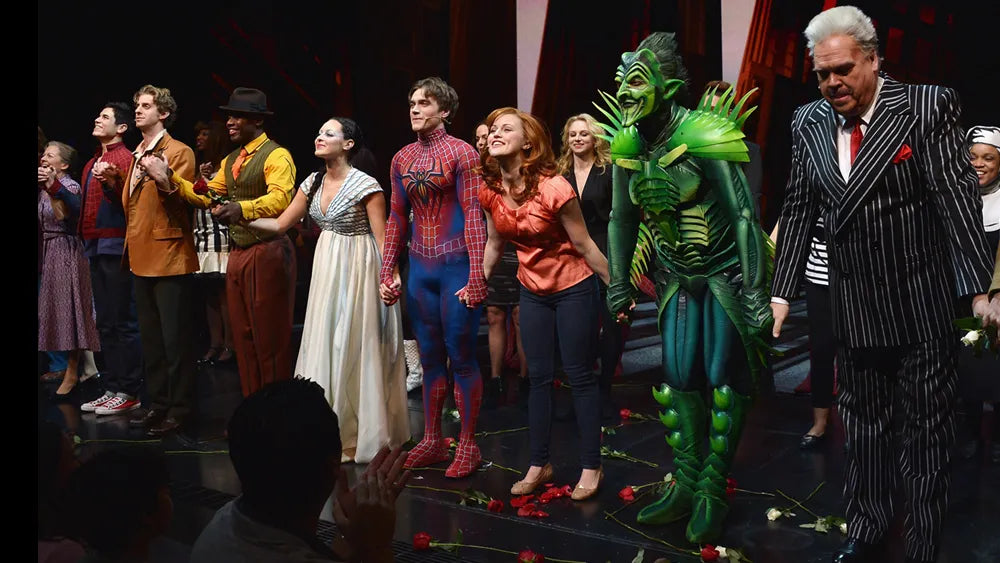
Reeve Carney, cast as Peter Parker, delivered an acclaimed vocal performance - including in the rare scenes where the show actually worked as a story. Jennifer Damiano played Mary Jane with a much-noticed stage presence, and Patrick Page was unanimously praised for his theatrical Green Goblin, widely seen as one of the best things in the show. The cast did their job. The problem was everything around them.
Reeve Carney
Peter Parker, an acclaimed vocal performance.
Jennifer Damiano
Mary Jane, a much-noticed stage presence.
Patrick Page
A unanimously praised Green Goblin, one of the best things in the show.
The 9 Accidents That Marked Broadway History
This is where Turn Off the Dark goes from 'ambitious show with problems' to 'national American scandal'. The stage effects Julie Taymor imagined - Spider-Man flying above the audience on cables, spectacular leaps from the balcony, several characters flying at once - were technically unprecedented. The performers wore industrial harnesses and were launched at high speed along precise trajectories. When something goes wrong there, it goes very wrong.
The first serious accident happened during technical rehearsals in September 2010: Kevin Aubin, an aerial understudy, broke both wrists after landing badly from a flight. A few weeks later, Natalie Mendoza (the actress playing Arachne) suffered a severe concussion after a scenery cable struck her on the head. But the worst was still to come.
On 20 December 2010, in the middle of a preview in front of a paying audience, Christopher Tierney - Spider-Man's understudy - fell more than nine metres during a flying sequence. His harness had been improperly secured. He fractured his skull, several ribs and vertebrae in his neck. In front of a panicking audience, paramedics stretchered the actor out. The incident made front pages around the world the next day and triggered an investigation by OSHA (the Occupational Safety and Health Administration), the American workplace safety body. The show was suspended for several days.
In total, 9 serious accidents were documented during the previews and performances of Turn Off the Dark - an absolute record for Broadway. The injured performers kept coming: Brandon Rubendall, T.J. Mayer (a fracture after a fall), Daniel Curry (a leg trapped in the machinery mid-show in 2013), and several others. Each incident reignited the safety controversy, forced technical modifications, and pushed the total cost of the project higher still.

Julie Taymor's Departure and the Complete Rewrite
Beyond the accidents, Turn Off the Dark suffered from a structural narrative problem. Taymor's script, built around the character of Arachne and her Greek mythological themes, baffled audiences and critics alike. The first previews in November 2010 drew devastating reactions. The trade critics - who normally wait until the official opening - exceptionally decided to publish their verdicts during the previews, breaking a Broadway taboo. The New York Times called the show 'a failure that would make you laugh and cry at the same time'. Variety was more brutal still: 'the greatest artistic and financial disaster Broadway has seen in fifty years'.
Under pressure from panicking producers and investors, Julie Taymor was removed from the production in March 2011. A new writer, Roberto Aguirre-Sacasa (who would later become famous as the showrunner of Riverdale and Sabrina), was brought in to rewrite the show from top to bottom. He cut almost all of the Arachne character, recentred the story on Peter Parker and Mary Jane, simplified the storytelling, and worked with the co-directors to make the show more accessible and more faithful to the comics.
The rewrite took three months, during which the show kept playing in previews (at a cost of some 1.3 million dollars a week in losses). It is the longest preview period in the whole history of Broadway: 182 performances before the official opening. The previous record was under 50. That statistical anomaly alone shows the scale of the disaster.
A preview period like no other
Losses during the rewrite1.3 million dollars a week
Length of the rewritethree months
Previous preview recordunder 50
In summary182 performances before the official opening
The Official Opening in June 2011: The Final Verdict
On 14 June 2011, Spider-Man: Turn Off the Dark officially opened after more than six months of previews and a complete rewrite. The critical reception was mixed, but noticeably better than before: reviewers praised Aguirre-Sacasa's narrative improvements, Patrick Page's performance as the Green Goblin, and the music by Bono and The Edge. But they remained unconvinced by the stage effects (still a source of delays and technical trouble) and by the overall coherence of the show.

Commercially, and paradoxically, the show did better than anyone predicted. Morbid curiosity drew tourists from all over the world - going to see 'the catastrophic Spider-Man musical' became a tourist attraction in its own right, on a par with visiting the Statue of Liberty or going up the Empire State Building. For two years, Turn Off the Dark played to roughly 70-80% capacity, taking more than a million dollars a week at the box office.
But that relative commercial success never covered the show's gigantic running costs. With 75 million dollars of initial investment, stage effects that needed a technical crew of 50+, and constant maintenance costs, Turn Off the Dark lost money almost every week of its existence. Final losses are estimated at between 60 and 65 million dollars across its four years of operation - the biggest financial loss in Broadway history.
The commercial reckoning
Capacity filledroughly 70-80%
Weekly box officemore than 1 million dollars
Technical crew50+ people
In summaryLosses estimated at between 60 and 65 million dollars
The Closure in January 2014 and the Reckoning
Spider-Man: Turn Off the Dark closed for good on 4 January 2014, after 1,066 official performances plus the 182 previews. In pure longevity terms that is technically a respectable score (three years of performances), but the financial figures tell a different story. According to several sources, the lead investors (Michael Cohl, Jeremiah Harris and their consortium) lost 60+ million dollars of their own money. The producers announced plans for a new version on a world tour or in Las Vegas, but none of those projects ever materialised.
The cultural legacy of Turn Off the Dark is fascinating. On one hand, it is a textbook case in every production management and theatre school - how NOT to run a big-budget creative project, how NOT to underestimate technical complexity, how NOT to build a script so disconnected from its source material. On the other, it has become a cult object for hardcore Spider-Man fans - something so strange and so expensive that it is fascinating in hindsight.
For fans who never saw the show, several documentaries and YouTube videos are in circulation. The Wall Street Journal released a feature-length documentary in 2017 ('Glass Onion: The True Story of Spider-Man's Broadway Disaster') that retraces the whole story with exclusive interviews. The songs by Bono and The Edge are on the streaming platforms and still hold up today - particularly 'Rise Above' and 'Boy Falls from the Sky'.

The closure in numbers
Official performances1,066
Previews182
Investor losses60+ million dollars
In summaryClosed for good on 04/01/2014
Why Adapting Spider-Man for the Stage Remains So Difficult
The Turn Off the Dark experience reveals something deep about the nature of Spider-Man as a character. On screen, animation and digital effects let the web-slinger's aerial acrobatics flow in a way live theatre simply cannot reproduce. When Sam Raimi films Tobey Maguire swinging between the buildings in Spider-Man 2, he uses a combination of stunts, doubles, practical effects and CGI. It is dangerous, but controlled. On Broadway, doing the same thing live, eight times a week, in front of 1,500 spectators, with no visible safety nets - that is asking the impossible of human performers.
Spider-Man is also narratively complex in a way that is hard to adapt to musical theatre. Musical theatre favours simple, powerful emotional arcs - love, loss, the search for identity. Spider-Man combines all of that with a sprawling mythology that takes in Venom and the symbiote, the Spider-Verse multiverse, the Sinister Six, and dozens of other supporting characters. Compressing all of that into two and a half hours of live performance while keeping the emotional depth is a near-impossible challenge.
Julie Taymor's decision to introduce Arachne and reinvent the mythology was probably an attempt to simplify that complexity - to create a new theatrical story rather than adapt the comics directly. But the choice pushed the show away from what Spider-Man fans wanted to see, and it did not win over the musical theatre crowd who did not know the source material either. The show ended up caught between two stools, fully pleasing nobody.
Impossible acrobatics
Live, eight times a week, in front of 1,500 spectators, with no visible nets.
A sprawling mythology
Venom, the Spider-Verse and the Sinister Six, compressed into two and a half hours.
A narrative gamble that failed
Arachne pushed the fans away without winning over the musical theatre crowd.
The Legacy: Why Turn Off the Dark Is Still Fascinating in 2026
More than ten years after the show closed, Turn Off the Dark still fascinates Spider-Man fans and Broadway lovers alike. Why? Because it is a unique hybrid object: industrial catastrophe, mad creative ambition, accident of cultural history, and extraordinary human experience for every performer and technician involved. Reeve Carney still talks about it regularly in podcast interviews, describing it as both the hardest and the most formative project of his career.
For fans who want to dig deeper into Spider-Man mythology beyond the stage, the films and the comics, the Marvel ecosystem now offers unprecedented riches. The full page on Peter Parker covers every biographical angle of the character. The Spider-Verse pillar page explores the parallel dimensions. And the villains pillar page digs into the ecosystem of his antagonists - with an amused nod to the fact that Patrick Page remains, to this day, one of the finest Green Goblins ever performed in any medium, despite the disaster going on around his role.
Turn Off the Dark is not only a catastrophe - it is also a warning and a lesson for every future superhero adaptation in musical theatre. No similar project has been attempted since. When you have burned 75 million dollars and nearly killed several performers trying to fly Spider-Man over an audience, you naturally hesitate to try again. Broadway may have lost its appetite for risks on that scale ever since. For fans who love improbable stories and the dramatic backstage life of show business, Spider-Man: Turn Off the Dark will remain the greatest artistic and industrial catastrophe of modern Broadway - and that is precisely what makes it unforgettable.
A lesson for Broadway
After 75 million dollars burned and several performers injured, no similar superhero musical adaptation has been attempted since.

