

14-Day Money-Back Guarantee
0
The essentials before you choose
Three questions are enough: who it is for, which season, and which format. A child needs a safe fabric and a size that leaves room to grow; an adult needs a cut that survives the wash. Two-piece set, bottoms only or a costume all-in-one: the format follows the use, never the other way round.
Pyjamas are the one Spider-Man garment the whole family can wear on the same evening without anyone finding it ridiculous. They are also the ones people buy worst: you look at the print, you take the usual size, and three washes later you discover that the fabric itches or the design has cracked. This guide is here to settle the three questions that matter before you order.
Who it's for: the only sorting that really changes anything
Needs have nothing in common from one age to the next, and that is the first buying mistake. A four-year-old needs a soft fabric, no detachable pieces, and a cut that doesn't get in the way when they turn over. A teenager wants bottoms they can wear during the day without looking like they're still in their pyjamas. An adult is after a cut that survives the wash and a print discreet enough to open the door to the delivery driver.
Our guide to choosing pyjamas by age covers every bracket, from child to adult. In the shop, the three ranges are kept separate for that very reason: children's pyjamas, adult pyjamas, and the full collection if you're looking to match several members of the family in one go.
Women's ranges, too often rushed
Adult ranges are mostly cut from men's patterns, which gives shoulders that are too wide and sleeves that are too long. There are references cut differently, and the Spider-Gwen universe has considerably widened the choice of prints beyond the classic red and blue. Our guide to women's and Spider-Gwen pyjamas covers the whole question.
CHILDREN'S PYJAMAS

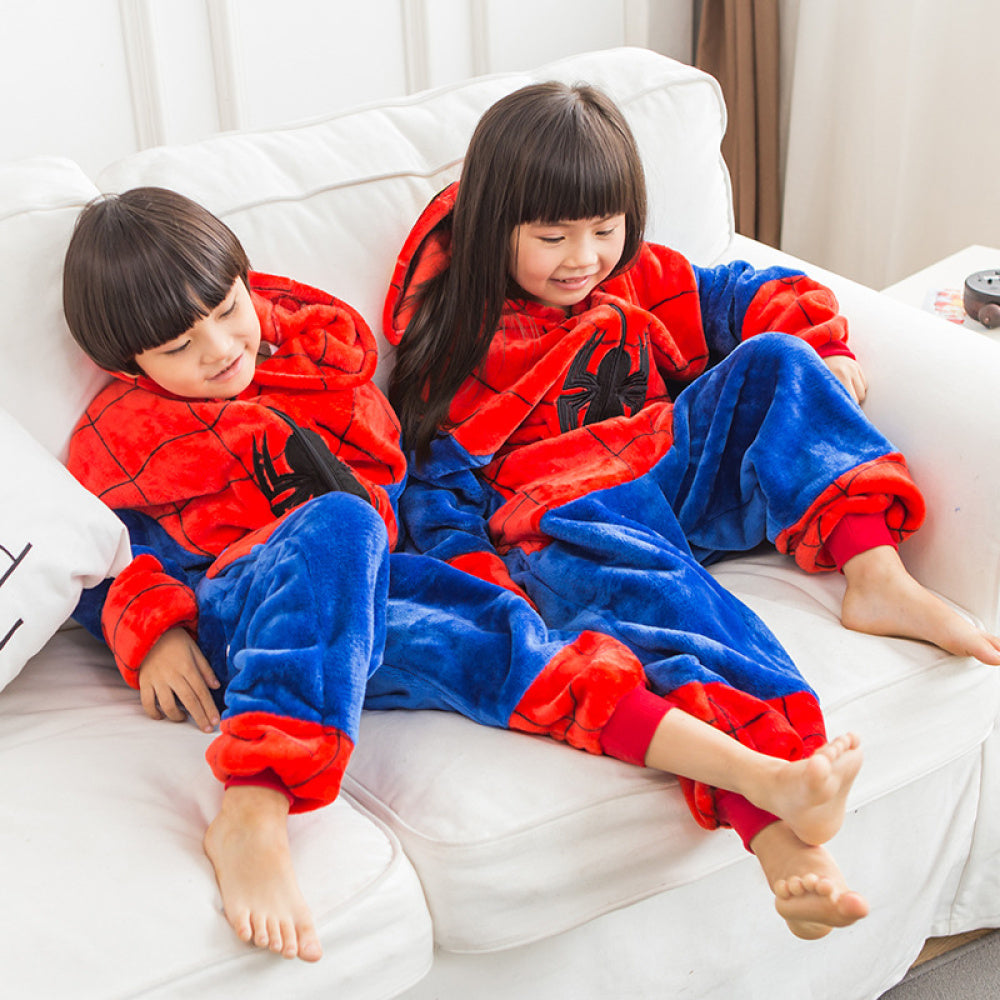
Spider-Man Costume Pyjama Set for Children
The costume version - the one that gets bedtime accepted without negotiation.
36.90 €
Discover →Which season: fabric before print
This is the criterion that decides real comfort, and the one people look at last. A light cotton works from April to October and washes without precautions. Fleece or brushed jersey holds up through winter in a poorly heated bedroom, but becomes unbearable as soon as the heating goes up. Buying both costs less than buying the wrong one twice.
The practical marker: a bedroom at eighteen degrees calls for cotton, a bedroom at fifteen calls for something thick. Our comparison of winter versus summer by age gives the detail age bracket by age bracket, because a child who moves at night doesn't cover up like a motionless adult.
WINTER PYJAMAS

Warm Spider-Man Pyjama Set for Children
Thick brushed fleece for bedrooms that drop below eighteen degrees, when cotton is no longer enough.
39.90 €
Discover →What to check on a child's label
For the youngest, fabric isn't only a question of comfort. The composition, the treatment of the cloth and the absence of small detachable parts fall under precise rules, and not every seller respects them equally. Our article on fabrics, safety and standards explains what to read on the label and which signals should make you put the item back.
Which format: set, bottoms only or all-in-one
Three families share most of the market, and they don't serve the same use. The two-piece set remains the most versatile: you can wear the top or the bottoms separately, and replace it piece by piece when one wears out. Bottoms on their own go with any t-shirt and often become a piece of loungewear in their own right. The costume all-in-one, for its part, is aimed at children and turns bedtime into a game.
The choice follows real use, never the other way round. A child who refuses to go to bed gains from receiving an all-in-one; a teenager who lounges around the house at the weekend will prefer bottoms on their own. Our comparison of sets, all-in-ones and bottoms goes through the formats one by one.
The size question, trickier here than elsewhere
Pyjama sizes don't follow daytime clothing sizes. A cut designed for sleeping has to leave room, which pushes many buyers to size up - and pyjamas that are too big on a young child are a risk, not an investment. The opposite is true too: a fitted set shrinks at the first hot wash.
ADULT PYJAMAS

Spider-Man Pyjamas for Adults
The adult cut, understated from a distance and owned up close: the one that survives opening the door to the delivery driver.
49.90 €
Discover →How much to spend, and where the right balance sits
The price gap in this range doesn't always reflect the quality gap. What you're really paying for is the weight of the fabric, how the print holds up in the wash and the quality of the seams - three things invisible in a product photo. A cheap set worn for two winters works out dearer than a mid-range model worn for four years.
That said, entry-level has its use: for a child in the middle of a growth spurt, who will change size within eight months, paying more makes no sense. Our selection of best value-for-money buys sorts out the references where saving money doesn't cost you comfort.
Pyjamas as a gift
This is one of the rare garments you can give without knowing someone's exact taste: the print does the work, and the size can be sorted out later. It works for a birthday as well as for Christmas, and it has the advantage of being used straight away rather than put away in a drawer. Our article on pyjamas as a gift idea sets out the combinations that work, and the gift selection widens things beyond textiles if the idea doesn't convince. Worth reading next: Spider-Man shirt and tie: wearing your passion in formal dress.
Matching the whole family without it turning into fancy dress
This is the most frequent request in this range, and the most poorly executed. Dressing three or four people in the same print rarely produces the desired effect: either everyone wears exactly the same thing and the whole thing turns into a group costume, or everyone has a different version and the unity disappears.
The method that works consists of fixing one common element and varying the rest. The simplest is to keep the same palette - the classic red and blue, or the black of the symbiote suit - while letting each person choose their format. The child takes the all-in-one, the teenager the bottoms only, the adult the two-piece set. From a distance, the family is coherent; up close, nobody is wearing somebody else's garment.
The size trap when you order everything at once
Buying four pairs of pyjamas in one order exposes you to a precise pitfall: sizes don't follow the same logic from one range to another. An age eight in children's and an adult S have neither the same room nor the same fabric weight, and a teenager often ends up between the two - too big for children's, swimming in adult. The useful reflex is to order the teenager in adult rather than children's, even if it means shortening the bottoms.
Another practical point: if the aim is a photo or a particular evening, you need to allow time for a possible size exchange. Ordering a week ahead leaves no margin, and that is the leading cause of disappointment on this kind of group purchase.
What really carries across generations
Some items cross the ages without difficulty, others don't. Socks and slippers come in sizes from 24 to 45 with the same design, and give an immediate coherence at little cost. Bed linen, on the other hand, doesn't match up: a child's duvet cover in an adult's bedroom falls flat, and the other way round too.
PYJAMA BOTTOMS

Spider-Man Web-Slinger Pyjama Bottoms
Bottoms on their own: the piece that goes with any t-shirt and settles the case of the teenager caught between two sizes.
34.90 €
Discover →The five mistakes people repeat in this range
They all come up in customer feedback, and none of them is a matter of taste. The first is taking a size up 'to make it last': on a young child, loose pyjamas disturb sleep and pose a real safety problem. The second is choosing the thickness based on the season of purchase rather than on the real temperature of the bedroom - fleece ordered in November becomes unusable as soon as the heating comes on.
The third is buying a costume format for someone who didn't want one: spectacular when the parcel is opened, rarely worn afterwards. The fourth is neglecting the composition on an item intended for a child, when it is the only garment worn for eight to ten hours straight, right against the skin.
The fifth is the most expensive: putting the set in the tumble dryer. A cracked print can't be repaired, and that is what sends perfectly wearable pyjamas to the bin. We come back to this below, because three habits are enough to avoid it.
What goes with them, and matters more than you'd think
Pyjamas on their own don't make for a comfortable night. On a cold wooden floor, slippers change the experience more than the thickness of the pyjamas themselves, and socks are often enough for children who can't stand slippers.
For the bed, a matching duvet cover extends the universe without overloading it, and a throw serves just as well on the sofa as on the bedspread. A mood light finishes the whole thing off: it's the element that really transforms a bedroom in the evening, far more than the linen.
If the aim is to redo the whole bedroom rather than add one piece, our guide to putting together a complete bedroom gives the order in which to proceed - bed linen first, lighting next, wall decoration last.
Pyjamas and bedtime
There is one use of this garment that product pages ignore completely: it's a routine tool. With a young child, putting on pyjamas marks the passage from day to night, and that signal works all the better when it's tied to something looked forward to. A print they love turns a constraint into a step.
The effect has its limits, and they're worth knowing: a costume that's too exciting can produce the opposite of what you're after, and restart playtime just when it's time to sleep. Our article on pyjamas and the bedtime routine comes back to this point, and our piece on the animated series aimed at the youngest fans explains where the attachment of three- to six-year-olds to this particular character comes from.
WOMEN'S PYJAMAS

Spider-Man Pyjamas for Women
A cut designed around a women's pattern, where most adult ranges offer only one.
44.90 €
Discover →Recognising good pyjamas without being able to touch them
Buying online deprives you of the only reliable test: a hand on the fabric. Three clues replace that gesture, and they're almost always on the product page provided you know where to look.
Fabric weight, which doesn't lie
Expressed in grams per square metre, it tells you the real thickness far better than adjectives do. A light summer jersey sits around one hundred and forty to one hundred and sixty; a winter brushed fleece goes beyond two hundred and fifty. Between the two, you're in mid-season territory. When the information is missing, that's rarely a good sign: manufacturers who take care over their fabric display it.
Composition, and the hundred per cent trap
Pure cotton breathes better and suits sensitive skin, but it creases and shrinks more. A blend with a share of synthetic holds its shape better and dries faster, at the cost of less breathability. Neither is superior in absolute terms - the right choice depends on who's wearing it and how often it's washed. For a child, our guide to fabrics and standards sets out what the composition means in practice.
The type of printing
This is the most decisive point for lifespan, and the one most rarely specified. A design woven into the fabric never fades but limits the designs that are possible. Screen printing gives clean colours and a sharp result, at the cost of real sensitivity to heat. A heat transfer, finally, offers the most detail and the shortest life - it's the one that cracks fastest.
On the product photo, a very detailed print with gradients is almost always a transfer. A simple flat design in two or three colours is screen printing. That single glance lets you anticipate how many washes the item will take.
Caring for pyjamas so they last
Three habits are enough, and they all concern the print, the part that gives way first. Washing inside out protects the screen print from rubbing. Staying at thirty degrees stops the fabric shrinking and the colours bleeding. And banning the tumble dryer on printed models, whose heat cracks the design in a few cycles.
A fourth habit is added for sets worn by several children in succession: wash them on their own the first few times. Red prints almost always bleed on the first cycle, and one pair of Spider-Man pyjamas washed with light-coloured laundry is enough to tint a whole load. Two separate washes settle the question for good.
As for ironing, it's inside out or not at all: an iron placed directly on a print sticks to it permanently. These three habits extend the life of a set far more reliably than a high purchase price, and they apply to all printed textiles - t-shirts as much as pyjamas.
Going further
The character himself explains a good part of this attachment. The page devoted to Peter Parker goes back over what makes this hero different from the others, and the guide to the films in order lets you place the versions behind the different prints - the classic suit, the one from the recent films, or the animated look of the multiverse.
For the whole range of merchandise, from the most affordable to the most sought-after, the merchandise guide goes through the ranges one by one, and the guides and advice page brings all our buying pointers together in one place.
In summary
Who it's for, which season, which format: in that order. The fabric decides real comfort, the size is chosen without excess room for young children, and the format follows from the use rather than the impulse. The three ranges are kept separate - children, adult, and the full collection for matching the whole family.
And for lifespan: inside out, at thirty degrees, never in the tumble dryer. That's what separates pyjamas worn for two winters from pyjamas worn for four years.
One last word on what this garment really represents. Pyjamas bearing a hero's image are not an evening costume: they are often the first object through which a child takes ownership of a character, before the figure, before the poster, before the film. They are also, for an adult, one of the rare places where you can display a thirty-year attachment without having to justify it to anyone. The catalogue reflects that double reading - which is why the children's and adult ranges don't look alike, and why it's better to come in through the right one.

