

14-Day Money-Back Guarantee
0
The essentials before you choose
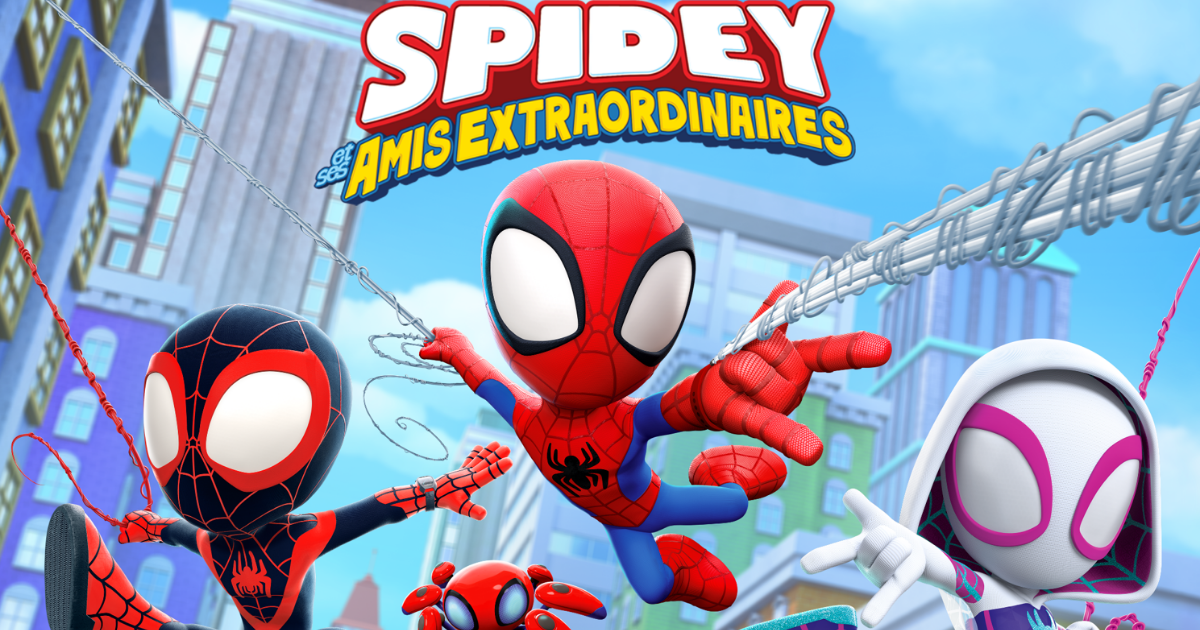
Spidey and classic Spider-Man are not aimed at the same age. The Spidey artwork is round, colourful and never threatening: designed for 2-6 year olds, it is recognised instantly by a child who cannot read yet. That is the decisive criterion at nursery, where everything is found by eye and the bag has to stay light.
You are looking for Spider-Man gear for a three or four year old, and you come across two very different visual worlds. One shows a muscular hero with a stern gaze, the other three rounded, smiling characters.
This is not a matter of taste: these are two distinct licences, designed for two different ages. Here is how to choose, and how to kit out a nursery-age child without getting it wrong.
Spidey or classic Spider-Man: the difference that matters
Two worlds, two audiences
Spidey and His Amazing Friends is a series made for 2-6 year olds. Its three heroes — Spidey, Ghost-Spider and Spin — have rounded proportions, bold colours and always positive expressions.
Classic Spider-Man, the one from the comics and the films, is aimed at a noticeably older audience. His artwork is angular, often in chiaroscuro, and the character is shown in action rather than smiling.
A four year old can perfectly well love both. But in a group setting, the Spidey version has a concrete advantage that we detail further down. Our introduction to the series and its three heroes explains in detail why this format works so well at that age.
The criterion that settles it: recognition
At nursery, a child does not read their name on the label. They find their belongings by the picture, among twenty bags hanging on the same pegs.
That is where the Spidey artwork wins clearly. Three colourful, distinct characters are spotted at a glance, whereas a red and blue silhouette in mid-action blends in with all the others.
The corollary is useful: if several children in the class have Spider-Man things, choose artwork where one of the three heroes dominates — Ghost-Spider or Spin rather than Spidey — to avoid mix-ups.

Spider-Man Nursery Backpack Spidey and His Amazing Friends
The nursery format in the team's colours, sized for small shoulders and recognisable at first glance. See it with our Spider-Man backpacks.
View the product — €39.90The backpack
This is the centrepiece, and the one where mistakes cost the most in comfort.
The size
At nursery, a bag has to hold a snack, a comforter, a change of clothes and the home-school book. Nothing more. A height of 28 to 32 centimetres is plenty, and anything bigger becomes cumbersome.
The simple visual guide: on the child's back, the bag should not go below their lower back or rise above their shoulders. If it touches the back of their thighs, it is too big.
The straps
Padded and adjustable, no exceptions. A three year old does not complain about a strap that digs in: they carry the bag in one hand, which throws their walking off balance.
Also check that the adjustment holds. On cheap models, the buckle slips and the bag ends up round their bottom after a fortnight.
The fastening
A wide zip with a pull big enough to be grabbed by a small hand. That is the detail that decides whether the child is independent or calls an adult at every snack time.
The test to run before term starts: ask them to open and close it on their own, three times. If they cannot manage, the bag is not right, whatever the artwork. Our backpack guide by age and use sets out the formats for the age groups that follow.
The pencil case and the small supplies
At nursery, the pencil case is used less than at primary school, but it has a strong symbolic role: it is the child's first truly personal object.
Go for a simple model, with a single pocket and an easy fastening. Double-compartment pencil cases are unmanageable at this age and end up open at the bottom of the bag.
The shape matters more than the capacity: a flat pencil case sits next to the exercise book, a round one rolls and takes up all the space. We go into choosing the design by age in our Spider-Man pencil case guide.

Spider-Man Pencil Case Spidey and His Amazing Friends
A pencil case with a simple shape and a single pocket, with artwork the child identifies immediately. Find the whole range in our Spider-Man pencil cases and our gift ideas.
View the product — €22.90The clothes
At nursery, clothes have to survive paint, the sandpit and three washes a week.
The T-shirt
Cotton, straight cut, soft neckline. Children dress themselves more and more on their own at this age, and a neckline that is too tight is a real obstacle — they end up asking for help or giving up.
On printed artwork, check how it holds up in the wash: a design that cracks after five machine washes turns a new garment into an old one.
The jacket and the layers underneath
At nursery, children go outside at playtime in almost all weathers. A light jacket they put on themselves is better than a warm coat someone has to put on for them.
The decisive criterion is the fastening: go for a zip with a large pull or press studs rather than a row of buttons. Our guide to dressing your child for the new school year reviews the fabrics and the sizes by age.
The bedroom and bedtime
This is often where the Spidey world is most useful, for a reason that has nothing to do with decoration.
A three or four year old going through a difficult phase settling at night is soothed by familiar landmarks. A duvet cover, a throw or a cushion in the colours of a series they love turn the bed into known territory.
The Spidey artwork lends itself to this better than the classic artwork: bright, smiling, with no action scenes. A fight poster above the bed of a three year old is not a neutral detail.
To put together a room that holds together without overloading it, our ideas for creating a complete Spider-Man bedroom and our duvet cover guide give the proportions that work.

Spider-Man Duvet Cover - Spidey and His Amazing Friends
A bedding set in the team's colours, in bright tones that suit a little one's bedroom. The whole range is in our duvet covers, and the rest of the children's world in our T-shirts for children.
View the product — €59.90What nursery really asks for
Before buying anything at all, it is worth looking at what the school actually expects — the list is shorter than people think, and very different from the primary school one.
A minimal list
In nursery and reception, the essentials come down to four items: a bag, a complete change of clothes in a plastic bag, a comforter if the child has one, and the home-school book supplied by the school.
School supplies as such — pencils, glue, scissors — are almost always provided and shared. Buying a filled pencil case is therefore about the child's pleasure more than about necessity, which takes nothing away from its symbolic use.
Everything has to be machine washable
This is the constraint parents discover in October. Paint, felt-tips, mashed potato, wet sand: every object that goes to school will come back dirty, the bag included.
So always check the care label before buying. A bag that is not recommended for the machine is a bag that will be machine washed anyway, then ruined.
Everything has to be found unaided
The real challenge of nursery is independence. A child who identifies their belongings, opens them and closes them on their own gains confidence, and the teaching team notices.
That is why the artwork is not a parent's whim: it is part of the functional kit just as much as the fastening or the size.
Making the kit last a whole year
A well-equipped start of term can last until the end of term in July, or fall apart by October half-term. The difference comes down to very little.
Wash the bag at the holidays, not when it is black. A fixed rhythm — every school holiday — avoids the build-up that ends up ingrained in the fabric.
Repair it straight away. A seam that gives way is stopped in five minutes at the start, and becomes beyond saving three weeks later. Same for a broken zip pull, which a simple ring replaces.
Plan for a second identical T-shirt if your child gets attached to one particular garment. It is an experienced parent's trick: it avoids difficult mornings when the favourite garment is in the wash.
Check the sizes at Christmas. Between three and five, a child changes size during the year. A mid-point check avoids discovering in March that they have been wearing clothes that are too small for weeks.
The mistakes that keep coming back
Buying classic Spider-Man for a three year old. It is not a bad aesthetic choice, it is a bad functional one: they do not recognise their belongings as quickly, and some action artwork makes an impression on them.
Buying too big so it lasts. An oversized bag at nursery gets in the way of walking and tips over when the child bends down. Growth is handled at replacement, not at purchase.
Overlooking independence. A zip that is too small, a buckle that is too stiff, a neckline that is too tight: each of these details forces the child to ask for help, which goes exactly against what nursery is trying to develop.
Matching everything. Bag, pencil case, T-shirt, water bottle and duvet all in the same artwork is saturation. One strong item and two echoes are enough, as shown in our gift ideas by age.
Forgetting to label. Even with very recognisable artwork, the name remains essential — written inside, on a sewn-in label or with a fabric pen.
When to move from Spidey to classic Spider-Man
The question usually comes up between six and eight, and it is rarely settled by a date: it is the child who gives the signal.
The signs of the switch
They start finding the series 'for babies'. They take an interest in the characters the older ones watch. They ask questions about the films. Or more prosaically, they no longer want their bag in front of their classmates.
This moment often arrives during the school year, which is one more argument for not over-investing in a complete kit from the same licence: a child can drop a universe in a few weeks.
How to support the transition
The simplest approach is to mix things in gradually rather than replace everything. Keep the bedroom items, which stay in the private sphere, and change first what is seen at school — the bag, the T-shirt, the pencil case.
This gradual approach costs less and respects the child's pace, as they often stay attached to their bedtime things long after turning the page in public.
And the little brother or sister
This is the argument that makes Spidey kit particularly good value in a family with several children. A nursery bag in good condition serves two, sometimes three children — provided it was chosen for its sturdiness and not just for its artwork.
In that case, go for a model where all three heroes appear rather than just one: it will suit a boy as well as a girl, and it will not date.
Where to start if money is tight
Not everything is equally useful, and the order of priority is fairly clear.
The bag first. It is the object they carry every day, the one that has to be the right size, and the one that serves as the main visual landmark.
Then the clothes, because they are seen and they bring immediate pleasure, for a modest outlay.
The bedroom last. It is the most expensive and the least urgent — unless sleep is precisely the issue, in which case the duvet goes to the top.
To build things up gradually without blowing the budget, our small gifts under €20 and our toy guide by age suggest low-cost additions, and our Spider-Man toys cover the playtime side.
The questions parents ask
My child has never seen the series, is that a problem?
Not at all. The artwork works on its own: three colourful characters stick in the mind without knowing their story. Plenty of children in fact discover the series after having an object with them on it, not the other way round.
Is it suitable for a girl?
Yes, and it is even one of the strengths of this licence compared with classic Spider-Man. The team includes Ghost-Spider, whose white and pink palette sets her clearly apart, and a lot of the artwork shows all three heroes together.
If your daughter identifies particularly with that character, our Ghost-Spider costume guide for girls covers the sizes and the models available.
Do the sizes come up small?
On licensed clothing, the general rule is to take the size matching the child's actual age, without going up a size 'for next year'. A garment that is too big gets in the way of independence, and that is precisely what you are trying to develop at this age.
The only case where going up a size makes sense is the jacket, which is worn over other layers in winter.
And what if the child changes their mind during the year?
It happens more often than you would think, and it is not a problem. A four year old can go from one passion to another in a month, without that calling into question the use of their kit.
The answer is simple: concentrate the budget on one or two items that really carry identity — the bag, a garment — and stay neutral on the rest. A plain pencil case and a simple water bottle survive every change of mind.
Should you buy everything before term starts?
No, and it is actually not advisable. Wait for the start-of-term meeting or the first week: every school has its own habits, and you will avoid buying something the staff provide or do not allow.
Only the bag is worth buying in advance, because the child needs to make it their own before the first day. The rest can follow.
What to remember
For a nursery-age child, the Spidey licence is the right choice — not out of aesthetic preference, but because its artwork is designed to be recognised by a child who cannot read yet.
The rest comes down to three checks: a bag that does not go below the lower back, a fastening they handle on their own, and a name written somewhere. The artwork decides enthusiasm, these three points decide use.

