

14-Day Money-Back Guarantee
0
The short answer
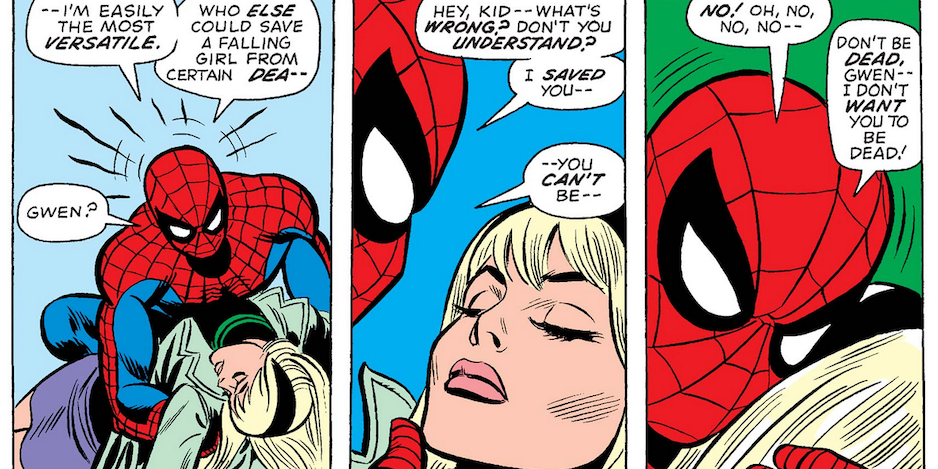
Norman Osborn throws Gwen from the top of the George Washington Bridge; Peter's web brings her fall to a brutal halt and the famous ‘SNAP’ leaves real doubt about the true cause of death. That suspicion feeds his guilt and tips the comics into the Bronze Age. The consequences are detailed below.
In the sprawling world of Spider-Man, few story arcs have had as much emotional and symbolic impact as The Night Gwen Stacy Died. Published in 1973 in The Amazing Spider-Man #121-122, this two-part story marks a dramatic turning point in Peter Parker's life. For the first time, a superhero fails irreversibly, losing the woman he loves deeply — Gwen Stacy.
But why does this death still resonate today, in the comics as much as in the film adaptations? Because it is not just a tragic loss. It is the reflection of a loss of innocence for Spider-Man, and the anchor point of a trauma that would shape his development for decades.
In this full analysis, we will explore what is at stake in this legendary arc, its consequences for Peter Parker, and its influence across the whole Spider-Verse — from Andrew Garfield to Spider-Gwen.
A relentless piece of dramatic construction
Even before the tragedy, writers Gerry Conway and Gil Kane had woven a quiet tension: Norman Osborn, under the influence of the Green Goblin serum, recovers his memories and his hatred of Spider-Man. When he discovers Peter's secret identity, he goes straight for his weak spot: Gwen Stacy.
Gwen's kidnapping and the fight at the top of the George Washington Bridge (often confused with the Brooklyn Bridge) set up a confrontation that is as physical as it is emotional. This is not just a superhero punch-up: it is a cruel game of chess between two broken men.
- Gwen is unconscious, probably drugged by Osborn.
- Spider-Man saves her... or thinks he does.
- The fatal ‘SNAP’ in that legendary comics panel leaves room for doubt: was it the fall? Or the web snapping her neck?
That precise detail — the possibility that Peter is indirectly responsible — adds a layer of eternal guilt to his grief. A tragic mechanism of rare depth for the time.
In our page about Peter Parker, we go back over all the key moments that shaped the hero into the man he is today. You can also read our article on the analysis of Gwen Stacy's death in the films.
An irreversible trauma for Peter Parker
Gwen Stacy's death is not simply the loss of a girlfriend. It becomes a deep psychological shock for Peter Parker, a turning point in the way he is Spider-Man. From that moment on, his sense of responsibility, already central, takes on a new gravity. He understands that no power, not even a hero's, can control everything.

Here are the major repercussions this event will have on his journey:
- Crushing guilt: Peter will always wonder whether he killed Gwen by catching her badly. That doubt haunts him.
- Renewed hatred of the Green Goblin: Norman Osborn becomes more than a simple enemy: he embodies loss, suffering, the intimate nemesis.
- A new wariness: Peter becomes more and more aware that those close to him are in danger because of his double life. This theme comes back with Morlun, Spot and again in the recent multiverse arcs.
- A shift in his relationship with love: Mary Jane, then just a friend, gradually becomes an emotional pillar. It is a decisive turning point in their relationship (explored in this article devoted to MJ).

On a deeper level, Gwen Stacy has become a sacrificial figure. Every Spider-Man in the multiverse carries a version of this trauma. In No Way Home, you feel the weight of this event in Andrew Garfield's eyes, in a version of the character who never really healed. His redemption, saving MJ from a similar fall, is a direct tribute to that iconic scene.
This individual trauma thus becomes a canon event of the Spider-Verse. It is one of the fixed points on every trajectory, as explained in our article devoted to canon events.
If you want to relive the most powerful moments of Gwen & Peter, discover our selection of Spider-Man figures inspired by the saga's most iconic scenes, or dive into the Spider-Man decorative posters and their heavy emotional charge.

An iconic scene that became foundational in Marvel comics
The arc The Night Gwen Stacy Died, published in 1973 in Amazing Spider-Man #121-122, overturned the standards of superhero comics. At a time when comics were still heavily codified, Marvel dared the unthinkable: killing a main character in a brutal and irreversible way.
This scene is not only an emotional pivot, it also becomes a founding milestone in the writing of comics:
- A shift in tone: we move from the classic heroic tale to a more adult narrative, where the consequences last.
- The end of the Silver Age of comics: many fans consider this arc the beginning of the Bronze Age, where heroes become fallible, human, tormented.
- A narrative model copied everywhere: from Batman with Jason Todd to Daredevil with Elektra, the loss of a loved one becomes a superhero's rite of passage.
Since then, the scene of Gwen's death has been adapted or referenced across many media:
- In The Amazing Spider-Man 2 (2014), with Emma Stone, the scene is recreated almost shot for shot, devastating in its realism and its emotion.
- In Spider-Verse, the character of Spider-Gwen was literally born from this tragedy, embodying a universe where Gwen survived… and became a heroine in her own right.
- In alternative comics, such as House of M or What If…?, this death is often reinterpreted as a fundamental point of divergence.
That ability to transcend universes, to mark readers, films and series so deeply, makes Gwen Stacy a mythical figure. And the scene of her fall from the George Washington Bridge is no longer just a comics page, it is a pop-culture icon.
If you are passionate about the web-slinger's great story arcs, discover our page devoted to all of Spider-Man's arcs, from One More Day to Big Time, or dive into the Brand New Day arc which, much later, would try to erase the scars of this trauma… at what cost?
For full immersion, explore our Spider-Man costumes or our decorative lamps too, to pay tribute to the dark, moving world of the web-slinger.
A lasting emotional and narrative legacy
Gwen Stacy's death is not only a dramatic turning point in Peter Parker's life. It represents a shift in the way superheroes themselves are built. Since that event, Spider-Man no longer fights only supervillains. He also faces guilt, grief, responsibility… themes that had not yet been explored in this way in the mainstream comics of the time.
This trauma becomes the catalyst for many later decisions:

- Peter withdraws further into himself, struggling to form new emotional ties, particularly with Mary Jane Watson.
- He pushes his own limits to protect those he loves, becoming a more determined, more mature Spider-Man.
- He develops a deep mistrust of Norman Osborn, the man responsible for Gwen's death, sharpening an already legendary rivalry between the web-slinger and the Green Goblin.
But what many readers remember is the brutality of reality in this arc. There is no miracle. Gwen does not come back. The superhero does not win in the end. It is that narrative honesty that makes ‘The Night Gwen Stacy Died’ a timeless pillar of the Marvel universe.
In a universe where the multiverse is exploding with dozens of Spider-Man variants, this version of Peter stays rooted in tragedy. A universal lesson: being a hero comes at a price.
And for everyone who wants to relive the web-slinger's greatest moments, do have a look at our Spider-Man merchandise page for a 100% Spidey atmosphere.

