

14-Day Money-Back Guarantee
0
The short answer
Against the Inheritors, those totemic predators who hunt down every spider in the multiverse, Billy Braddock brought what the others lacked: the brain of a general staff. Mapping the attacks, forming squads, opening clandestine portals — his role inside the Spider-Army counts for as much as his Union Jack uniform. We walk through his story below.
A Spider-Man forged by war and resistance
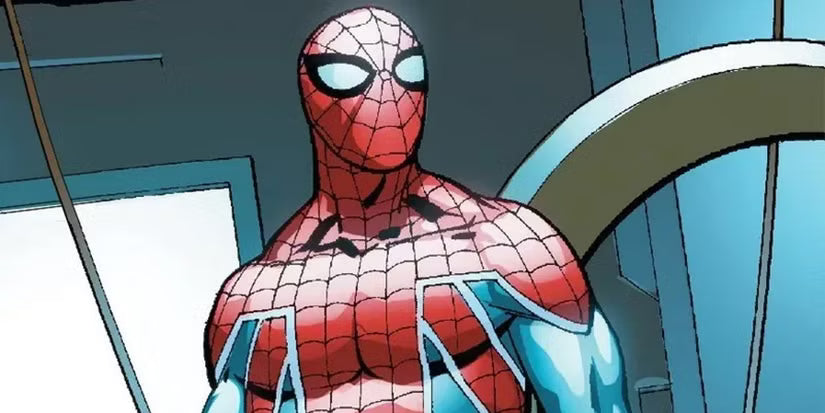
Among the countless versions of the web-slinger explored in the Spider-Verse, one of the most fascinating — and most underrated — is Spider-Man UK. A hero of Earth-833, a founding member of the Captain Britain Corps and a central figure in the multiversal defence organisation, he embodies a unique archetype: a military Spider-Man, disciplined, organised, trained for war. Where Peter Parker fights alone on the streets of New York, Spider-Man UK, alias Billy Braddock, fights for the survival of the entire multiverse.
And it is precisely this strategic dimension that put him on the front line against the greatest threat ever to appear in the arachnid universe: the Inheritors. These totemic predators, already covered in our articles on the Inheritors and in our analysis of the terrifying Morlun, hunt every version of Spider-Man across the realities. Against them, survival no longer rests on heroism alone… but on strategy, coordination and the unification of hundreds of spiders.

It is in this context that Spider-Man UK, far from New York and far from Peter Parker, became a pivotal piece of the puzzle: tactical officer, squad leader, portal coordinator and leader of the Resistance. His trajectory is nothing like a classic Spider-Man arc. It belongs to an almost military dimension of the arachnid myth, which makes him a key character for understanding the inner workings of the Spider-Army seen in Spider-Verse and reinforced later in Spider-Geddon.
In this first part, we look back at how this atypical hero was built: his origins, his place in the Captain Britain Corps and the reasons he became one of the first to grasp the scale of the Inheritor threat. And as always, the analysis is woven into the wider editorial universe of the site: whether that means the alternative versions of Peter (such as Chasm or Spider-Ham), or the big pillar pages such as the one devoted to the web-slinger's film history.
Finally, there is no ignoring the cultural and visual impact of Spider-Man UK: with his Union Jack uniform and his look somewhere between knight and multiversal soldier, he has shaped a whole line of Spider-Man figurines and collectibles. A memorable design that, here again, marks out how singular the character is across the vast Spider-Man panorama.

The first shock: when Spider-Man UK discovers the real threat
When the Inheritors' hunt truly begins across the multiverse, few Spider-People immediately grasp the scale of the disaster. Many run. Others face the enemy without understanding its totemic nature. Spider-Man UK, though, realises very early that this threat falls completely outside the usual pattern of the web-slinger's enemies. These are not villains chasing power or destruction: they are ancestral predators who see every Spider-Man as natural prey.
As a member of the Captain Britain Corps, Billy Braddock has an advantage Peter does not: a global view of the multiverse. Used to monitoring dimensional fractures and stepping into unstable realities, he picks up the first weak signals quickly. When he discovers the first worlds decimated by Morlun and his family — entire realities where the Spider-Totems were torn away down to the last one — he understands that this enemy is no isolated phenomenon. It is an organised hunting campaign.
His reports to the Corps are ignored or played down, because even their multiversal archives hold nothing more than fragments about the Inheritors. Yet, as we explain in our article on the Spider-Totems, understanding this mystical dimension of the arachnid myth is essential: the Inheritors strike at the very source of the Spider's power.


That early realisation pushes Spider-Man UK towards a position nobody had yet considered: they have to organise a resistance. Not simply recruit a handful of Spider-Men, but coordinate a genuine multiversal army. That strategic vision would become the foundation of the future Spider-Army, led in part by figures already central to our blog such as Peter B. Parker or Spider-Man Noir.
And as the Inheritors' attacks multiply, Spider-Man UK starts mapping their movements, working out their hunting patterns, and even anticipating their next targets. An almost military approach, and a completely new one in the history of the web-slinger's variants. Where Peter often improvises, Billy plans, analyses and builds lines of defence. It is one of the traits that makes him such a distinctive character.
In this second part, you can already see the shift: the story of Spider-Man UK is not that of a lone hero, but of a commander in the middle of a multiversal war. His fight is as strategic as it is physical, and it is this approach that leads to the creation of strongholds, rallying points… and the first clandestine portals used by the Resistance. Something that strongly echoes the dynamics explored in our article on Spider-Island, where collective organisation becomes essential.

And of course, there is no ignoring the impact of this period on the merchandise. The multiverse versions of Spider-Man have boosted sales of figurines and Spider-Man masks, especially the models inspired by the Spider-Verse. Proof that this war against the Inheritors left its mark not only on the comics, but on modern pop culture as a whole.

The Spider-Army takes shape: alliances, sacrifices and strategy
As the Inheritors' hunt intensifies, Spider-Man UK becomes one of the first architects of the clandestine organisation that will become the Spider-Army. It is not a role he chose: it is a role circumstances force on him. Where most Spider-People are disoriented, traumatised or busy running, Billy Braddock understands that the only chance of survival lies in coordination. The multiverse cannot be saved by a handful of isolated heroes — it has to be defended by a unified force.
The first strategy meetings, held in secret through unstable portals, look more like councils of war than superhero get-togethers. And it is Spider-Man UK who imposes their structure: dimensional maps, fallback routes, ambush zones, analyses of the Inheritors' hunting habits. This is a long way from the friendly neighbourhood Spider-Man. This is military strategy applied to the Spider-Verse.
These meetings make unexpected alliances possible: lone spider-heroes such as Spider-Man Noir, technological versions such as Spider-Man India, or major figures such as Spider-Ham. Diversity becomes a strength: each Spider brings a speciality, a talent, a knowledge of their own Earth.

One of the most fascinating aspects of this period is the way Spider-Man UK accepts that his decisions cost lives. Unlike Peter Parker, who carries every death as a burden, Billy Braddock thinks like a strategist: sacrifice one reality to save ten. That dilemma, explored too in darker arcs such as Kraven's Last Hunt, shows just how different the war against the Inheritors is from anything Spider-Man usually faces.
It is also during this phase that the safe hideouts are set up: dimensional sanctuaries designed to stop the Inheritors from following totemic traces. These bases become the nerve centres of operations, where the Spider-People regroup, heal, or prepare their counter-attacks. An idea that has inspired plenty of visual takes on the Spider-Man posters and the multiverse pyjamas.
Spider-Man UK is not only a tactician. He also becomes a moral figure. Not in the same way as Ben Parker or May Parker, but in a more martial sense: he is a constant reminder that the multiverse will not survive unless the Spider-People learn to act like an army.
The way Spider-Man UK grows inside this collective resilience shows how badly the multiverse needs heroes able to think beyond their own reality. And that is precisely what makes him a decisive player in the final assault on the Inheritors.
The final assault: Spider-Man UK and the fate of the Spider-Verse
When the Spider-Army moves from flight to counter-offensive, Spider-Man UK plays a decisive part in planning the final assault on the Inheritors. Where other versions of the web-slinger are driven by survival or individual heroism, Billy Braddock sees this battle as the logical conclusion of a multiversal war. And his experience in the Captain Britain Corps gives him a unique perspective: he understands that victory will not be decided by brute force alone, but by the perfect synchronisation of hundreds of spiders drawn from different realities.
The final plan rests on several strategic elements he helped to design: calibrated portals used to trap the Inheritors, forces concentrated at precise points of the multiverse, and the coordination of specialised units — stealth, technological or mystical.

Spider-Man UK also proves himself in the field. In the fiercest fights he holds his own against starving versions of Morlun or Daemos, thanks to a mix of physical technique, dimensional gadgets and a soldier's discipline. He knows he may not survive this battle — many will not — but he embodies the idea that every Spider has to accept sacrifice if it means breaking the chain of predation.
His legacy is all the more striking because the war against the Inheritors inspired a whole swathe of modern merchandise, not least the Spider-Verse figurines, the masks, the Spider-Man clothing or the multiverse posters. The design of Spider-Man UK, part modern knight, part British national symbol, has stayed with fans.
But his role does not stop at the war: he embodies a Spider-Man who has understood that the multiverse is not a mosaic of separate realities, but a living ecosystem where every variation of the web-slinger has a part to play. That vision echoes the whole philosophy of this site, which explores the many facets of the character through pillar pages such as the story of Peter Parker or the analyses devoted to the great totemic threats.
In the end, looking closely at Spider-Man UK shows that the Spider-Verse is not only a narrative concept, but a space for thinking about collective heroism, sacrifice, and the way alternative versions can become the pillars of shared survival.

