

14-Day Money-Back Guarantee
0
The short answer
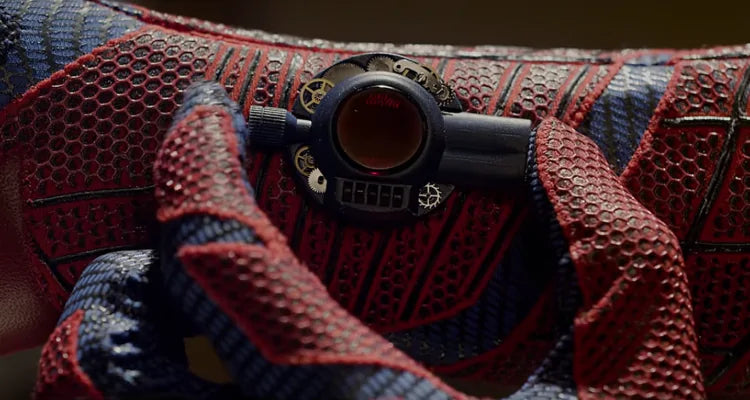
In the comics, the web doesn't come out of the hero's body: Peter Parker builds his own web-shooters with his bare hands, worn at the wrists, firing a chemical fluid that solidifies the instant it hits the air. On screen, Sam Raimi's trilogy is the exception, with organic webbing. The full mechanism is explained below.
It's Spider-Man's most iconic move: the wrist snaps forward, that unmistakable 'thwip', and a web shoots out to send him flying between the skyscrapers. But how does the famous web-shooter actually work? Is it mechanical or organic? Does Peter Parker make his own webbing? And above all: could such a technology ever exist in real life? Between the comics, the films and real science, here's everything you need to know about one of the cleverest gadgets in superhero history - and how children can have a go at slinging webs themselves.
In the comics: a mechanical web-shooter, built by a genius
Contrary to popular belief, the Spider-Man of the comics doesn't produce webbing with his body. It's his mechanical web-shooters (those famous wrist gadgets) that do all the work. And that's exactly the detail that makes the character so fascinating: Peter Parker isn't just agile, he's also a scientific genius. A teenage prodigy in chemistry and engineering, he built these small wrist-worn devices with his own hands, hidden beneath the sleeves of his suit.
That's an essential part of the myth: Spider-Man's powers aren't just his strength and his spider agility. His intelligence is part of the package. To discover the full extent of his abilities, our feature on Spider-Man's powers covers everything that makes him such an extraordinary hero - well beyond the web-shooter alone.
Web fluid: a chemical invention
The heart of the system is the web fluid (the 'webbing'). Peter developed a liquid compound, stored under pressure in small cartridges. When he fires, that liquid is expelled and, on contact with the air, instantly solidifies into a filament of incredible strength. A clever touch dreamed up by the writers: this webbing doesn't last forever. It dissolves on its own after roughly an hour, which spares New York from being permanently covered in webs.
A trigger designed to prevent accidents
How does Spider-Man avoid firing a web every time he clenches his fist or picks something up? Thanks to an ingenious safety mechanism: the shot only fires with a precise double press of two fingers on the palm, on a small central button. A deliberate movement, almost impossible to make by accident. It's this kind of engineering detail that makes the character believable and consistent - and that true fans love to pick apart, as in our article on the hidden details of Spider-Man's suit.
Who invented the web-shooter? The story behind a brilliant detail
The mechanical web-shooter didn't appear by chance. When Stan Lee and Steve Ditko created Spider-Man in 1962, they made a bold narrative choice: rather than give Peter Parker one more power, they handed him a tool he had to design himself. That detail changes everything. It turns a teenager bitten by a spider into a genuine inventor, and roots the character in something deeply human: work, ingenuity, effort. Spider-Man isn't just strong, he's clever.
That choice fed decades of stories. How many times has Peter found himself in the middle of a fight with an empty web-fluid cartridge, forced to improvise or run? That vulnerability, unthinkable with unlimited organic webbing, created some memorable moments of tension. It also reminds us that behind the mask is a fallible young man, whose story begins in the pages of a legendary founding comic. It's that humanity, more than his gadgets, that made him one of the best-loved heroes in the world.
On screen: when the webbing turns organic
On the big screen, the story is slightly different. In Sam Raimi's cult trilogy (with Tobey Maguire), the writers made a daring choice: they made the webs organic. Raimi's Spider-Man doesn't build web-shooters; the webbing shoots straight out of his wrists, like a natural extension of his mutation. A decision that divided purists, but one that held up on screen: it avoided having to explain how a schoolboy whips up a revolutionary fluid in his bedroom, and reinforced the whole 'turning into a spider' idea.
The adaptations that followed went back to the source. In The Amazing Spider-Man and in the Marvel Cinematic Universe alike, the web-shooters are mechanical once again, faithful to the comics. In the MCU they even get a technological helping hand from Tony Stark, with suits packed full of electronics. This evolution of the gadgets goes hand in hand with that of the suits, a subject we explore in our round-up of Spider-Man's most legendary suits.

The web-shooter for children
Spider-Man Web-Shooter for Children
For replaying the web-slinger's most famous move at home or in the garden. A model designed for small hands, easy to wear on the wrist just like the real thing.
View the product - 24.90 EURAnd in real life? The science of spider silk
Here's the question everyone asks: could a real web-shooter exist? The answer comes in two parts. First, real spider silk is an utterly extraordinary material. Weight for weight, it is stronger than steel and incredibly elastic. Scientists consider it one of the best-performing natural materials there is, and have spent years trying to reproduce it in the laboratory for medical, textile and industrial applications. On that point, the intuition of Spider-Man's creators was visionary: a web able to carry the weight of a grown man isn't so absurd after all.
Reproducing Spider-Man's move, on the other hand, remains firmly in the realm of fiction for now. Firing a filament that solidifies instantly, strong enough to swing from one building to the next, all while fitting inside a small band at the wrist... we're still a long way off. And that's before you factor in the superhuman strength and agility of the spider needed to withstand all that swinging! Spider-Man's webbing therefore remains a wonderful blend of plausible science and superhero magic - and that's exactly as it should be.
There is one thing science does confirm, though: the physics of the swing imagined by the writers holds up. Travelling by swinging on the end of a line, like a giant pendulum, really is an efficient way of getting around a city: you convert height into speed, then let go at just the right moment to launch yourself further. It's exactly what a child does on a swing, only far more impressive. The real obstacle remains: without Spider-Man's superhuman abilities, an ordinary human body couldn't cope with the acceleration. Once again, the webbing only does half the job: the rest is the spider.
Far more than a means of transport
The webbing is often reduced to a simple way of getting around, but Spider-Man puts it to wildly creative use. He uses it to pin criminals down by sticking them to a wall, to create shields or safety nets, to disarm an opponent from a distance, or even to knock together improvised objects on the fly (a bat, a parachute, a raft...). Some Spider-Men have pushed the concept even further, with webbing that has special properties.
That versatility, combined with his spider-sense that warns him of danger, makes Spider-Man a formidable fighter despite strength that is 'only' superhuman. The webbing is his Swiss army knife, the tool that turns an agile teenager into a genuine superhero. A stroke of genius right from the start, as told in our article on the legendary comic that gave birth to Spider-Man.

The launcher glove
Spider-Man Web-Launcher Glove
The glove that turns any child into Spider-Man. Slip it on, take aim, fire: the star accessory to complete an outfit and live the adventure.
View the product - 42.90 EURSpecial webbing: when Spider-Man innovates
Over the decades, the writers have had great fun spinning Spider-Man's webbing into a host of variants, often cobbled together by Peter as his adventures demanded. There's impact webbing, which wraps up a target in a single shot, then there's electric webbing for short-circuiting an enemy or a machine, and formulations designed to resist fire, ice or opponents with colossal strength. Every new threat sends the hero back to his chemistry bench.
In certain sagas, the webbing takes an even more spectacular turn. The black symbiote suit, for example, generated its own organic webbing, with no web-shooters and no cartridges: a 'convenience' that hid a trap, as told in the story of Spider-Man and the symbiote, a dark and legendary relationship. This endless creativity around a simple strand of web is exactly why the character has never stopped reinventing himself, film after film, as shown by the evolution of his most legendary suits.
Slinging your own web: web-shooters for children
Good news for young (and not-so-young) fans: while the real web-shooter doesn't exist yet, toy makers have found a thousand ways to recreate the magic of the move. There's now a whole range of toy web-shooters, each with its own mechanism, so you can live the Spider-Man experience at home or in the garden.
The water models fire a jet, perfect for summer and outdoor play. The dart or sucker models add an aiming dimension that children love, with targets to hit. Some are worn on the wrist to mimic the real web-shooter as closely as possible, and the most elaborate even include a laser sight. To help you find your way through all these mechanisms, our dedicated guide explains how to choose an automatic, water or manual launcher, and our comparison of the best web-shooter for children by age and use helps you decide.
Which web-shooter for which age?
| Age | The right web-shooter |
| 3-5 years | Simple water or soft-web model, with no small parts |
| 6-8 years | Sucker-dart launcher with a target, under supervision |
| 9 years and over | Wrist-worn launcher or one with a sight, closer to the real gadget |
The web-shooter is also the star accessory for completing a fancy dress costume: it turns a simple outfit into proper hero kit. We tell you all about it in our guide to Spider-Man fancy dress accessories for children (mask, web-shooter and gloves).
Our tips for great fun (and no breakages)
A toy web-shooter is at its best when play has a bit of structure. With water models, stick to the outdoors or the bathroom: perfect for summer days, less so for the living room. With sucker-dart models, the golden rule is simple: never aim at the face, and set up a target instead (a drawing taped to the wall, a sticker, a box) to turn each shot into a little accuracy challenge. Children love keeping score.
For younger ones, check the recommended age on the packaging and make sure there are no small parts, and keep a friendly eye on the first few games. Finally, a web-shooter really comes into its own as part of a full outfit: mask on the face, gloves on the hands and launcher on the wrist, and your child genuinely feels like the web-slinger. That's often where the best hours of play come from - and the best childhood memories of Spider-Man.

With a laser sight
Spider-Man Web Launcher with Laser Sight
For older children who want to aim true: this launcher has a built-in laser sight and comes as close as it gets to Spider-Man's high-tech gadget.
View the product - 39.90 EURSwinging in video games: finally, the right feel
For a long time, one challenge defied developers: capturing the feel of the swing in a video game. How do you give the player that exhilarating sense of cutting through the air between the skyscrapers? The answer came with the new generation of games, where the web now attaches realistically to buildings, where momentum builds, and where letting go at just the right moment delivers a genuine rush of adrenaline. Plenty of players say the same thing: swinging has become an end in itself, quite apart from the combat.
That success partly explains why the recent games are considered benchmarks of the genre. To understand how this mechanic redefined the Spider-Man experience, our feature on the masterpiece that redefined the superhero in video games looks back at that technical achievement. It brings things full circle: born on paper in 1962, the web-slinging move has never stopped gaining in realism, from the comic to the controller.
The move that marked generations
Whether it's mechanical in the comics, organic in Raimi's films or high-tech in the MCU, the web-shooter remains the absolute symbol of Spider-Man. It's the move every child instinctively copies, two fingers folded into the palm, shouting 'thwip!'. A piece of design more than sixty years old, and yet still just as iconic and fun. Proof, if any were needed, of the timeless genius of the web-slinger's creators.
So next time your child holds out a wrist to 'sling a web', you'll know everything behind that legendary gesture - from Peter Parker's imaginary chemistry to the real spider silk that fascinates scientists. And if they fancy taking it further for real, all they need now is the right web-shooter.
FAQ - Spider-Man's web-shooter
Does Spider-Man make his own webbing?
In the comics, yes: Peter Parker, a chemistry genius, invented a web fluid and mechanical web-shooters worn at the wrists. In Sam Raimi's films, on the other hand, the webbing is organic and comes straight out of his wrists.
How long does Spider-Man's webbing last?
In the comics, the fluid dissolves by itself after roughly an hour. A clever detail that stops the city from being permanently covered in webs.
Could a real web-shooter exist?
Not yet. Real spider silk is a material stronger than steel weight for weight, which scientists are studying closely. But firing and solidifying a web strong enough to swing from one building to the next remains, for now, science fiction.
Why doesn't Spider-Man fire webs by accident?
Because firing requires a precise movement: a double press of two fingers on a button in the hollow of the palm. Impossible to do by mistake simply by clenching your fist.
Which toy web-shooter should you choose for a child?
For the youngest, a simple water or soft-web model. From age 6, a sucker-dart launcher with a target. And for older children, a wrist-worn model or one with a sight, closer to Spider-Man's real gadget.

