

14-Day Money-Back Guarantee
0
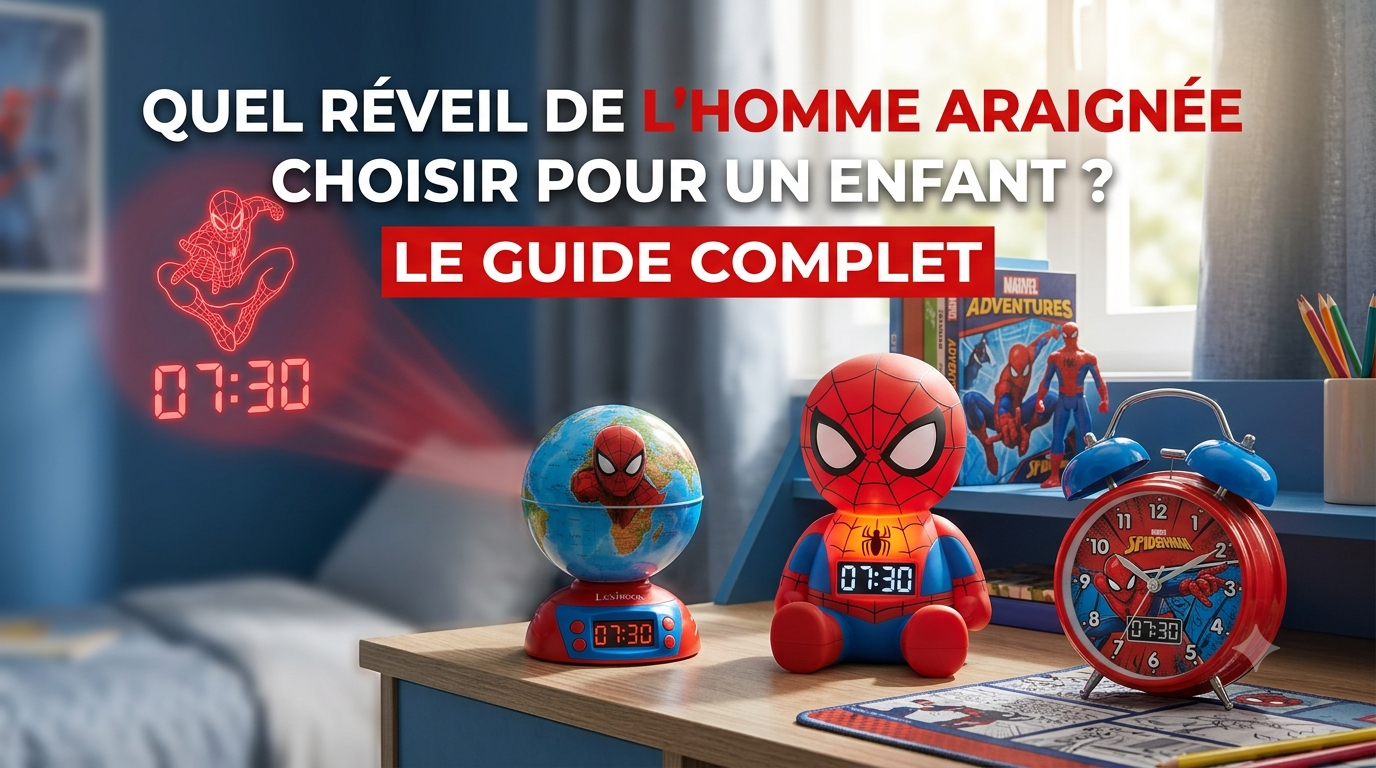
The essentials before you choose
Three criteria settle it: an analogue dial with hands or a display in figures depending on how well your child knows numbers, a built-in night light for the youngest ones, and adjustable brightness at night. The power source, batteries or mains, matters too. We cover each of these points below.
There are objects that look tiny and yet completely transform a child's everyday life. The alarm clock is one of them. Far more than a simple time display, it is a first step towards independence: learning to get up on your own, understanding the passing of time, no longer depending on a parent's phone to know the time. And when that alarm clock wears the colours of Spider-Man, getting up in the morning suddenly becomes far less painful — because who would want to keep their favourite hero waiting?
You still have to pick the right model. An analogue alarm clock to learn to tell the time, an ultra-legible digital version, an alarm clock doubling as a night light to reassure the youngest: each type answers a specific need depending on age. In this guide we break down all the options, explain how an alarm clock helps a child gain independence in the morning, and how to fit it neatly into the bedroom. Everything you need to turn this little object into a genuine ally of family life.
Why give your child a real alarm clock
At a time when everyone uses their smartphone to wake up, giving a child a real alarm clock can seem old-fashioned. In reality it is an excellent idea, for several reasons. First, it avoids bringing a screen into the bedroom, with its well-known harmful effects on falling asleep and on sleep quality. A dedicated alarm clock lets your child keep a phone-free bedroom, one that encourages rest.
Next, a personal alarm clock builds responsibility. Your child learns to manage getting up on their own, to anticipate the time to leave, to become the driver of their own morning rather than being dragged out of bed every day. It is valuable learning, especially when school starts again and the pace tightens up. Finally, an alarm clock bearing Spider-Man's image makes the object desirable: your child wants to use it, to look at it, to take care of it. Passion becomes an engine of independence, exactly as our article explains on what Spider-Man teaches your child without you realising it.
The different types of Spider-Man alarm clock
Not all alarm clocks are equal, and the right choice depends above all on your child's age and on how it will be used. Here are the main families, each with its strengths.
The analogue alarm clock, for learning to tell the time
The analogue alarm clock, with its hands and its dial, is the teaching tool par excellence. It is by looking at it every day that a child takes in the idea of hours and minutes in concrete terms, an essential skill learned around the end of nursery and into primary school. A clear dial, with easily readable numbers and a visible second hand, turns learning to tell the time into a daily game. It is the ideal companion for this important stage.
The digital alarm clock, instantly readable
The digital alarm clock shows the time in figures, at a glance, with no ambiguity. It suits children who can already read numbers and reassures by its simplicity. Many models add practical functions: an adjustable backlight so it does not dazzle at night, a repeat function for heavy sleepers, sometimes even the date or the temperature. Do choose a display whose brightness can be turned down, so that it does not light up the bedroom too much during sleep.
The alarm clock night light, two functions in one
Some models combine an alarm clock with a night light: they give off a soft, reassuring glow, ideal for children who are afraid of the dark. This dual function is particularly valuable for the youngest, as it settles two needs at once. If ambient lighting is a question in your bedroom, our dedicated guide explains how to choose a Spider-Man lamp by age and use, the perfect complement to an alarm clock night light.

THE SPECTACULAR ALARM CLOCK
Spectacular Spider-Man Alarm Clock
An alarm clock with a spectacular design, to make getting up on the right side of the bed appealing. A readable dial and a heroic presence on the bedside table.
View the product — €29.90The useful functions to look at before buying
Once you have chosen the type of alarm clock, a few functions make a real difference day to day. They often cost no more, but they transform the waking-up experience, for child and parents alike. Here are the ones worth examining closely.
The alarm sound and the repeat function
The alarm sound is the heart of the clock. Ideally it is a gradual alarm, rising gently in volume for a soft wake-up rather than a brutal jolt. Some models even offer varied sounds or a melody, more pleasant than a shrill ring. The repeat function, or snooze, buys a few extra minutes: handy for heavy sleepers, but to be used sparingly so that no bad habits set in. A good compromise while learning to get up first time.
Brightness and power supply
For a digital alarm clock, being able to adjust the brightness of the display is essential: a screen that is too bright at night disturbs sleep and lights up the room needlessly. The best models let you dim, or even switch off, the display at night. On the power supply side, a battery alarm clock goes wherever you like, with no socket to worry about and no trailing cable — a real safety advantage in a child's bedroom. A mains model saves you changing batteries but requires a socket nearby. Some versions combine the two, with a backup battery that keeps the time during a power cut.
Gaining independence in the morning, especially at back-to-school time
It is probably the greatest benefit of a personal alarm clock: morning independence. A child with their own alarm clock learns to get up on time without being told ten times. That sense of responsibility comes into its own when school starts again, when the body has to get used to early mornings after holiday lie-ins. The alarm clock becomes a structuring landmark, a small ritual that frames the day from its very first moment.
To be really effective, this independent wake-up is prepared the night before. A regular bedtime and quality sleep are the condition for a gentle wake-up: we help you put that framework in place in our guide to preparing back-to-school sleep with the right bedtime routine. The alarm clock is also very much part of the back-to-school kit: it naturally rounds out our Spider-Man back-to-school guide, alongside the bag, the pencil case and the lunch bag. Sleeping well and getting up well: those are the two sides of a successful morning.

THE CLIMBING ALARM CLOCK
Climbing Spider-Man Alarm Clock
Spider-Man climbs up the dial: a playful model that turns telling the time into a little moment of pleasure for your child.
View the product — €29.90Alarm clock or phone: protecting your child's sleep
The question is worth pausing on, because it touches directly on your child's health. Using a phone as an alarm clock means letting a screen into the bedroom — and with it the temptation to check notifications, play games or watch videos before sleeping. Yet the blue light of screens delays falling asleep, and the mere presence of the phone is often enough to eat into sleeping hours. For a growing child, whose rest determines concentration and mood, that is a real issue.
A dedicated alarm clock settles the problem at the root: the bedroom stays a screen-free space, entirely turned towards sleep and rest. Your child has an object of their own, simple, that does one thing and does it well. It is also a gentle way of setting a healthy framework around screens, without making it a source of conflict. Many parents find that a child with their own alarm clock falls asleep faster and gets up in a better mood. The small initial outlay pays for itself many times over in peaceful nights.
Choosing the right alarm clock by age
The ideal alarm clock is not the same at three as at eleven. Matching the model to your child's maturity makes sure it really gets used and gives its best. Here are the markers by age group.
| Age | The recommended model | Why |
| Nursery (3-5 years) | Alarm clock night light or educational clock | Reassures at night and shows visually when to get up |
| Primary (6-10 years) | Analogue alarm clock with a clear dial | Learning to tell the time, and independence |
| Secondary school (11 and over) | Digital alarm clock with functions | Instantly readable, repeat function, more understated style |
Beyond age, also think about the sound level of the alarm: loud enough to wake, but not so loud that it creates a stress reaction. A model with a gradual alarm, rising gently in volume, gives the softest wake-up. And do not forget the power supply: a battery alarm clock goes anywhere, with no socket to worry about, a real advantage in a child's bedroom.
Where to put it and how to fit it into the decor
Where the alarm clock sits matters more than you might think. Ideally it goes on the bedside table, within reach but not too close to the pillow, so that your child can switch it off without hunting for it, while still having to make the small effort of stretching out an arm — a good way of avoiding dropping straight back to sleep. Keep it away from direct light sources so the display reads well, and away from a socket if the model is mains-powered.
On the decorating side, the alarm clock is a finishing touch that completes the bedroom's world. Chosen in the same tones as the rest of the bedding and the accessories, it reinforces the overall coherence described in our guide to creating a complete Spider-Man bedroom for a child. A Miles Morales alarm clock in black and red, a model that climbs up the dial, a retro comics version: each style tells a story. Discover every model in the Spider-Man alarm clocks collection, and all the decorative pieces in Spider-Man decorations.

THE MILES MORALES VERSION
Miles Morales Spider-Man Alarm Clock
The black and red tones of Miles Morales for a stylish bedroom. The alarm clock that appeals to fans of the multiverse Spider-Man.
View the product — €29.90Turning the wake-up into a positive morning ritual
Waking up should never mean stress. Used well, it can even become a moment to look forward to in the day. The trick: turn getting up into a little game. You can, for example, praise your child every time they get up on the first ring, or set up a fun ritual once they are on their feet, such as a superhero pose in front of the mirror. Linking the alarm to a positive feeling rather than to a constraint completely changes your child's relationship with the morning.
Regularity is the key. Getting up at the same time every day, including at weekends as far as possible, helps your child's body clock settle and makes waking up easier and easier. Avoid putting the alarm clock too close to the bed, so that your child has to sit up to switch it off: that small movement chases away the urge to drop back to sleep. Finally, make a point of valuing the fact of managing their own wake-up: it is a genuine source of pride for a child to say they got up 'all by themselves, like a big kid'. The alarm clock then becomes far more than an object: a symbol of their growing independence.
Common mistakes to avoid
Even with the right model, a few missteps can spoil the experience. The first classic mistake: choosing an alarm clock whose alarm is too aggressive. Waking a child with a jolt every morning builds a negative association with getting up; a gradual alarm and a soft sound are always better. The second trap, a display that is too bright on a digital model: if it lights up the bedroom all night, it disturbs sleep. Always check that you can turn the intensity down.
Third mistake: going for an alarm clock that is too complicated for your child's age. A model bristling with buttons and functions puts off a young child, who will not use it. Simplicity always wins. Also avoid putting the alarm clock right against the pillow, which makes dropping back to sleep easy and, on mains-powered models, brings a power source needlessly close to the bed. Finally, one last slip: neglecting style. An alarm clock your child finds beautiful and true to them is an alarm clock they will enjoy using every day; looks are not a detail, they are what makes an object genuinely adopted.
Frequently asked questions about Spider-Man alarm clocks
From what age should you give a child an alarm clock?
From nursery age, with an alarm clock night light or an educational model that shows visually when it is time to get up. Around 6-7, when your child learns to tell the time, an analogue clock with a clear dial becomes an excellent teaching tool. The digital alarm clock suits older children who read figures confidently.
Analogue or digital alarm clock for a child?
Analogue is ideal for learning to tell the time thanks to its hands, which makes it the best choice at primary school. Digital gives instant readability in figures plus practical functions, perfect for a child who already has numbers mastered. So the choice depends above all on age and on the aim: learning, or simple convenience.
Can an alarm clock help with going back to school?
Yes, it is a genuinely valuable ally. It helps your child find a regular getting-up rhythm again after the holidays and gain independence in the morning. Combined with a good bedtime routine, it makes the return to school far smoother and gives your child ownership of their morning from day one.
How do you choose an alarm sound suited to children?
Go for an alarm that is neither too faint, at the risk of not waking them, nor too brutal, which could stress your child. Models with a gradual alarm, rising gently in volume, give the gentlest wake-up. Also check that the sound stays pleasant and not shrill, so that waking up remains a positive moment of the day.
Where should you put the alarm clock in the bedroom?
The ideal spot is the bedside table, within reach but far enough from the pillow that your child has to sit up to switch it off: that small movement helps them not to drop back to sleep. Keep it away from direct light sources that would make the display hard to read, and, for a mains model, near a socket without the cable trailing. A well-placed alarm clock can be seen at a glance from the bed and blends naturally into the rest of the decor.

