

14-Day Money-Back Guarantee
0
The short answer
Peter Parker lives in Forest Hills, in Queens — a neighbourhood of family houses, not Manhattan. That choice is anything but trivial: it lands the character with buildings too low to swing between, a daily subway commute, and a family that counts every penny. The whole difference between Spider-Man and the billionaire heroes sits in that address.
Ask anyone where Spider-Man lives and they will say New York. That is true, and it is not enough. Batman has Gotham, Superman has Metropolis, two invented cities. Spider-Man lives in a real city — and not just any corner of it. He lives in Forest Hills, in Queens, a residential neighbourhood of detached houses, a good half-hour on the subway from the skyscrapers you see on the posters.
That address is one of the most structural decisions ever taken about the character. It sets his social class, his physical constraints, his daily journeys, his money worries, and even the way he gets around. Here is why.
Forest Hills, Queens: the most precise address in comics
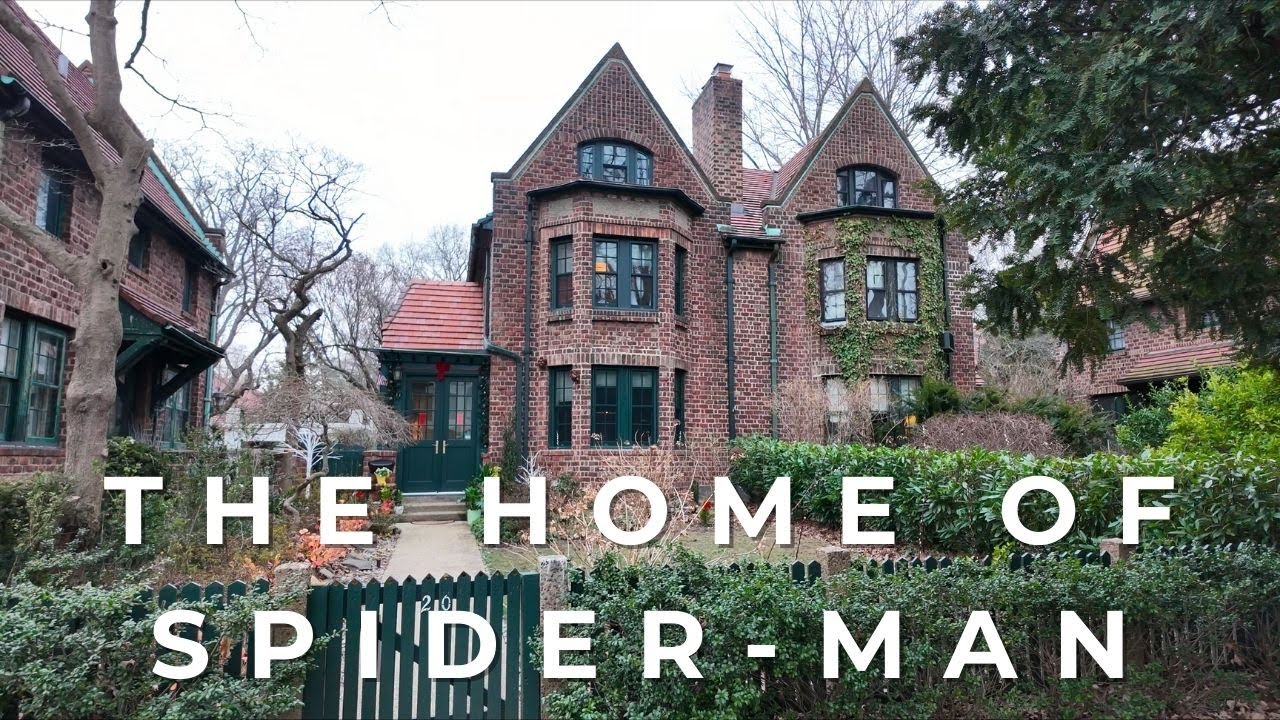
Where most superheroes live in some vague city centre, Peter Parker has a named neighbourhood, findable on a map, with its suburban streets and its brick terraced houses. Forest Hills genuinely exists, in the heart of Queens, and is nothing like a fictional set.
The Parker house holds a place of its own. It is not a lair, nor a mansion, nor a secret laboratory. It is a modest family home, with a bedroom upstairs, a kitchen where the bills get discussed, and a porch. Few superheroes have a home this ordinary, and that is precisely what the place is for.
This house is also the stage for the two most painful events in the series. It is the house Uncle Ben walks out of on the night of his death, as we recounted in our account of how he died, and it is where the drama of Aunt May's death in Back in Black plays out later on. The home is not a neutral backdrop: it is where the character takes the blows.

Why Queens, and not Manhattan
In the early 1960s, comic-book heroes lived in smart districts or secret bases. Putting a teenager in an outer borough was a break with the rules. Queens is the New York of office workers, small shopkeepers and families who take the subway to work.
The intention is easy to read: make the character reachable. A fifteen-year-old reader does not picture himself in a Manhattan tower. He pictures a cluttered bedroom, an aunt who worries, a secondary school where you get pushed around. That geographical choice is the first act of the Spider-Man formula, before the powers even.
The visual construction of the neighbourhood owes a great deal to the artwork of the early years, and we set out the share of it that belongs to Steve Ditko in the visual architecture of the character: narrow alleys, fire escapes, cramped interiors. A New York seen from below, not from above.

Spider-Man Poster – Retro Comics
The graphic register of the years when Forest Hills was invented. The Queens of the origins, before cinema got hold of it.
See the product — 22,90 €A geography that constrains the hero
The detail few people pick up on: you cannot swing through Queens. Spider-Man's webs need anchor points that are high and close together. Forest Hills is a neighbourhood of two-storey houses, with gardens and wide streets. Nothing to hook on to.
So the character is reduced to running, leaping from roof to roof at ridiculous heights, or taking public transport like everyone else. Recent films have turned it into a running joke, but the constraint is an old one and it tells you something: Spider-Man is only spectacular once he reaches Manhattan. At home, he is on foot.
Cross the East River, on the other hand, and the city becomes a playground. Bridges play a pivotal part in that switch, and the most symbolically loaded of them is the one we covered in our article on the Brooklyn Bridge. A bridge is not only scenery: it is the border between the character's two lives.
The daily commute: Queens, Midtown, Manhattan
Peter Parker's life is organised around one axis. He sleeps in Forest Hills, studies at Midtown High, and works or goes into action in Manhattan. Three places, three identities, and journeys between them that take time.
That travelling time is a constant narrative device. It explains the lateness, the missed lessons, the failed dates, the moments when the hero turns up too late. A character living above his own place of action would not have those problems. Distance, for Spider-Man, is an opponent.
It also explains the character's chronic money trouble. Between rent, the subway and odd jobs, the question of money keeps coming back — a thread we followed through every job he has ever had, from freelance photographer to company boss.

Canvas Print Poster – Neon Spider-Man
The city at night, the one Peter crosses on his way home. Canvas format, to hang above a desk.
See the product — 24,90 €Two New Yorks in the same story
Queens and Manhattan are not simply two places, they are two registers. Manhattan is the city of institutions, head offices, billionaires and world-scale threats. Queens is the city of neighbours, corner shops and end-of-the-month worries.
Spider-Man moves between the two, and that is what sets him apart. He fights cosmic threats by day and comes home at night to a house where you have to watch the heating. That swing produces the tension that has defined the character for sixty years.
The Daily Bugle sits firmly on the Manhattan side — the media institution that judges without knowing, whose workings we showed through the figure of the journalist Ben Urich. The gap between the neighbourhood Peter comes from and the newsroom that smears him is one of the most durable engines in the series.
When cinema finally filmed Queens
Adaptations glossed over that geography for a long time. The films of the 2000s and 2010s played out overwhelmingly in Manhattan, with tall facades and non-stop swinging. The original neighbourhood was cut down to a handful of shots.
It took until 2017 for a film to take the subject on and turn it into a staging principle, with a hero running through gardens for want of buildings. We set out that choice in our re-reading of Homecoming, where the scale of the neighbourhood shapes the whole film, right down to its antagonist — the owner of a demolition firm who belongs to the same New York as Peter.
That geographical faithfulness has a direct effect on the character's credibility. A Spider-Man who never leaves Manhattan becomes a postcard hero. A Spider-Man who takes the subway home stays a teenager from Queens with a secret.
Video games followed the same path, a little later. The early titles made do with a generic Manhattan, an ideal swinging ground but an interchangeable one. Recent productions have widened the map to the outer boroughs, precisely because players were asking for the neighbourhoods that make the character rather than the postcard.
That shift says something broader about the maturity of the myth. For a long time, adapting Spider-Man meant filming skyscrapers. Today, the best adaptations begin by filming a suburban street, an elevated subway line and a state secondary school — and only then do they allow themselves the skyline.

Spider-Man Poster – Miles Morales Graffiti
The other borough, the other Spider-Man: Brooklyn answers Queens, in an unapologetically urban register.
See the product — 22,90 €Brooklyn, the other borough
Queens does not have a monopoly. Miles Morales comes from Brooklyn, and that shift of a few kilometres is anything but trivial. Every Spider-Man carries his borough with him, with its architecture, its visual culture and its people.
This logic of territory has become a writing principle: instead of duplicating a hero, you attach him to a different neighbourhood, and the character changes along with it. That is what lets several Spider-Men coexist in the same city without blurring into one another.
It also explains why recent animated productions have pushed the artwork on the boroughs so far: the setting does not illustrate the character, it defines him. To place each version in its film, the overview of the films and the universes is there to help you find your way.
The neighbours as a plot engine
A neighbourhood of houses produces something an anonymous block of flats does not: neighbours. And in this series, the neighbours are not set dressing. The most important meeting in Peter Parker's love life comes from exactly there.
Anna Watson, a friend and neighbour of Aunt May, spends months insisting on introducing Peter to her niece. The teenager flees that arranged date with the energy of despair, convinced that a disaster is being forced on him. The niece is called Mary Jane Watson, and the scene of their meeting has become one of the most famous in all of American comics.
That device is unthinkable anywhere else. It assumes two neighbouring houses, two women who take tea together, and a little local family pressure. Manhattan does not offer that arrangement; Forest Hills does. The central romance of the series was born of an urban layout.
The same mechanism works in reverse. A hero who lives surrounded by neighbours cannot come home in costume, or leave by the front door, or explain away his absences. Every constraint of the secret follows from the social density of the neighbourhood. Where other heroes have a private lift, Peter has to keep an eye on the windows across the street.
The address readers have been hunting for decades
The geographical precision of the story has fed a small obsession among readers: finding the house. One address comes up regularly in discussions and on certain pages — Ingram Street, a street that really does exist in Forest Hills. Successive editions have kept the vagueness going rather than clearing it up, and that is probably for the best.
The real neighbourhood looks nothing like the cliché of working-class Queens. Forest Hills is home to Forest Hills Gardens, a residential development designed in the early twentieth century on the model of the English garden cities, with curving streets and houses in brick and mock timber. There is also a tennis club there that hosted the major American tournament for many years before it moved.
In other words, the chosen neighbourhood is neither a ghetto nor an anonymous estate: it is a decent residential suburb, where a modest family can own a house without being rich. That is exactly the social setting the character needed — comfortable enough to be ordinary, tight enough that every expense counts.
That balance explains a good part of readers' attachment. A hero who is too poor tips into misery and you stop believing he pays his bills; a hero who is too comfortable loses every everyday stake. Forest Hills has held the middle line for sixty years, and no writer has ever needed to correct it.
The real Queens: the most diverse borough in New York
There is a deeper reason why this anchoring has aged so well. Queens is, by a comfortable margin, the most diverse borough in the city: dozens of languages are spoken there, and no single community truly dominates. It is the New York of recent arrivals and of journeys still in progress.
A masked hero takes on a particular resonance in a setting like that. Under the costume, he could be anyone — and in Queens, that 'anyone' covers a demographic reality, not a slogan. This trait of the character, often phrased as an abstract principle, was first of all a geographical fact.
It is also what made it possible for other people to take up the mask without the formula buckling. A Spider-Man from Brooklyn, a Spider-Man from somewhere else: the logic of the neighbourhood welcomes variation instead of suffering it. Few heroes have a principle this extensible, and it rests entirely on the starting address.
An anchor that has survived every reboot
The series has been through resets, dozens of changes of writer, annulled marriages, deaths and returns. Almost everything has moved. The neighbourhood has never been renegotiated. No reboot has moved Peter Parker to Manhattan or Los Angeles.
That stability is telling. The elements you do not touch are the ones the formula depends on. If Peter lived in a loft, his money would need explaining. If he lived in Manhattan, he would lose his journeys and his distance. If he lived in a mansion, he would stop being the ordinary reader's hero.
The weakest adaptations are precisely the ones that forget it: as soon as the character becomes a city-centre resident with high-tech kit, something goes wrong. Conversely, every time a story comes back to the house, the subway and the end of the month, it finds its footing again straight away. The neighbourhood is not a continuity detail, it is a device.
What the address says about the character
Reducing Spider-Man to New York misses the point. What makes him particular is not the city, it is that he occupies its edge. He is neither a city-centre hero nor a vigilante of the underworld: he is a kid from a residential neighbourhood who goes into town to work.
Every trait he is credited with follows from that. The precariousness, because Queens is not Park Avenue. The ordinariness, because you have neighbours there. The humility, because you come home at night to a house that impresses nobody. And the double life, because you have to cross a bridge to go and save the world. For the man behind the mask, the full portrait of Peter Parker takes the subject further.
If you want to bring that New York into your home, the Spider-Man posters and the Spider-Man decorations cover both the comics register and the city at night, while the figurines, the T-shirts and the Spider-Man masks complete the set. Queens has no skyline, but it produced the most popular hero in New York.

