
14-Day Money-Back Guarantee
0
The short answer
Dmitri Smerdyakov, dreamt up by Stan Lee and Steve Ditko, opens the gallery of Spider-Man’s adversaries: he attacks through stolen identity rather than brute force. Half-brother to Kraven the Hunter, he would later join the Sinister Six. His infiltration methods are set out below.
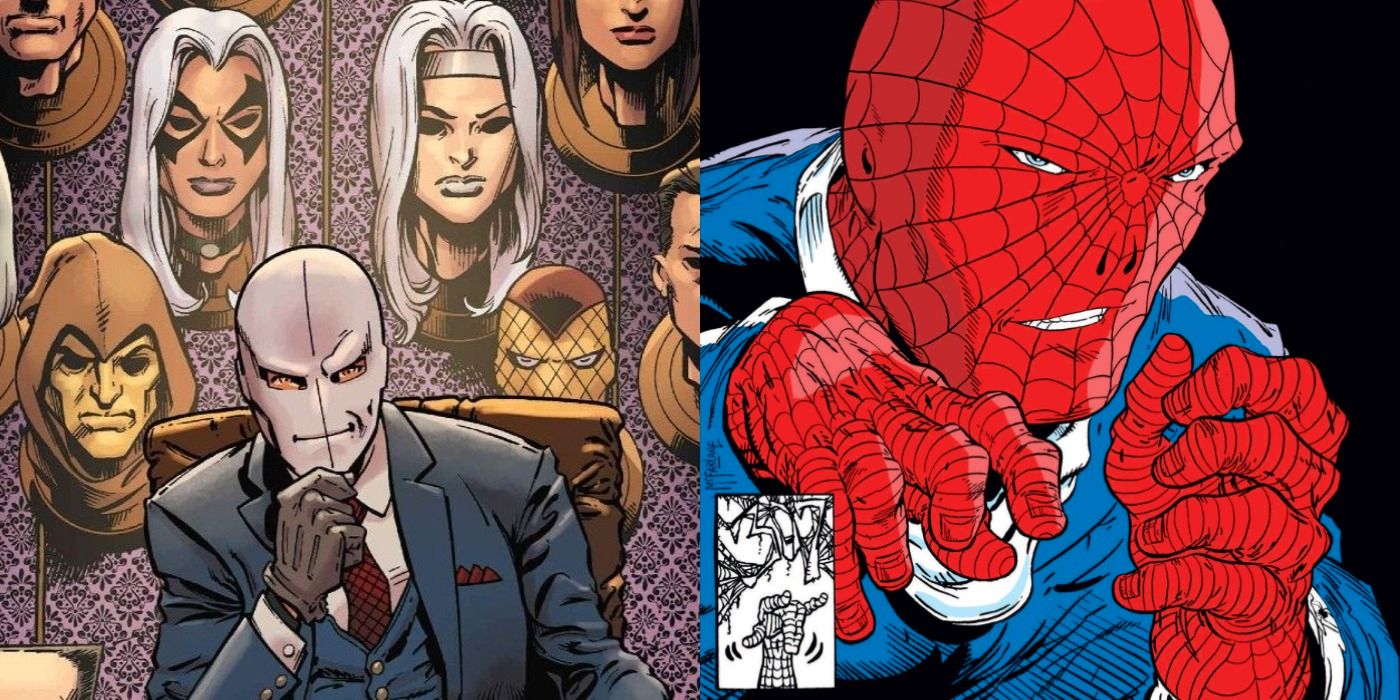
Before Venom, before the Green Goblin, before even Vulture… one single name stood against Spider-Man from the very first issue of his series: the Chameleon. First appearing in Amazing Spider-Man #1 (1963), this master of disguise marks the birth of the iconic clashes between Peter Parker and the super-villains of the Marvel Universe.
And yet, despite his pioneering role, the Chameleon remains a character the wider public often forgets. Hardly spectacular at first glance, he nonetheless embodies themes that run deep through Spider-Man’s world: identity, duplicity, betrayal.
🧠 In this article we are giving the Chameleon back the place he deserves in the gallery of Spider-Man’s greatest enemies, exploring his first appearance, his narrative evolution, his infiltration methods and his place in modern adaptations.
A faceless enemy, right from issue one
Created by Stan Lee and Steve Ditko, the Chameleon — real name Dmitri Smerdyakov — makes his debut in the very first issue of Amazing Spider-Man, published in March 1963. From that opening confrontation he stands apart with an approach nobody had seen before: no brute force, but a flawless disguise and a sophisticated plan of manipulation.
In that founding episode he tries to trap Spider-Man by stealing his identity in order to make off with military secrets. The choice is a symbolic one: the first obstacle Peter Parker faces is not a monster or a mad scientist, but a treacherous double, a man who steals his very image.
👉 This game of mirrors sits at the heart of Spider-Man’s mythology, as we see again later with the symbiote or with the Spider-Verse variants.
🎭 The Chameleon wears no recognisable mask and no flashy costume: his power lies in his ability to have no face at all. A bold choice for a first antagonist, and one that says a great deal about the depth Stan Lee wanted to give his young hero.
A hidden link with Kraven the Hunter

Few people know it, but the Chameleon is in fact the half-brother of Kraven the Hunter. That family tie would only be revealed far later in the comics, adding a tragic dimension to Dmitri’s story: raised in the shadows, jealous of Kraven’s charisma and success, he forges an identity out of deception and solitude.
💥 That family bond brings him thematically close to Spider-Man, who also has to face family, loss and moral choices. You find the same complexity in other enemies such as Kingpin or Vulture, who are not simply ‘bad guys’ but men carrying deep wounds.
🕷️ In Part 2 we tackle the Chameleon’s evolution through the comics, his alliances with other villains and his most dangerous manipulations of Peter Parker.
The Chameleon in the comics: the evolution of a silent enemy
After his first appearance in Amazing Spider-Man #1, the Chameleon has made countless returns — often discreet, always memorable. He is the perfect embodiment of a background threat: the kind that never strikes head-on, but infiltrates, manipulates and destabilises.
A master of infiltration among Marvel villains
Through the 1980s and 1990s, Dmitri Smerdyakov grows far more complex. He no longer settles for looking like his targets: he studies their speech, their psychology, their network. Thanks to nanomasks and vocal implants, he becomes almost undetectable, even to the most seasoned superheroes.
One after another he infiltrates the Avengers, the secret services of SHIELD, and even the Daily Bugle, where he tries to get to Peter by posing as a work colleague. It is a psychological approach you also find in adversaries such as Mysterio or Shocker, but here it is pushed to its absolute peak.
Ally or traitor? His role in the Sinister Six
The Chameleon is also one of the founding members of several versions of the Sinister Six, the legendary team of Spider-Man enemies led by Doctor Octopus. His role in the group stays ambiguous, though: often seen as its least ‘physical’ member, he makes up for it by bringing a strategy of infiltration and disinformation.
🧠 For example, in the “Return of the Sinister Six” arc he supplies his team-mates with false identities so they can slip under SHIELD’s radar. That talent for sowing doubt makes him an indispensable link in the villains’ ecosystem.
👉 Want to explore this cult team? Read our full article on the Sinister Six and their most powerful members.
An obsession with Peter Parker
What makes the Chameleon so dangerous is not that he attacks Spider-Man, but that he attacks Peter Parker. In many arcs he is not trying to rule the world, but to dismantle the man behind the mask.
In the “Origin of the Species” arc he goes as far as kidnapping a baby connected to Peter in order to trigger an extreme psychological reaction. In “The Gauntlet”, he fakes the death of Peter Parker himself… and takes his place.
These unsettling moments are a reminder that, long before physical threats like Rhino or Carnage, it is Peter’s identity that is the Chameleon’s number one target.
📌 In Part 3 we step into the modern era: the Chameleon facing new technology, his role in video games and animated series… and why he could soon be back on the big screen.
The Chameleon in the modern era: technology, adaptation and rebirth

As the threats of the Marvel universe evolve, the Chameleon has known how to adapt his methods. In the most recent stories he drops the handmade disguises for cutting-edge technology: nanomasks, retinal implants, voice deepfakes… A modernisation that makes him a more credible opponent than ever.
A spy in the age of AI and cyber-control
The latest versions of the character show him as a genuine master of the digital world. He is able to:
- steal and alter biometric identities;
- create fake videos of Spider-Man to discredit him with the public;
- infiltrate the security systems of Stark Industries or Oscorp;
- pass himself off as figures of authority — police officers, head teachers, journalists.
👉 In a world where digital identity is an extension of the self, the Chameleon becomes an even more topical threat, sitting at the crossroads of espionage, mass manipulation and psychological power.
The Chameleon in video games and cartoons
Although he is often pushed into the background in modern adaptations, Dmitri has still left his mark on several generations of fans:
- 1994 animated series: the Chameleon appears in several episodes, using holographic projectors to transform at will.
- Spectacular Spider-Man (2008): he plays a more serious, more unsettling role, manipulating the heroes from the shadows.
- Marvel’s Spider-Man video game (PS4): although he never physically appears, several audio files and pieces of lore suggest he may have infiltrated some of the story’s NPCs.
A serious candidate for a big-screen adaptation?
With Marvel Studios keen to go back to more down-to-earth films centred on New York and Peter Parker’s identity (as in Spider-Man 4: Brand New Day), the Chameleon would be a formidably coherent choice.
His strengths make him an ideal villain for a realistic, psychological plot:
- no need for massive special effects;
- a confrontation built on tension, intimacy and manipulation;
- a powerful parallel with Peter Parker, himself a master of the mask;
- the chance to tie the Chameleon to Kraven, whose own adaptation is already planned.
🕷️ In the final part we look back at the thematic legacy of the Chameleon in the Marvel universe, and at the best products and comics for rediscovering this far too underrated villain.
The Chameleon’s legacy: the enemy who attacks identity
The Chameleon may not be the most spectacular of Spider-Man’s enemies, but he is arguably one of the most symbolic. His power is not to destroy the city, but to destroy the sense of self. He constantly calls into question what it means to be Peter Parker… or even to be human.
In a world where digital doubles, fake identities and mass manipulation have become everyday realities, Dmitri Smerdyakov is more relevant than ever. He embodies that quiet fear that our own image might slip out of our hands.
Why this villain deserves a second look
- ✅ Because he was the web-slinger’s very first opponent, in Amazing Spider-Man #1.
- ✅ Because he offers a mature, psychological reading of the hero/villain conflict.
- ✅ Because he could play a central role in a future Spider-Man film that is more realistic and more urban.
How to bring this multiple identity into your collection
Fancy bringing the Chameleon into your Spider-Man world at home? Here are a few ideas from our collections:
- Spider-Man action figures: some come with accessories or alternative faces, a direct nod to the Chameleon’s style.
- Spider-Man masks: to explore the idea of the masked identity… and why not build your own Chameleon cosplay.
- Spider-Man T-shirts: show your support for the web-slinger’s very first villain with our retro designs.
Conclusion: a villain to watch… from the shadows
The Chameleon does not shout. He does not smash through walls. He slides, silent, into the cracks in trust and identity. And that is precisely what makes him so fascinating. In a Marvel universe packed with monsters and gods, he reminds us that the most dangerous enemy is sometimes the one who looks most like you.
Boutique-Spiderman.fr keeps helping you rediscover the key characters of the Spider-Man universe with passion, precision and depth. Stay tuned for our next features on the forgotten greats of the Spider-Verse.

