

14-Day Money-Back Guarantee
0
The short answer
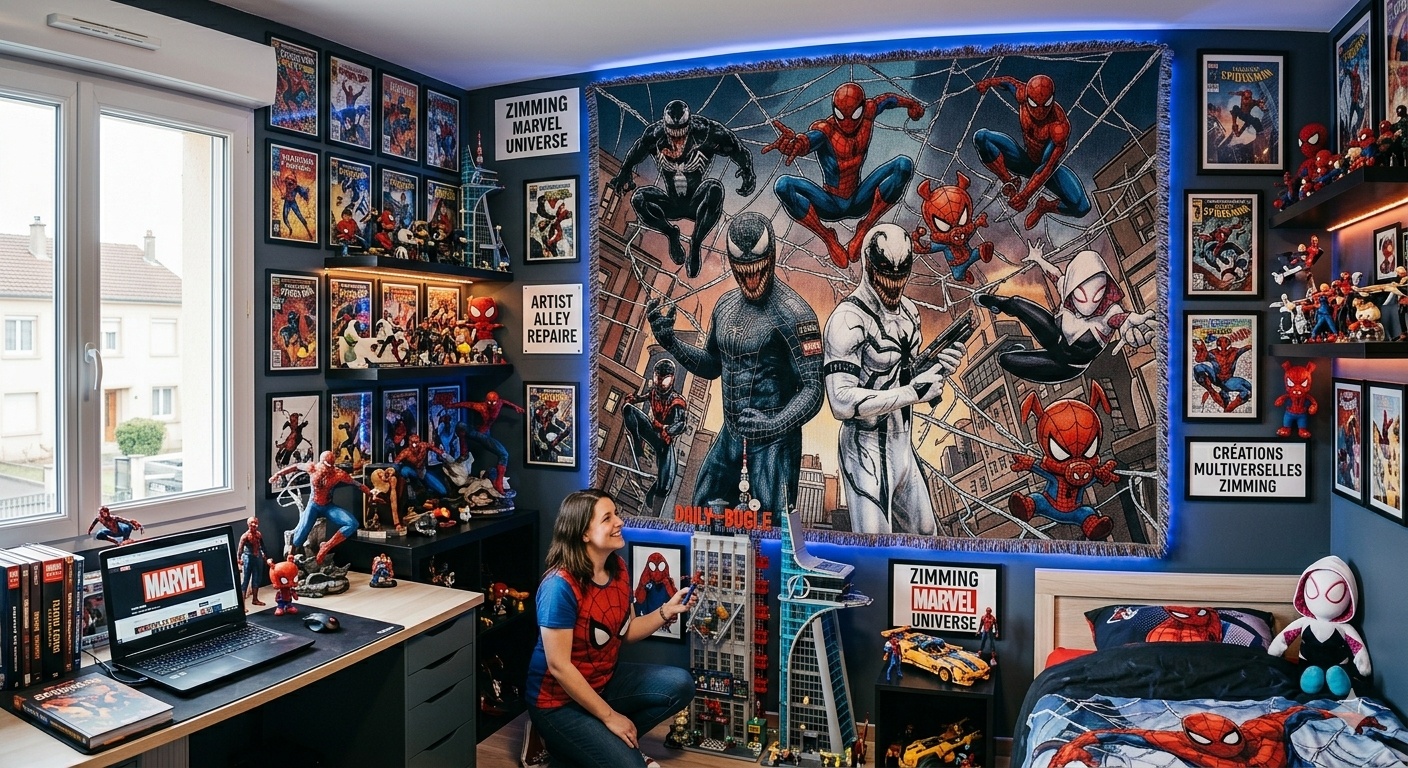
A large wall textile, in formats reaching 150 by 130 cm, gives the decor an anchor point that scattered posters never create: the fabric softens reflections and dampens sound reverberation. Comics, multiverse or minimalist designs: we break down the criteria below.
There is a moment, when decorating a Spider-Man bedroom, when you feel that something is missing without quite being able to put your finger on it. The posters are up above the desk, the duvet cover dresses the bed perfectly, the lamp casts a red and blue glow at dusk, and yet the room still feels empty somewhere. That emptiness is the walls. Three square metres of bland beige behind the desk, two metres of white above the bed, and all the magic of the web-slinger stopping halfway up. That is exactly where the tapestry comes in, as a centrepiece able to tip a nicely decorated child's bedroom into an immersive superhero lair.
A Spider-Man tapestry is not simply a bigger poster. Nor is it a substitute for the gallery wall made up of several prints. It is a textile object in its own right, and its dimensions, its material and its visual effect produce something no other item in the bedroom can imitate: the feeling of stepping into a continuous universe rather than looking at a fixed image. This guide explores how to choose that wall textile - the right version of the web-slinger, the right size, the right installation and the right fit with the rest of the decor - so that it becomes the visual signature of the room, and not one more addition to an already crowded pile.
Why the tapestry is the forgotten weapon of a proper Spider-Man bedroom
In most themed bedrooms parents put together for their children, the instinct is to multiply small objects: figures on the shelf, posters pinned above the bed, cushions scattered about, a blanket folded at the foot of the mattress. Every piece is right, but the eye bounces around without finding an anchor. The tapestry reverses that logic. It takes up a single wall of the bedroom, but it takes it up massively, sometimes across 150 by 130 centimetres or more, and it finally gives everything else a frame. The poster looks more deliberate, the blanket laid on the bed speaks to a coherent visual world, and the room gains depth without needing three more objects added to it.
The second advantage is subtler but just as decisive: the material. Unlike a paper print that reflects light harshly, fabric absorbs part of the lighting and gives it back softly. In the evening, when the Spider-Man night light gives off its muted glow, the tapestry does not shine like a mirror: it comes alive. The reds deepen, the blues take on a shade close to the web-slinger's original costume in the comics, and the whole wall breathes. For a child's bedroom that alternates between bright daylight and a hushed bedtime mood, this behaviour of the material matters enormously. It is what separates a prettily decorated bedroom from a genuinely immersive one.
There is, finally, an acoustic dimension that many parents discover after installation. A large panel of fabric stretched against a wall slightly dampens sound, softens echoes and makes the room calmer. In a child's or teenager's bedroom where video games, late-night episodes and phone conversations follow one another, that gain in acoustic comfort is far from trivial. Where a Spider-Man rug handles the resonance of footsteps, the tapestry handles the reverberation of voices and media. The two work in tandem, and together they transform a bedroom's acoustics almost as much as its decor.
The different designs: choosing the version of the web-slinger that will speak to your child
Choosing a Spider-Man tapestry never comes down to picking the one that photographs best. Every design points to a different version of the character, to a precise era of his history, and to an imaginative world that will not touch every child or every teenager in the same way. A seven-year-old discovering Spider-Man through the animated series does not relate to the costume the way a teenager obsessively replaying Marvel's Spider-Man 2 on PS5 does. That nuance is what you need to respect for the wall centrepiece to work over the long run.
The first big family is the classic comics designs. Here you will find the original red and blue costume colours, the iconic poses of the web-slinger between two skyscrapers, sometimes a panel styled like a comic-book speech bubble. These tapestries point straight back to the founding universe of Stan Lee and work particularly well in a bedroom where the child already reads the albums or takes an interest in the character's origin story in the comics. For a long-standing fan, or for a parent who wants to pass on the version they knew themselves as a child, it is the truest choice. The Amazing Spider-Man design in particular echoes the most recognisable narrative arc of the franchise.
The second family revolves around the Spider-Verse and the multiverse. These are the most visually explosive designs: neon colours, graphic layering effects, several versions of the web-slinger sharing the same piece of fabric. A tapestry drawn from the Into the Spider-Verse or Across the Spider-Verse aesthetic immediately imposes a pop, almost street-art mood that suits pre-teens and teenagers perfectly. It is also the design that speaks best to the Miles Morales culture, which since 2018 has become the favourite way in to the character for younger fans. If the bedroom already features elements inspired by the animated film, a Spider-Verse tapestry becomes a natural extension.
The third family is the symbolic and minimalist designs. These are tapestries built around a single strong graphic element: a logo blown up to wall scale, a silhouette of Spider-Man mid-swing, or the famous line 'with great power comes great responsibility' set in typography. These designs age better than highly detailed illustrations. A fifteen-year-old who tires of things quickly can keep a discreet tapestry for a long time, because it acts as a nod rather than a declaration. For a bedroom shared between two children of different ages, or for a room that has to follow the child into adolescence without being redone every two years, this kind of understated design is often the most strategic.
WALL DECOR - SPIDER-VERSE

Spider-Man Into The Spider verse Tapestry
29.90 EUR
The whole bedroom wall becomes a window onto the multiverse. Neon colours, animated motifs, street-art aesthetics: the centrepiece for fans of the animated film.
Discover itSize and dimensions: fitting the tapestry to the room
Size is probably the worst-judged decision when buying a tapestry. Many parents order while looking at the product photo without picturing what 150 by 130 centimetres of fabric actually takes up on a wall. To avoid that mistake, the habit to adopt is simple: before buying anything, measure the width and the height of the target wall, subtract twenty centimetres of margin top and bottom, and aim for a tapestry whose width does not exceed 70 to 80 per cent of the wall. A tapestry that is too small looks lost in the space; one that is too big spills over the adjacent furniture and smothers the room instead of structuring it.
For a standard child's bedroom of 9 to 12 square metres, a size around 150 by 100 centimetres remains the most versatile. It works just as well behind the bed, where it plays the part of a decorative headboard, as above the desk, where it turns an ordinary workspace into the web-slinger's HQ. For a more generous bedroom, from 14 square metres upwards or with a high ceiling, you can aim for more imposing sizes. Beyond that, the fabric starts to call for a more technical wall fixing, and it is better to anticipate that before buying rather than discovering it in front of the wall with the tapestry in your hands.
Orientation is the other parameter to settle. Vertical and horizontal designs do not produce the same psychological effect on a child. A Spider-Man diving or climbing, presented in portrait format, creates an upward dynamic that visually enlarges the room and works particularly well above a low bed. A Spider-Verse design stretched into landscape format dresses long walls better and gives a cinematic impression, almost as if the room housed a large-format film poster. If the bedroom already has a Spider-Man rug on the floor oriented one way, choosing a tapestry that continues that line rather than contradicting it immediately reinforces the coherence of the whole.
Installation: hanging a tapestry without damaging the wall
There are three main ways to fix a tapestry, and the choice depends as much on the wall as on the freedom you want to keep to move it later. The first solution, the most common, is to use a wooden or metal rod slipped into a hem at the top of the tapestry, then hung from two screwed hooks or two discreet nails. It is the method that gives the finest result, because it lets the fabric hang naturally and allows it to ripple slightly. It is, on the other hand, the one that requires drilling the wall, which can be a problem in rented accommodation.
The second method uses reinforced adhesive strips of the hook-and-loop wall type. It drills nothing, supports reasonable loads - always check the maximum weight stated on the pack - and lets you take the tapestry down after several years without leaving a mark. The only drawback is that it presses the fabric flat against the wall, which removes a little of the 'wave' effect that gives a hung tapestry so much character. For a rented flat or a bedroom you plan to redo in two years, it is nonetheless the most pragmatic solution.
The third solution, more creative, is to fix the tapestry onto a light wooden frame, like a giant stretched canvas. It is the approach closest to a large framed gallery-format poster, but with the richness of fabric as a bonus. It takes a little DIY, sometimes the help of a parent or an older brother, but it produces a very clean, almost museum-like result. For a slightly more mature teenager's bedroom, where you want to avoid the 'taped-up poster' effect, this method radically changes the visual status of the tapestry. It becomes a work rather than an accessory.
Whichever fixing method you choose, the non-negotiable rule is to test the result before fixing anything permanently. A tapestry is not ordered, hung and then left there for the rest of the year: you unroll it on the floor, hold it against the target wall with two people for several minutes, step back, look at it under different lighting - daylight, main light on, night light - and only then do you decide on the final height. That half-hour of testing saves weeks of frustrated glances at a wall where the tapestry sits five centimetres too low or off the axis of the bed.
WALL DECOR - SPIDER-SENSE

Spider-Man Spidersense Tapestry
29.90 EUR
The rippling sense motif that vibrates the moment the room lights up. A nod to the fans who have known the web-slinger's graphic signature since childhood.
Discover itPairing the tapestry with the other decor pieces in the bedroom
A Spider-Man tapestry that works is never an isolated tapestry. It is a tapestry that talks to the other pieces already in the room. The classic trap is to stack up every version of the web-slinger: a Spider-Verse duvet cover, an Amazing tapestry, a Tobey Maguire poster, a Miles Morales lamp, a logo blanket. The result is a patchwork that tires the eye and paradoxically gives each piece less impact. The simple rule to apply is the pivot rule: a single element tells the dominant story, the others serve it.
In most well-balanced bedrooms, it is the tapestry that takes on this pivot role, because it occupies the largest visual surface. Everything else - duvet cover, blanket, cushions, lamp - then adopts a palette that extends the tapestry's rather than contradicting it. If the tapestry is dominated by classic red and blue, avoid adding a duvet cover in fluorescent Spider-Verse colours. If the tapestry leans towards Spider-Verse neon, banish pieces in tones that are too soft and will look dull by comparison. It is this work of chromatic coherence that tips a bedroom from an accumulation into real staging.
Hanging height also plays a subtle role. A tapestry hung too low, at an adult's eye level, crushes the bedroom and visually signals a lack of thought. Hung too high, it loses its impact because the child cannot see it in full from the bed or the desk. The ideal height, in 90 per cent of cases, is the one where the centre of the tapestry sits roughly 145 to 155 centimetres off the floor - that is, at eye level for a child sitting on the bed or standing up playing. It is also the height that aligns the bottom of the tapestry with the top of the headboard or the desk, creating visual continuity between furniture and wall.
For bedrooms that are already very busy, where decor pieces have piled up over the years, the strategy is the opposite: you hang the tapestry first, step back, look, and then take down everything that no longer has a place. It is often at that moment that you realise two or three secondary posters are now doing the room a disservice. Putting them away or moving them to another room of the house immediately gives the tapestry the mental space it deserves. A Spider-Man bedroom is not the bedroom with the most Spider-Man in it: it is the bedroom where every Spider-Man element counts.
Care and longevity: keeping the tapestry alive for years
The second hidden advantage of a fabric tapestry over a paper poster is how it holds up over time. A poster yellows, buckles in damp air and loses its colours in direct sunlight within two or three years. A tapestry in thick polyester or a polyester-cotton blend can follow a child into adolescence provided you keep a few care habits. The first is to avoid prolonged exposure to direct sunlight, which means not hanging it facing a south-facing window without a filtering curtain. As with a Spider-Man duvet cover whose colours have to survive many washes, the sun remains enemy number one of a design's vibrancy.
The second habit is to dust the tapestry every two to three months. A pass with an electrostatic duster or a low-power vacuum with a soft brush head is enough to lift the fine layer of dust that gradually dulls the colours. Once a year, hand-washing in lukewarm water with a neutral detergent - or a 30-degree wool cycle in the machine for tapestries whose label allows it - brings the fabric's brightness back. Above all, never tumble-dry a tapestry: it shrinks the fibres and distorts the design. Laid flat on a sheet in a ventilated room, it regains its original shape overnight.
The last point about longevity concerns storage. If the bedroom is rethought, when moving house for example or during a big decor change in the teenage years, the tapestry can be rolled - never folded - in a breathable cotton cover and stored flat in a cupboard. It will come out intact five or ten years later, and can then become the centrepiece of a bedroom for a younger sibling or a cousin, or simply remain a keepsake of a childhood devoted to the web-slinger. This idea of passing it on is probably the finest quality of the tapestry: it ages with its owner instead of going out of date in two seasons.
WALL DECOR - AMAZING

The Amazing Spider-Man Tapestry
29.90 EUR
The classic red and blue design, faithful to the original comics. The safe choice to cross the ages without ever dating. A piece that gets handed down.
Discover itMatching the tapestry to age and to changing taste
The mistake most parents make is choosing the tapestry for the child's current age without projecting three years ahead. A five-year-old loves bright colours and cartoonish designs, but at eight or nine they often start to find their old decor 'too babyish'. A twelve-year-old pre-teen wants something more stylised, closer to street-art codes than to Sunday-morning cartoons. If the tapestry is not chosen with that evolution in mind, it will end up folded away in a cupboard three years after it was bought.
The practical rule is to aim one step above the child's current age. For a six to eight-year-old, choose a classic comics tapestry or a symbolic one rather than a very childish scene; it will see them through the move to nine or ten without a problem. For a ten to twelve-year-old, betting on a Spider-Verse tapestry - visually more grown-up, closer to the aesthetic codes of contemporary animation - will work right up to the start of the teenage years. For a teenager, minimalist designs or photographic illustrations such as the Spider-Man costume from the recent films carry across the years without ever looking dated.
For fans who already know their stuff, a tapestry can even become a way of asserting a specific preference within the vast universe of Spider-Man characters. A tapestry centred on Spider-Gwen in the bedroom of a girl who loves animation, or a Miles Morales tapestry for a child who identifies with the most recent version of the web-slinger, says something about personal taste rather than a generic choice. Those choices are the most lasting, because they are also the most emotionally invested.
Finally, for bedrooms shared between a brother and a sister or between two children of different ages, a shared tapestry with a neutral design - logo, quote, silhouette - often works better than a very specific one. It lets each child keep their own identity in their own small objects (figures, individual posters, blankets) while sharing a common frame that recalls their shared passion for the world of the web-slinger. This idea of a unifying centrepiece applies well beyond children's bedrooms, by the way: in a family games room, in a converted basement, or in the bedroom of a parent who is rather more of a collector than they care to admit.
The tapestry as the finishing touch of a truly Spider-Man bedroom
The moment you hang the tapestry on the wall, something happens that no other decor piece brings about: the bedroom stops being an accumulation of themed objects and becomes a real world. The bed, the desk, the rug and the lamp are no longer juxtaposed items but components of one coherent set. That transformation is what justifies taking the time to choose the design, the size, the installation and the fit with everything else. A few hours of thought up front produce a bedroom that will last several years, against a few minutes of impulse ordering that would produce an object folded away at the back of a cupboard six months later.
To explore the options concretely, the full collection of Spider-Man tapestries brings together all the designs mentioned in this guide - classic comics, Spider-Verse, symbolic, Miles Morales, Spidersense - in sizes suited to British bedrooms. To go further and put together a coherent bedroom, the complete Spider-Man decor collection offers every element that will naturally talk to the tapestry you choose: complementary posters, wall stickers to fill the gaps, matching lamps and rugs. The ideal is still to start from the tapestry as the pivot, then adjust the rest of the room around it, rather than the other way round. That is how you go from a bedroom that is simply decorated to a bedroom you remember years later, because it really did look like what the web-slinger deserved.

