

14-Day Money-Back Guarantee
0
The short answer
Readers follow Spider-Man's visit to Timothy Harrison, a young bedridden fan, to whom he finally takes off his mask. The twist, delivered by the narrator, reveals that the boy has leukaemia and only a few weeks left to live. We unpack its emotional impact below.
Contents
In the Marvel universe, the huge battles, the overpowered villains and the spectacular multiverses usually steal the show. And yet, sometimes a simple human story is all it takes to move readers. 'The Kid Who Collects Spider-Man' is one of those rare stories, published in 1984 in Amazing Spider-Man #248, that stay etched in your memory long after the last panel.
Written by Roger Stern and drawn by Ron Frenz, this short ten-page story involves no supervillain and no cosmic disaster. It simply stages an intimate encounter between Spider-Man and a young boy named Timothy Harrison. And yet many fans consider it one of the most powerful stories in Peter Parker's entire career.
But why has this story, so stripped-back on the surface, marked whole generations? What is its symbolic scope, and what does it tell us about the very essence of Spider-Man as a character? That is what we are going to explore in depth in this article, revisiting the narrative, emotional and symbolic elements of this masterpiece the wider public has largely overlooked.
And if you're a collector or a fan of the web-slinger, you'll surely find a special echo of this story in our collection of Spider-Man figurines or our accessories such as the phone cases or even the keyrings.
An extraordinary meeting between hero and fan
It all starts with an article in the Daily Bugle telling the story of Timothy Harrison, a young boy with an incurable illness whose greatest passion is Spider-Man. He collects everything about him: newspaper articles, photos, cuttings, figurines. He knows his story by heart, admires his fights, and dreams of meeting him one day.
One evening, that dream comes true. Spider-Man visits Tim in his bedroom. There, in a gentle, almost suspended atmosphere, Peter Parker opens up. He talks about his past, the radioactive bite, the loss of his Uncle Ben, and the crushing responsibility that comes with his powers.

What is striking about this story is the simplicity of the storytelling. No chase, no flashy costume, just a human conversation. The man behind the mask shows his face – literally – to a child who embodies everything he keeps fighting for. It's a scene of rare emotional power in Marvel comics.
Reading this sequence, you grasp the full empathy of the character. Spider-Man is not only a hero. He is the symbol of the link between great responsibility and the small moments of a life. It is these moments of vulnerability that feed his human side as much as his legend.
A conversation, not a fight
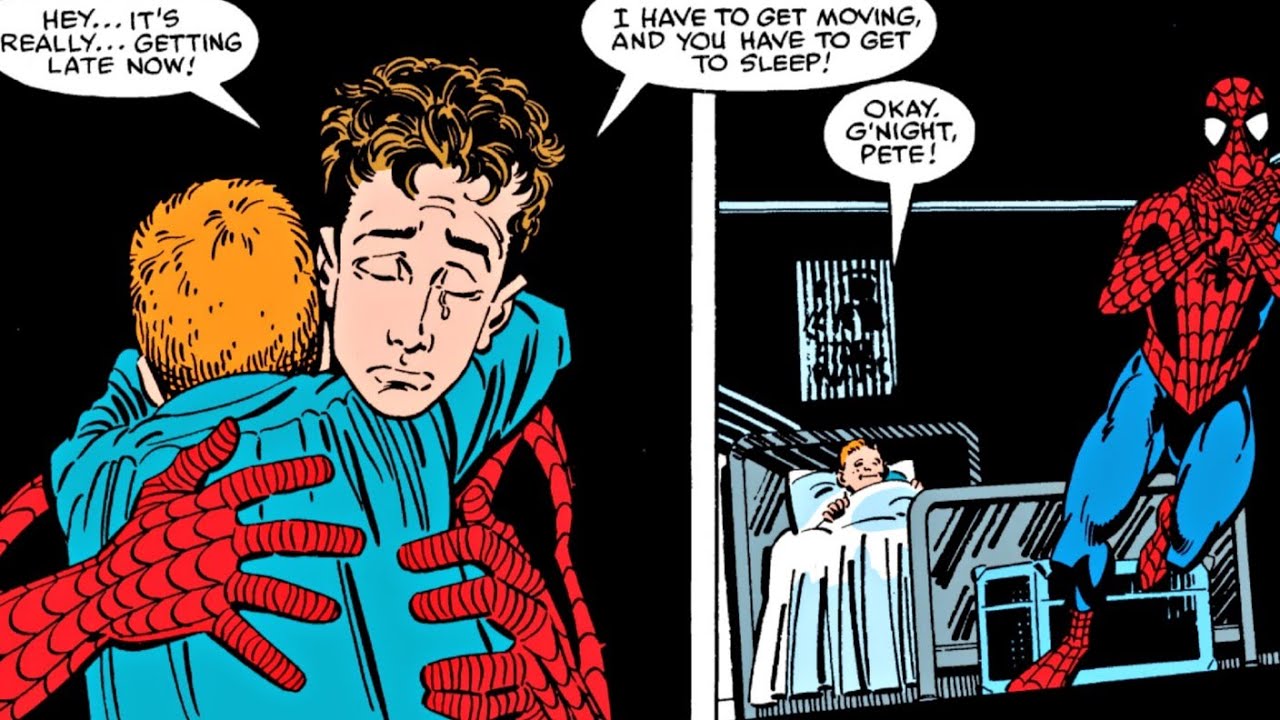
Spider-Man visits Timothy Harrison, a young fan with an incurable illness, and tells him about the radioactive bite, the loss of Uncle Ben and his responsibilities.
A heartbreaking, unforgettable final twist
Throughout this meeting, Peter Parker talks about Spider-Man in the third person, never explicitly revealing his identity. He shares his battles, his fears, his regrets, and above all the loss of Uncle Ben, the founding moment of his calling as a superhero.
But as the visit draws to a close, Spider-Man takes off his mask. He tells Tim that he is Peter Parker. A moment at once intimate, solemn and overwhelming. Peter saves that ultimate confidence for those he respects deeply. And here it is not a superhero he honours, but a dying child who never stopped hoping.

The final twist of the story comes from a single line by the narrator: 'Timothy Harrison has leukaemia. He has only a few weeks to live.'
The shock is brutal. The reader then understands the depth of the scene. This is not a simple meeting between a child and his idol. It is a farewell, a hero's act of recognition towards one of his youngest and most faithful admirers. One last light offered to a boy who won't have time to grow up.
That ending makes this short story one of the most moving ever published in the Spider-Man universe. It goes beyond the frame of the traditional comic and touches the very essence of what it means to be a hero. Not only in the fight against evil, but in the ability to offer hope, compassion and humanity.
This kind of moment resonates deeply with other landmark episodes such as those told on our page devoted to the story arcs, where the most intimate stories often take precedence over the spectacular showdowns.
1
The third-person account Peter talks about Spider-Man without revealing his identity: battles, fears, regrets, the loss of Uncle Ben.
2
The mask removed At the end of the visit, Spider-Man takes off his mask and tells Tim that he is Peter Parker.
3
The narrator's line Timothy Harrison has leukaemia and only a few weeks left to live.
Why this story remains one of Spider-Man's most memorable
In just a few pages, The Kid Who Collects Spider-Man achieves what many whole arcs never manage: capturing the soul of Peter Parker. This story distils everything that gives Spider-Man his emotional power. Here is why it still leaves its mark today:
A rare humanity:
Peter Parker appears more human than ever here, far from the fights against the Green Goblin or Kraven.
A moving face-to-face:
Far from the streets of New York, this is a silent fight: against illness, injustice and fate.
A universal message:
The story reminds us that heroism is not measured only in strength or fame, but in compassion and dignity.
A timeless story:
Published in 1984, it keeps all its emotional power 40 years on.
This one-shot deserves to be read and reread, just like the great Spider-Man narratives.

It is also a superb way into the emotional, deeply human side of the Marvel universe. You understand better why so many fans place this story alongside moments as striking as the death of Gwen Stacy, Back in Black or even Maximum Carnage.
And if you too want to carry that emotion over into real objects, our selection of Fancy Dress or our Masks will let you keep a piece of that magic to hand. If you're short on ideas, take a look at our page devoted to Spider-Man merchandise.

