
14-Day Money-Back Guarantee
0
The short answer
Glimpsed in the Spider-Man: Brand New Day trailer, The Hand is a secret society of Japanese ninjas founded in 1588, corrupted by the Snakeroot clan in the service of a demon, the Beast. Its most fearsome weapon remains resurrection: it raises its own dead. Origins, hierarchy and the Daredevil connection below.
There is one shot, in the trailer for Spider-Man: Brand New Day, that set fan theories ablaze faster than any Marvel logo: a swarm of blood-red silhouettes, blades drawn, descending on an unmasked Peter Parker in the heart of a prison. These ninjas come neither from Spider-Man's own world, nor from the usual New York villains the web-slinger has been facing since 2016. They belong to an organisation far older, far darker, and above all far more closely tied to another Marvel vigilante: Daredevil.
This organisation has a name that is simple and chilling: The Hand, known in French as La Main. An order of mystical ninjas, immortal assassins, manipulators of the shadows who have run through Marvel Comics history for more than forty years. Their appearance in the most anticipated film of 2026 is no mere writer's whim: it marks the arrival of a whole swathe of street-level Marvel on the big screen, and it reshuffles the deck of what Spider-Man will have to face. In this feature we break it all down: where The Hand comes from, why it terrifies, what ties it to Daredevil, and what its presence in Brand New Day signals for what comes next.
Who are The Hand? Portrait of a centuries-old ninja order
The Hand is not just another band of mercenaries. It is a secret society of Japanese ninjas, a brotherhood of assassins born of the shadows whose reputation rests on three pillars: absolute mastery of the martial arts, near-impenetrable secrecy, and a mystical dimension that sets them apart in the whole Marvel universe. Where an ordinary killer makes do with a blade, a member of The Hand draws on centuries of discipline, camouflage and supernatural powers handed down by a demonic entity.
Structurally, The Hand works like a feudal pyramid. The organisation is split into several factions, each led by a clan chief called a chunin. Above those factions reigns a supreme leader, the jonin, who coordinates operations and embodies the order's ultimate authority. This rigid, almost religious hierarchy explains how The Hand has survived across the centuries without ever disappearing: cutting off one head is not enough, another grows back at once in the shadows.
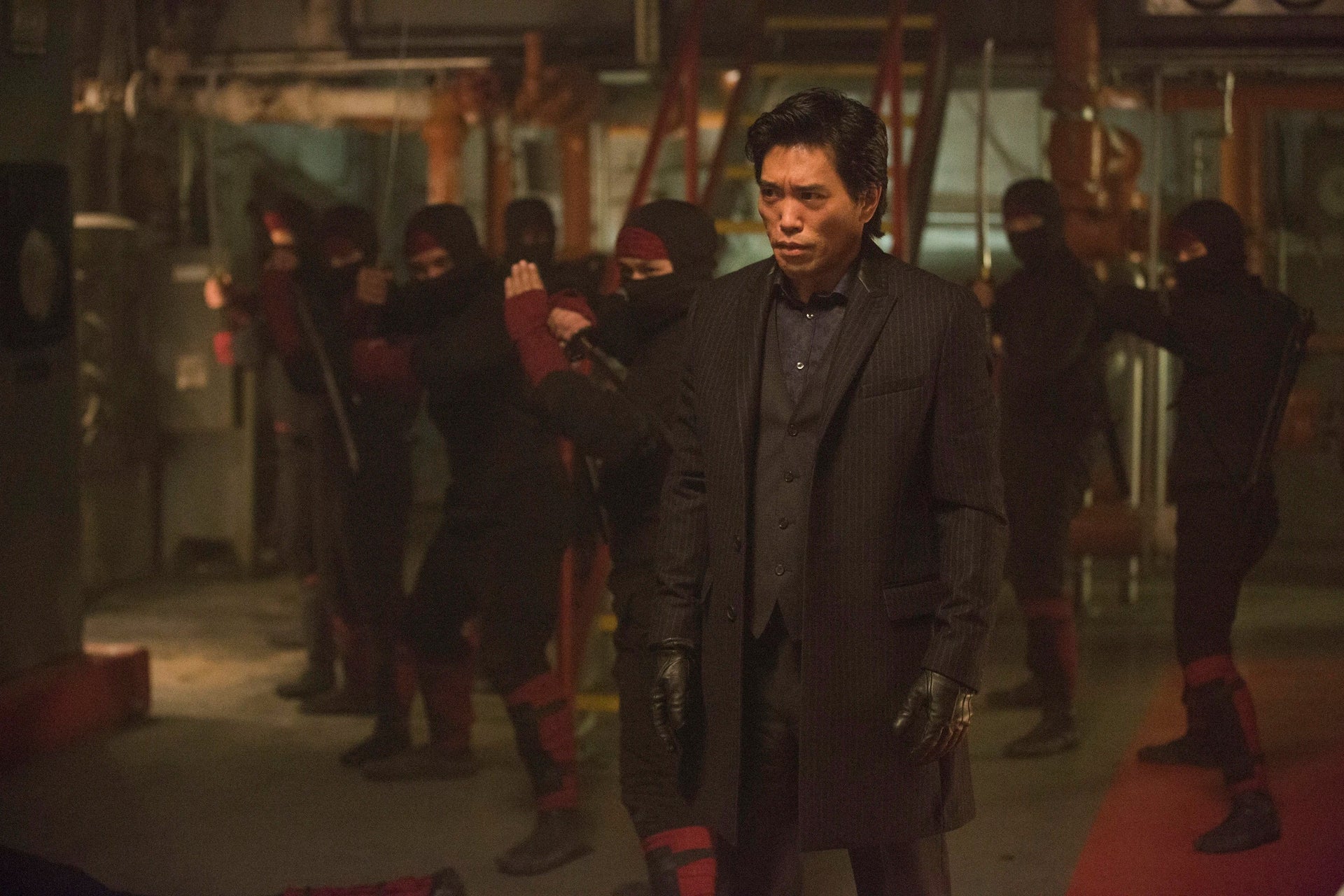
What makes The Hand truly formidable, however, is not its organisation. It is its unspoken creed: death is never final. The ninjas of The Hand can resurrect their own fallen, and sometimes turn the corpses of their enemies into loyal soldiers. To fight The Hand is therefore to fight an army that never truly thins, a red tide that re-forms after every battle lost. It becomes much easier to understand the vertigo a Spider-Man might feel when surrounded by dozens of blades in a prison corridor.
Origins: 1588, Kagenobu Yoshioka and the corruption by the Beast
To understand what The Hand became, you have to go back to its founding. In comics continuity, the order was created in 1588 by a man named Kagenobu Yoshioka. At the outset, The Hand was nothing like a demonic sect: it was a secret society devoted to Japanese nationalism, a gathering of men determined to defend a certain idea of their country and its honour. The founding ideal was almost noble, at least in the minds of its founders.
But the story of The Hand is the story of a fall. The order was infiltrated, then corrupted from within by outside forces far older than itself. That shift turned a patriotic movement into a killing machine in the service of darkness. What is so fascinating in the tale of The Hand is precisely that idea of an original purity led astray: the founders thought they were building an instrument of national pride, and they spawned a cult of immortal assassins. It is the kind of buried tragedy that gives Marvel's criminal organisations all their depth.
The Beast, the Snakeroot and the demonic pact
At the heart of this corruption sits an entity: the Beast. This ancestral demon is the true power behind The Hand. The ninjas do not merely fear it: they serve it, they worship it, and they work tirelessly to free it from its prison and install it in the world. It is this entity that, in exchange for their devotion, grants the order its magical abilities, chief among them the power to bring the dead back to life.
The vector of that corruption has a name: the Snakeroot, a clan of demon-worshipping ninjas, older still than The Hand itself, whose sole purpose is to bring their master forth. It was the Snakeroot that, by infiltrating the order's ranks, turned a nationalist brotherhood into an apocalyptic sect. This layering of levels - a warrior facade, a hidden cult, an imprisoned demon - makes The Hand one of the most unusual threats in all of Marvel: these are not just killers, they are religious fanatics serving an entity that dreams of swallowing the world.
The power that really frightens: resurrection
If you had to remember only one of The Hand's abilities, it would be this one. Thanks to the Beast's gifts, the order has mastered the art of resurrection. A slain ninja can be revived; a defeated enemy can be raised from the dead, stripped of their own will, and turned into a puppet devoted to the cause. This mechanic has enormous narrative consequences in the comics, because it means that no victory over The Hand is ever total.
It is also what makes the organisation so dangerous for heroes like Daredevil or Spider-Man, who do not kill. Against a conventional army, a hero can knock out, tie up, neutralise. Against The Hand, every opponent put down can rise again, and every fallen ally can come back as an enemy. This near-horror dimension - the idea of a dead man standing up once more, blade in hand - injects into the fights a tension that few villains in the Spider-Man stable know how to produce. That is probably why Brand New Day leans so heavily on sheer numbers and on the sense of being overwhelmed in its action scenes.

THE OFFICIAL MASK FROM THE FILM
Spider-Man Brand New Day Mask
Pull on the exact mask from the new Fresh Start suit and step into the web-slinger's shoes against the red ninjas. Breathable fabric, clean finishing, total immersion guaranteed.
View the product — €36.90The Hand in the comics: from Daredevil #174 to the great shadow wars
The Hand's entrance into the Marvel universe is dated and signed. The organisation first appeared in Daredevil #174, written and drawn by the legendary Frank Miller. At the time, Miller was completely redefining Daredevil, pulling him out of the classic superhero mould to anchor him in a world of organised crime, New York's underworld and Eastern mysticism. The Hand was born of that vision: an order of mystical assassins hired to eliminate Matt Murdock.
That creative context is essential to understanding The Hand's DNA. It was not conceived as an adversary for Spider-Man, but as a dark mirror of Daredevil's world: the same city, the same alleyways, the same blurred line between justice and violence. By importing The Hand into a Spider-Man film, Marvel Studios is not dipping at random into its catalogue of villains: the studio is deliberately walking the web-slinger into Daredevil's territory.
Elektra, Wolverine, Kingpin: the great crossovers
Over the decades, The Hand has become a recurring cog in Marvel's biggest storylines. It is intimately bound to the fate of Elektra, Matt Murdock's former lover, by turns a victim, a resurrected figure and an instrument of the order. It has crossed paths with Wolverine, whose past is riddled with training and manipulation by rival ninja clans. It has served as the armed wing of major crime figures, proving that even the most powerful lords of the underworld do not turn their noses up at hiring an army of immortal assassins.
This ability to graft itself onto other people's stories is The Hand's great narrative strength. It is not a villain with a personal grudge against one particular hero; it is a force of nature, a tool writers can plug into any arc to raise the stakes instantly. It is easy to see why cinema eventually took an interest: a modular enemy, visually spectacular, and loaded with decades of mythology.
Why The Hand is inseparable from Daredevil and New York
You cannot talk about The Hand without talking about Daredevil. The two are bound by blood, by ink and by the city. Ever since Daredevil #174, the order has come back tirelessly to haunt the Man Without Fear, to the point of becoming his most emblematic collective enemy. The Hand has killed and resurrected those close to him, has tried to corrupt him, and has turned New York into the battlefield of a secret war that ordinary mortals do not even suspect.
This closeness between hero and clan also explains the geography of their clashes. The Hand has made New York, and especially the neighbourhoods Daredevil patrols, one of its Western strongholds: it weaves criminal networks there, sometimes allies itself with the local underworld and moves its pieces in the shadow of the skyscrapers. It is no accident that in recent adaptations the order always ends up crossing paths with the city's great crime bosses.
For the viewer discovering Spider-Man up against red ninjas, this shared history is the essential key. The web-slinger and the Man Without Fear share the same playing field, the same city, the same moral refusal to kill. We went into that kinship in our article on the link between Spider-Man and Daredevil, an underrated alliance, and The Hand's arrival on screen suddenly makes that relationship burningly topical. The great crime bosses are never far away either: the shadow of Kingpin, the criminal who became king of New York hangs over any plot mixing ninjas, organised crime and turf war.
The Hand hits the big screen in Brand New Day
Here is the big event for fans: with Spider-Man: Brand New Day, due out on 29 July 2026 in France and 31 July in the United States, The Hand makes its true big-screen debut. The organisation had already left its mark on the series of the old Netflix era, in particular Daredevil, where it was one of the major antagonists of the whole Defenders saga. But this is the first time this clan of mystical ninjas has reached the scale of a cinema blockbuster, carried by the firepower of Marvel Studios.
This step up is no small thing. Moving The Hand from the small screen to the big one means acknowledging that Marvel's dark, urban side - the one of street-level vigilantes, ninjas and crime lords - is now joining the big league. For Spider-Man, it means facing a radically different kind of opponent from his usual enemies: where a Green Goblin or a Mysterio is a personal duel, The Hand imposes the logic of numbers, of the swarm, of trench warfare.
The prison fight decoded
The scene that set social media alight is the prison one. In the images revealed, we find an unmasked Peter Parker, surrounded inside a penitentiary, catching one of the ninjas' blades with his bare hands. Then comes the flood: a horde of Hand members leaps at him, swords raised, in a spectacular shot that evokes a samurai film more than a classic superhero feature. The web-slinger is overwhelmed, alone against a red tide.
One detail in particular caught the eye: Spider-Man appears to break a katana thrown at him, as if his strength and above all his new webbing had crossed a threshold. That moment is heavy with meaning. It suggests that the Peter Parker of Brand New Day is no longer quite the same, and that the great reset which redefined his life also comes with an evolution of his abilities. For those who want to understand that shift, our analysis of the great reset that changed Peter Parker's life lays the groundwork for this new chapter.

THE COMPLETE FRESH START SUIT
Cosplay Costume - Spider-Man Brand New Day
Become the hero of the most anticipated film of 2026 with this full cosplay in the Fresh Start design. Fitted cut and faithful details for a striking presence on the night.
View the product — €109.90From black to red: the ninjas' new design
Purists of the Daredevil series will have noticed an aesthetic change straight away. In their television appearances, the ninjas of The Hand wore black outfits picked out with touches of red, discreet, made to melt into the night. In Brand New Day, the studio has gone for a radically different approach: robes of a bright, bold, almost provocative crimson. The black of the invisible assassin gives way to the red of the warrior who owns it.
This choice is not mere costume-department vanity. Bright red turns the ninjas into a visually identifiable, spectacular mass, ideal for a blockbuster's big crowd scenes. It also creates a striking contrast with Spider-Man's suit and underlines the scale of the threat: these are no longer a few furtive shadows, but a crimson army surging forward. That aesthetic turn says a great deal about the ambition of a film that fully embraces mass spectacle.
Where The Hand sits among the villains of Brand New Day
The Hand is not the only threat to the web-slinger in this new instalment. Brand New Day lines up an impressive gallery of villains, where crime figures, metahumans and professional killers all cross paths. To place The Hand within that ecosystem, you have to see it as a collective force, a menacing backdrop and a physical obstacle, where other antagonists embody more individual, personal threats.
The table below sums up the order's singular place among the other announced dangers, the better to grasp its dramatic function in the story.
| Threat | Nature | Presumed role in the film |
|---|---|---|
| The Hand | Order of mystical ninjas | Mass threat, link to the Daredevil universe |
| Scorpion | Exoskeleton-clad enemy | Personal physical opponent, long-awaited payoff |
| The Punisher | Lethal vigilante | Ambiguous antihero, moral mirror of Spider-Man |
What this overview reveals is the coherence of the casting: all these characters belong to the same register, that of street-level Marvel, urban and brutal. The Hand plays the role of binding agent, the force that links Daredevil's world, Spider-Man's and that of the most radical vigilantes. For a full tour of the antagonists, we devoted an entire feature to the question in the villains of Spider-Man Brand New Day, who are the bad guys of the 2026 film. And because one of the most fascinating vigilantes of the bunch deserves his own spotlight, our portrait of Frank Castle, the Punisher completes the map of the dangers waiting for the web-slinger.
What The Hand's arrival says about Spider-Man's future on screen
The Hand bursting into a Spider-Man film goes far beyond a single confrontation. It signals a convergence: the once-separate worlds of the web-slinger and of the street-level vigilantes are finally coming together. By importing an enemy so loaded with history, so tied to Daredevil, Marvel Studios opens the door to a darker, more mystical and more urban side of Peter Parker's universe. He is no longer just the schoolboy with a complicated love life; he is a New York hero plunged into his city's secret wars.
For the viewer, that shift is an invitation to be curious. Understanding The Hand means giving yourself the keys to anticipate the film's stakes, to catch the references running from one scene to the next and to guess at the alliances that might form. The presence of the red ninjas hints at future narrative bridges, at crossovers with other protectors of the city, and perhaps at the emergence of a threat far vaster than a single film can hold.
If you want to arrive at the cinema ready for the event, without missing any of the references that will be flying, our guide to being ready for the Spider-Man event of the year gathers everything you need to have in mind. And to relive the shockwave that started it all, the official trailer finally revealed remains the best starting point for picking apart, frame by frame, the entrance of these red ninjas.

THE OFFICIAL T-SHIRT FROM THE FILM
Official Spider-Man Brand New Day T-Shirt
Show your passion for Brand New Day every day with this official t-shirt featuring the film's artwork. Soft cotton, comfortable cut and unapologetic geek style for the big release.
View the product — €34.90The Hand, the red shadow that changes everything
From its founding in 1588 by Kagenobu Yoshioka to its crimson surge through a prison in Brand New Day, The Hand will have travelled a winding road: from a nationalist brotherhood corrupted by the Beast to one of the most feared orders of assassins in Marvel. Born from Frank Miller's pen in the pages of Daredevil #174, forged in New York crime and Japanese mysticism, it embodies everything that makes street-level Marvel so fascinating: the violence, the secrecy, and that primal fear of an enemy who never truly dies.
Its arrival on the big screen is not an end but a beginning. By setting Spider-Man against this army of red ninjas, Marvel Studios is not merely offering a spectacular action sequence: the studio is announcing a new era, where the boundaries between New York's heroes dissolve, where the web-slinger inherits Daredevil's battles, and where the whole city becomes the theatre of a shadow war. The Hand has crossed cinema's threshold. It remains to be seen how far its red shadow will stretch.

