

14-Day Money-Back Guarantee
0
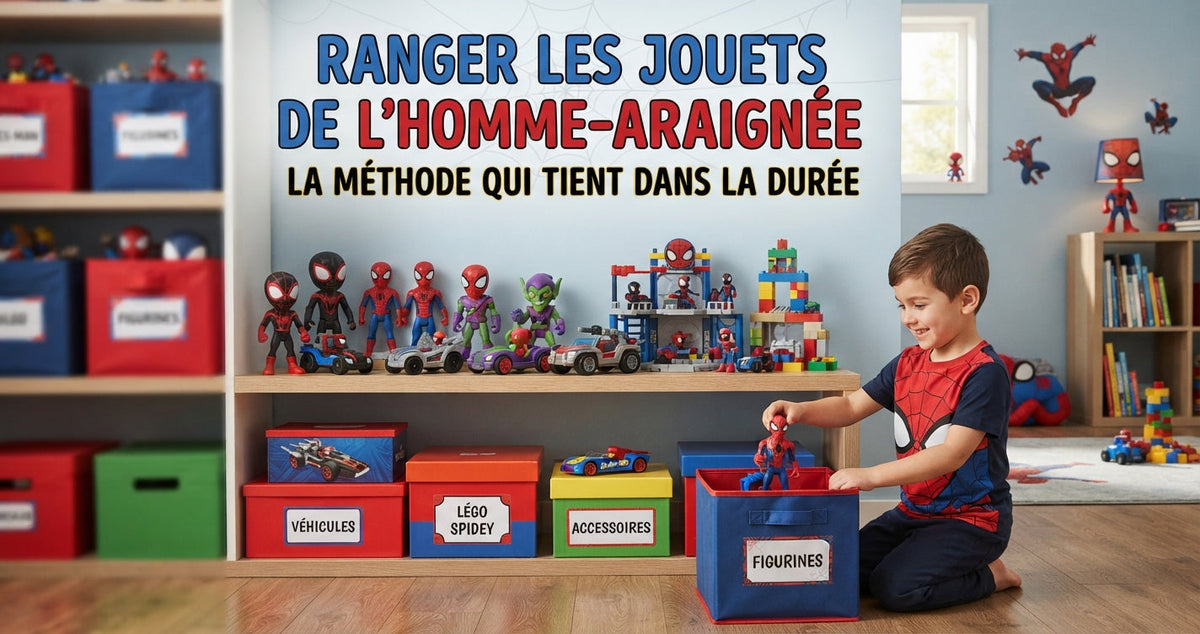
The essentials before you choose
Storage that lasts rests on three rules: one family of toys per container, a physical limit that forces a decision when the container overflows, and a rotation that keeps part of the toys out of play. Soft fabric Spider-Man laundry baskets, listed from €29.90, are the main container for soft toys and bulky items.
Contents
Why storage always breaks down after a few daysSort by family before buying a single boxOne container per family, and only oneThe single-basket rule: when the container overflows, something goesRotation: fewer toys out, more actual playingWhat goes where: the floor, the shelf, under the bedSmall building bricks: the case that breaks every systemCleaning the containers and getting your child to tidy up without a battle
Why storage always breaks down after a few days
On Saturday morning the bedroom is spotless. By Wednesday evening the floor has vanished under action figures, bricks and two soft toys. This is neither a question of temperament nor a lack of authority: it is a question of system. Storage holds up when tidying takes less effort than leaving things lying about. The moment your child has to think a second too long about where something goes, it stays on the floor.
The first cause of failure is the number of decisions. Six boxes, a shelf, a crate under the bed and a chest in the living room: that makes eight destinations for a single action figure. An adult decides without thinking about it; a six-year-old gives up and puts the thing down wherever they happen to be. Bringing the system down to four destinations at most removes that hesitation, and it costs nothing: it means getting rid of containers, not buying them.
The second cause is the catch-all box. One big chest looks practical, but it forces you to tip everything out as soon as you are after one particular accessory. The contents end up spread across the rug. If you are not sure which families your child actually owns, the overview of toys by age and by type gives you a sorting baseline, and the Spider-Man toys section shows the formats that come up most often.
TOO MANY DECISIONS
Eight possible destinations for one action figure, and the child simply puts it on the floor. Cut the number of choices and tidying becomes a reflex again.
THE CATCH-ALL BOX
One big chest mixes bricks, soft toys and small pieces. Finding an accessory means tipping it all out, and tipping it all out undoes yesterday's tidying.
THE INVISIBLE VOLUME
Toys arrive in waves: birthdays, the festive season, presents from grandparents. With nothing going out, the pile grows faster than the shelving.
The third cause is sheer volume. Toys arrive in waves and rarely leave. Without an organised way out, no piece of furniture keeps up. This article covers the storage system: sorting, containers, limits, rotation, placement. It does not cover decorating. For the overall look, the complete bedroom guide covers bedding, walls and lighting, and the room-by-room decorating guide extends it to the rest of the home.
Sort by family before buying a single box
Sorting always comes before buying. Tip every single toy into the middle of the room, chests and bags included, along with whatever is sleeping in the living room and in the car. As long as part of the stock stays out of sight, you are organising a sample. Then make four piles and no more: building bricks, action figures and vehicles, soft toys and fabrics, skill and movement games. Four families, not six: the number of destinations decides whether this works.
The brick family is the most demanding: hundreds of small, hard, noisy pieces that slip in everywhere. It calls for a flat, open container and a defined play surface. Action figures come next: little bulk, plenty of tiny accessories, strong sentimental value. They belong at child height, never at the bottom of a chest. Mixing those two families in the same box remains the most common mistake.
1
Tip it all into the middle Get everything out on the floor, chests and bags included. As long as part of the stock stays hidden, you are tidying a sample and you will be starting again a fortnight later.
2
Make four piles Building, action figures, soft toys, movement games. A borderline object goes in the pile where your child will look for it, not in the most logical one.
3
Clear out the dead weight Broken, incomplete, outgrown: three bags for repair, donation and recycling. This step often frees up a whole container.
4
Measure before you buy Judge the volume of each pile before choosing a container. You buy for what you own, not for what you imagine owning.
For action figures, sorting comes with a display question: some pieces are for playing with, others are for looking at. The Spider-Man action figures section mixes the two uses, and the complete guide to choosing and displaying your figures sets out where the line falls. In practice: whatever ends up on the floor every day goes in the box, whatever never comes out goes on a shelf. Otherwise the box turns into a display case that cannot be tidied.
Soft toys and movement games close the list: the first take up a huge amount of space for variable play value, the second come out in bursts then disappear for weeks. If you are unsure what your child really uses, the Spider-Man guide for children sorted by need and the age-by-age toy guide will help you decide before you pick the most accessible container.
One container per family, and only one
One family, one container. That is the rule that separates storage that lasts from storage for show. The container has to be recognisable without reading a label: a shape, a colour, a height. A four-year-old cannot decipher the word 'building', but they do recognise the red basket standing in the corner. Whatever is in their hand then goes to one place and one place only.
The soft toy container is the easiest to define: large, soft, open at the top, no lid. You throw things in without aiming, which matches a child's accuracy at the end of the day. The Spider-Man soft toys section gives an idea of the volumes to plan for, and the soft toy guide by age and use separates the ones still in service from the ones that just sleep.
The fabric laundry basket fills this role better than most toy chests. Carried by its two handles, with no lid and no hinge to close. The model from the Spider-Man laundry baskets section shown just below stands upright while staying soft: your child fills it standing up, with no lid to lift and no slot to aim at. That detail is what makes the difference in the evening.

Spider-Man Logo Laundry Basket
A cylindrical fabric basket with two black handles and a dark red background crossed by a white web, with a large spider in the centre. It stands upright without being rigid: ideal for soft toys and the bulky items your child throws in without aiming.
View the product - from €29.90One rule applies to every container: nothing locks, nothing stacks. A lid adds a movement, and every added movement makes spontaneous tidying collapse. A box sitting under another box is never opened: its contents become dead stock within days. Choose three visible containers over six stacked ones, even if the second option looks tidier.
The single-basket rule: when the container overflows, something goes
The single-basket rule fits in one sentence: the container sets the limit, not you. When the soft toy basket overflows, the answer is not to buy a second basket but to take something out. The benefit is considerable: the conflict moves. It is no longer the adult deciding, it is the container being full, and everyone can see that for themselves.
The decision is made with your child, never behind their back, and it has only three outcomes: keep it, put it in reserve, or let it go. The third needs a clear destination to be accepted: a cousin, a charity, a car boot sale. If presents are on the way, the gift guide and our ideas for a party that works will help you gauge the volume before it lands.
One trap comes up again and again: objects that are not toys. A lamp, a cushion or a framed print of the hero end up in the box by default, when they really belong to Spider-Man decoration and live very happily on a wall. Leave them out of the count: a box filled with things that are never played with triggers pointless decisions.
On budget, the kit does not come together in a day. The soft basket suits soft toys and movement games, never action figures or bricks, which need a low open format: two baskets are therefore enough to start with, figures going on a low shelf and bricks in a flat tray. The laundry baskets mentioned above are listed from €29.90 each: here is what each model comes to, before any other purchase. No extra furniture is needed to get going.
The price of the soft baskets, model by model
Spider-Man Logo Laundry Basketfrom €29.90
Spider-Man Face Laundry Basketfrom €29.90
Spider-Man Comic Book Laundry Basketfrom €29.90
Total to budget for at the start2 baskets, from €29.90 each
Rotation: fewer toys out, more actual playing
Rotation is the only lever that cuts the mess without throwing anything away. Part of the toys stays out of play, in a flat tray slid under the bed or at the back of a cupboard, while the rest is in service. The first effect is mechanical: fewer things on the floor, so quicker tidying. The second shows up in use: faced with a limited choice, a child gets into their game faster, whereas an undifferentiated heap gets rummaged through and never played with.
The rhythm is set by use, not by the calendar. When the same three toys come back every evening and the rest is just scenery, the rotation is overdue. Two to three weeks makes a comfortable interval. Swap a whole family rather than individual objects: the novelty effect is far sharper. Other methods of the same kind are gathered in our guides and advice.

Spider-Man Face Laundry Basket
A cylindrical basket with black handles and a black background scattered with cartoon-style red masks from top to bottom. Discreet from a distance, playful up close: it tells the second toy family apart from the red basket's at a glance.
View the product - from €29.90Not everything rotates. One soft toy acts as a bedtime anchor and never leaves the bedroom: taking it away creates anxiety for no gain. That emotional role is exactly why soft toys are among children's favourite presents. Identify those two or three untouchable objects from the start, say so out loud, and the rotation stops feeling like confiscation.
Movement games, by contrast, are the first candidates for rotation: they come out in bursts, take up a lot of room and are missed by nobody in between. Launcher accessories fall into this category, and the web-shooter comparison is a reminder of which ones need space and which pack away flat. Rotate them without a second thought: their return always has an effect.
What goes where: the floor, the shelf, under the bed
Storage reads vertically: three levels, three frequencies of use. On the floor, against a wall, you put what is used every day and what is heavy: the soft toy basket, the container for the family that gets played with most. A child tidies standing up, without bending or climbing, and that is what makes the movement automatic. Anything that needs a step stool drops out of the daily circuit. A high shelf in a child's bedroom is fixed to the wall, without exception: what a child can see but not reach, they will eventually climb.

Spider-Man Comic Book Laundry Basket
A red cylindrical basket with black handles: a yellow and red 'the Amazing Spider-Man' logo, the hero coming down a web against black, on a yellowed comic page background. Standing on the floor against a wall, it is spotted from across the room and filled standing up.
View the product - from €29.90The play area deserves to be marked out, because a child tidies far more willingly inside a visible perimeter. A rug marks where the toys come out and, above all, what has to be clear before dinner: the instruction becomes concrete. The Spider-Man rugs section offers several sizes, and the room-by-room model comparison explains which ones stand up to the traffic and the frequent cleaning of a child's bedroom.
Under the bed is the place of choice for the rotation reserve, provided you use flat trays on castors rather than cardboard boxes. Pull out, swap, push back: the job takes two minutes. Do not pile loose fabrics in there, as they take up damp; the throw guide for a child's bedroom is a reminder of how to store that kind of item without damaging it.
That leaves labelling. A child who cannot read yet needs a visual cue on each container: a coloured dot, a picture, a motif. The Spider-Man stickers do the job nicely, provided you give each family a different character. To match a character to each basket consistently, the overview of the Spider-Man universe gives you enough to choose from so that no two containers look alike.
Small building bricks: the case that breaks every system
Small building bricks defeat the best-designed systems. Numerous and similar, they scatter the moment a box is knocked over. The usual reflex, one big deep box, is the worst choice: finding a piece means plunging your arm in, stirring it about, then tipping the lot out. The ranges in the LEGO Spider-Man section come with instructions and numbered bags, which makes life after dismantling even trickier.
The right answer is flat, not deep. A wide, low tray lets you see every piece at a glance and pick without rummaging. A drawstring play mat works even better: you play on it, pull the cord, and everything gathers into a single bag. Tidying becomes a three-second movement instead of a chore on your knees.
Should bricks be sorted by colour or by size? For a child, rarely. Fine sorting is an adult pleasure that adds decisions and slows tidying down. One exception: the pieces of a model being built, kept in a separate box until it is finished. Same logic for the pieces of Spider-Man jigsaws, which must stay in their original box.
That leaves the tiny accessories that come with action figures: masks, weapons, stands, interchangeable hands. They deserve a compartmented box next to the main one, never inside it. If your child is drifting towards collecting, the guide to characters and versions worth collecting explains what gets played with and what gets displayed, and the merchandise guide sorts out what is kept boxed. Once each family has the right format, the table below sums up where each container goes and how often it is used.
| Location | What goes in it | Target frequency of use |
|---|---|---|
| Floor, against a wall | Soft toys, bulky items, the basket of the most-played family | Every day |
| Low shelf, at child height | Action figures in service, skill games, books | Several times a week |
| High shelf, fixed to the wall | Fragile pieces, collector's boxes, items to keep an eye on | Only with an adult, never by climbing |
| Flat trays under the bed | Rotation reserve, seasonal toys, duplicates | Every two or three weeks |
| Wall, hooks and pegs | Bags, fancy dress, soft accessories | Depending on the day |
Cleaning the containers and getting your child to tidy up without a battle
A container needs looking after, otherwise it ends up in the bin before your child has finished with it. Fabric baskets are cleaned with a damp sponge and dried open, in the air, never folded while damp. Empty them completely two or three times a year, shake the dust out outdoors, check the stitching on the handles. Bedroom textiles follow a different rhythm: Spider-Man duvet covers go in the washing machine far more often.
The contents need the same attention, particularly soft toys, which soak up dust and end up back in the bed. The soft toy care guide covers washing and drying without losing shape. The point that matters for storage lies elsewhere: a soft toy put back damp at the bottom of a full basket ends up passing its smell to the fabric of the container, and that smell is what finishes it off. Dry it completely before putting it back.
That leaves the hard part: getting your child to tidy. Three adjustments are enough. The slot first: never at bedtime, when tiredness guarantees a row, but before a meal or before something they are looking forward to. The length next: short and bounded, a visible timer beats an open-ended order. The role last: tidy alongside them, not instead of them, and hand them a whole family.
The most effective lever is still the character. A child who looks up to the hero accepts a rule credited to the hero far more readily than a parental instruction repeated for the tenth time. What Spider-Man teaches without anyone noticing and the reasons behind that passion explain why this works. Use it without overusing it: a rule tied to the character loses its power as soon as it is applied to everything.
The mistakes that make storage fail
- Buying the boxes before sorting A container chosen without knowing the real volume ends up too small or half empty. Sort, measure, then buy.
- Stacking closed boxes A box sitting under another is never opened. Anything that requires moving one thing to reach another drops out of the circuit.
- Tidying instead of your child A system they do not understand is a system they will not reproduce. They should be able to name each container without hesitating.
- Keeping everything just in case Without a regular way out, the stock grows faster than the containers. A full container triggers a decision, never a purchase.
What to remember
Storage that lasts more than a week depends on neither the furniture nor the budget. It depends on three decisions: four toy families and no more, one container per family that is recognisable without reading, and a physical limit that forces a decision as soon as it is reached. Add a regular rotation and you cut the volume on the floor without throwing anything away. The rest is just fine-tuning.
The order of operations matters as much as the content. Sort first, measure next, buy last. The costliest mistake is buying containers before knowing the real volume of each family: you end up with a box too small for the bricks and one half empty for the figures. Half a day of sorting beats three successive purchases.
Finally, accept that the system moves. Tastes change, one family swells, another fades away. Revisit the single-basket rule every two or three months, do a clear-out pass, adjust the rotation. Living storage is corrected in a few minutes several times a year; frozen storage has to be rebuilt from scratch and costs you a day. The difference is made by those short reviews.
Start this weekend, without buying anything. Empty everything out, make four piles, remove whatever is broken or incomplete, then judge the volume of each pile: you will know exactly which container you are missing. Put the soft toy basket on the floor against a wall, the figures at child height, the bricks in a flat tray, the reserve under the bed. State the rule in one sentence: when the basket is full, you choose what goes.

