
14-Day Money-Back Guarantee
0
The short answer
Brand New Day is packed with references: two comic covers recreated shot for shot, a Gen's Pizza that salutes Raimi, Bruce Banner turned professor at Empire State University, Yelena called 'the Black Widow' for the first time in the MCU, and Captain Jean DeWolff lifted straight out of the comics. Here are the fourteen most significant ones.
A Spider-Man film is made to be watched twice. Once for the story, once for what is lurking in the background. Brand New Day is no exception, and it pushes the game further than its predecessors: the specialist press counted several dozen references the day after release, and some of them call for a knowledge of the comics that the film never demands out loud.
We have kept the fourteen that genuinely add something — the ones that shed light on a character, extend an earlier film, or point to a direction. Be warned, what follows goes into the detail of specific scenes. If you have not seen the film yet, keep our list of what to watch first to hand instead.
Two comic covers recreated shot for shot
The film's most carefully built reference goes almost unnoticed. During the opening montage, two historic covers are reconstructed on screen. The first is that of Amazing Fantasy #15, Spider-Man's very first appearance back in 1962: he swings off carrying a crook, in exactly the composition of the original cover. The second comes from Amazing Spider-Man #134.
The choice is not a throwaway. Recreating Amazing Fantasy #15 in a film called Brand New Day is a statement of intent: we are starting again from the beginning. The title itself comes from a comics arc that reset the character, and this opening says so visually before the script ever explains it.
Amazing Spider-Man #134: why that cover in particular
The second cover deserves a pause, because it is not decorative. Amazing Spider-Man #134, published in 1974, is the issue that introduces Tarantula — Anton Miguel Rodriguez, the mercenary with poisoned spurs fitted to his boots.
And Tarantula is one of the antagonists in Brand New Day. Recreating the cover of his first appearance in the opening montage announces the character before he even walks on, for the benefit of the only readers able to recognise the panel. The film never comments on the gesture: it lays it down and moves on.
That is telling about the method overall. Where the Amazing Fantasy #15 cover is a statement of intent legible to everyone, the #134 one is a signal aimed at a fraction of the audience. The two sit in the same sequence, which says a great deal about the double reading the film is after. For the character himself, we have covered who Tarantula is and what the film does with him, and the full gallery of the film's villains puts each of them back in context.
Gen's Pizza and 'Peter 2': two nods to the Raimi era
The Gen's Pizza that appears on screen — red lettering, white background, circular logo — traces the Joe's Pizza from Spider-Man 2, the one where Peter delivered pizzas late under Mr Aziz's orders. The film does not linger on it, but the composition is far too close to be accidental.
The second salute is spoken. As he learns to master organic webbing, Peter mentions 'Peter 2' — the nickname given to Tobey Maguire's Spider-Man in No Way Home, and the only one of the three to produce his web naturally. A few words that confirm in passing that Peter remembers both of his counterparts perfectly, even though the rest of the world has forgotten him.


Cosplay Costume – Spider-Man Brand New Day
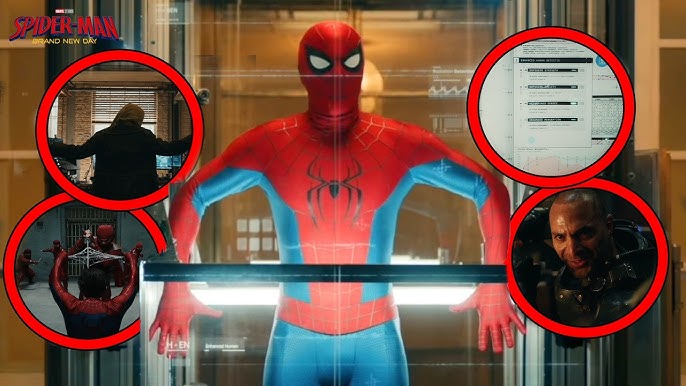
The film's Fresh Start suit, the one you see in the recreated Amazing Fantasy shots. Full-body cut, for anyone who wants the costume from the screening.
See the product — €109.90Bruce Banner, professor at Empire State University
Bruce Banner turning up as a professor is more than an Avengers cameo. The institution where he teaches, Empire State University, has been Peter Parker's university in the comics ever since Amazing Spider-Man #31. It is where Peter meets Harry Osborn and Gwen Stacy, and the setting shapes entire years of storytelling.

Putting Banner at ESU therefore does two things at once: it establishes a major comics location the MCU had never used for Spider-Man, and it gives Peter a scientific mentor in a film where he is otherwise alone. On that point, the contrast with the Peter of Homecoming, surrounded and guided, is striking.
'Not again': when Banner brings up Age of Ultron
Still with Banner. Once freed from Jean Grey's mind control, he lets out a resigned 'not again'. The line points back to Avengers: Age of Ultron, where Wanda Maximoff was already toying with his mind and set off the most destructive episode of his career.

It is a continuity gag, but it carries information: in the MCU, having your brain turned inside out by a telepath has happened before, and Banner clearly remembers it painfully. The film places Jean's powers on a scale the viewer already knows, without having to explain them.
Ned calls Yelena 'the Black Widow', and that is a first
When Ned Leeds barges into a video call between Spider-Man and Yelena Belova, he introduces her as 'the Black Widow'. Harmless on the face of it — except that it is the first time in the whole MCU that Yelena is officially given the title.
So the film establishes, through a supporting character's line, that she has taken up her sister's mantle. For everything else her presence carries, we have covered her two scenes and her refusal of the Avengers separately.

Spider-Man Fancy Dress – Tobey Maguire
The suit 'Peter 2' wears, the one the Gen's Pizza salutes between the lines. The Raimi version, for the fans of the first hour.
See the product — €99.90Jean DeWolff, the comics reference nobody saw coming
This is probably the film's deepest nod. The police captain played by Liza Colón-Zayas is called Jean DeWolff. In the comics, that character is an essential contact for Spider-Man inside the New York police — often the only voice defending him when the institution treats him as an outlaw vigilante.

Introducing DeWolff gives Peter an institutional ally he has never had on screen. And for comics readers it is a name heavy with implication, given how striking her arc is on the page. The film plays none of those cards here, but it puts the piece on the board.
The choice is all the more telling because the New York police have always been a blind spot in the Spider-Man films. The earlier instalments reduced them to flashing lights in the background or a vague threat. Naming a captain, giving her a face and a position, opens up a playing field the MCU had never used for this character — and it fits a film that, everywhere else, prefers to quote the pages rather than its own films.
MJ's pendant, a leftover from Far From Home
MJ has kept the broken Black Dahlia pendant Peter gave her in Far From Home, on Tower Bridge. She no longer knows who it came from, since she does not remember him — but she has kept it.
The detail is cruel and precise. It makes concrete what the spell did and did not do: it erased the name, not the attachment. That is exactly the nuance we worked through in our analysis of what MJ actually remembers, and here the film gives it physical proof.
Sadie Sink and the ghost of Stranger Things
The scene where Sadie Sink runs in slow motion is built as a direct echo of her most famous moment in Stranger Things, the one with Max set to Running Up That Hill. Same framing, same handling of time, same logic of a character torn out of a mental hold.
Whether it is a deliberate homage or a directorial signature, the effect lands on an audience that knows her for that role. For what her character actually covers, we have untangled the question of her role and, on the comics side, what the pages really say about Sara Grey.
E.V., the quiet heir to J.A.R.V.I.S.
Peter now has an artificial assistant called E.V. The principle — the companion voice that comments and assists in real time — comes straight down from J.A.R.V.I.S. and then F.R.I.D.A.Y., Tony Stark's AIs, and by extension from E.D.I.T.H., left to Peter in Far From Home.
The lineage is technical as much as narrative: it is a reminder that this Peter, however isolated, remains the heir to a line of engineers. The suit itself extends that logic, as you can see in our breakdown of the Fresh Start design.

Spider-Man Costume – No Way Home
The suit from before the spell, the one whose consequences Brand New Day spends its time recalling. The missing link between the two films.
See the product — €99.90Moves borrowed from the Insomniac game
Tom Holland has confirmed that several of his finishing moves in the fights take their cue from Marvel's Spider-Man by Insomniac. Players will recognise specific combos, particularly in the way an opponent is sent into a wall at the end of a sequence.
That is a first: until now the influence ran the other way, with the games copying the films. A film borrowing from the game says something about the place the Insomniac version now holds in how we picture the character.
The Naruto poster in Ned's bedroom
In a scene set at Ned's place, a poster for Naruto is visible in the background. The nod is aimed at the director himself, Destin Daniel Cretton, who is due to direct the live-action adaptation of the series.
It is the kind of detail that serves absolutely no purpose in the story, and that is exactly why the film is worth a second watch. It joins the long tradition of crews slipping their side projects into the set dressing.
The quiet narrative threads: MIT, and the rest
Several lines refer back to Ned and MJ's time at MIT, set up in the previous films. These mentions restart no plot, but they maintain the continuity of a world where life has carried on without Peter — which is, fundamentally, the subject of the film.
Other details sit on the side of the antagonists and the institutional backdrop. To work out who does what, our guide to Damage Control and the guide to the iconic villains cover the essentials.
False leads: what the film gets credited with and does not contain
A cluster of references mechanically attracts over-reading, and the days following a release produce it in quantity. So it is worth separating what is on screen from what is inferred, extrapolated, or plainly invented.
First point: the destination of Jean's bus is never named. The shot exists, the destination does not. Everything circulating about a specific institution is viewer deduction, not information given by the film.
Second point, related: neither Charles Xavier nor any school is shown. No logo, no building, no voice. The articles describing an appearance are describing something that is not in the cut released in cinemas.
Third point: no official roadmap was announced off the back of the film. The phase and era names doing the rounds since release come from no studio statement. Again, this is reading the signs, which is a legitimate exercise — as long as it is not presented as fact.
Finally, a useful reminder for sorting through rival lists: neither Charlie Cox nor Vincent D'Onofrio appears in this film. The references to the Daredevil corner come purely through the writing, not through faces.
How to spot them yourself on a second viewing
These details fall into four families, and knowing them changes the way you watch. The first is the shot compositions: the opening montage concentrates most of the graphic quotations, notably the two comic covers. That is the passage to watch first, because it goes by fast and it is dense.
The second family is the backgrounds. The poster in Ned's bedroom, the university signage, the street signs like the Gen's Pizza: nothing is underlined, everything looks like set dressing. They are the easiest to miss and the most rewarding to find.
The third is the lines of dialogue. 'Peter 2', 'not again', Yelena introduced as the Black Widow: three lines that each carry a piece of continuity, and that subtitles help you not to miss.
The fourth, finally, is the props — first among them MJ's pendant. An object already seen in an earlier film that reappears without comment is almost always intentional. Superhero cinema has made this grammar a language of its own, and Brand New Day uses it with more restraint than its predecessors: nothing is laboured, nothing is explained to the viewer.
What all these details say about the film
Put end to end, these references sketch a clear intention. The film draws on the comics — Amazing Fantasy #15, Empire State University, Jean DeWolff — rather than on its own films. That is a change of regime: the earlier instalments quoted the MCU, this one quotes the pages.
Two details are deliberately left hanging. The destination of Jean's bus is never named on screen, and the film shows neither Xavier nor any school. Everything circulating about it is interpretation, not what is shown — and it is worth knowing that before reading peremptory theories. For the mechanics of the ending itself, we have explained the post-credits scene and the resolution, and the V-Max message has its own explanation.
To carry it over into objects, the Brand New Day collection brings together the pieces tied to the film, the Spider-Man fancy dress and costumes cover every era mentioned here, and the figures, posters and Spider-Man masks let you recreate at home the gallery the film quotes. You can also put all the films back in order before a second screening.

