

14-Day Money-Back Guarantee
0
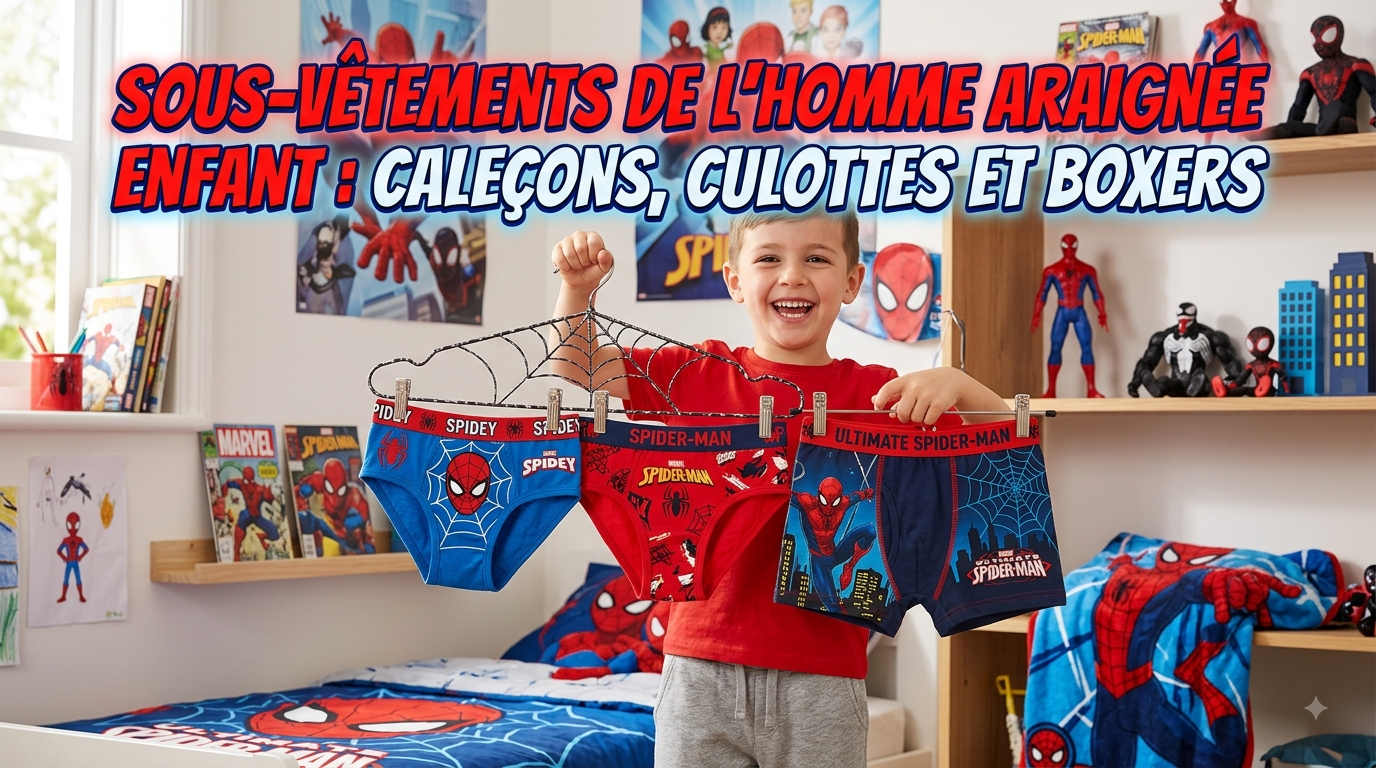
The essentials before you choose
Three things decide it, and the design comes last. The fabric — combed cotton against a child's skin, never pure polyester. The waistband, which has to be flat and covered in fabric, otherwise it leaves marks. And the size, which you take from their actual age: underwear that is too big twists round, too small and it digs in. Reckon on five to seven pairs.
It is the least discussed garment and the most worn. A child puts a pair on every day, keeps it on for twelve hours, and will never say that it itches — they will simply fidget.
Here is what really matters, from the fabric to the cut, and how to avoid the purchases that end up at the back of the drawer having never been worn.
The fabric, the one non-negotiable
This is where comfort is won or lost, and it is the point on which product pages say the least.
Cotton, and which sort
Cotton is still the benchmark in direct contact with the skin: it breathes, it absorbs moisture and it does not hold odours the way synthetics do.
Look for a mostly cotton composition with a small amount of elastane — a few per cent is enough to stop the garment going baggy after three washes.
A step up is combed cotton: the short fibres have been removed, so the fabric is smoother, it pills less and it holds up better over time.
What to avoid
Pure polyester against the skin. It does not breathe, it traps heat and moisture, and it encourages irritation in children with sensitive skin.
Be wary too of prints applied to the inside of the garment: a thick screen print creates a stiff patch that rubs. The design belongs on the outside.

Spider-Man Boxer Shorts Pack for Kids
A multipack that covers the week without repeat orders. The full range is in our Spider-Man boxer shorts and knickers.
View the product — €34.90The cuts, and which one for which age
The marketing vocabulary is vague and covers cuts that are not worn in the same way at all.
Boxer shorts
Short leg, close-fitting cut. It is the most versatile format from four or five years old: it does not ride up, it adds no bulk under trousers and it stays in place during sport. The same thread runs through Spider-Man compression T-shirt: what it is for and how to choose one.
It is also the easiest to pull on unaided, which counts at the age when a child dresses without help.
Briefs
Lighter, less fabric, quicker to dry. They suit younger children and the summer, but hold less well under loose clothing.
For a child who is potty training, it is often the simplest format to manage: less fabric to pull up, a quicker movement.
Knickers
The same logic for girls: a cut that does not ride up and flat seams. That is what separates a pair that gets worn from a pair that gets abandoned.
The rest of the everyday kit follows the same rule, as we set out in our guide to dressing your child.
The waistband, the detail that decides everything
It is the part nobody looks at and the cause of almost every refusal.
Flat and covered
A bare elastic waistband, in direct contact with the skin, marks and itches within hours. Look for elastic that is covered in fabric, stitched flat.
The test is simple: run your finger round the inside. If you can feel the edge of the elastic, your child will feel it too, all day long.
The right tension
You should be able to slide two fingers between the waistband and the tummy. Any tighter and it leaves a red mark by the end of the day; any looser and the garment slides down and your child hitches it up every ten minutes.
Seams and the label
Flat seams at the gusset and the sides prevent the sort of redness that takes a while to trace back to its cause. As for the label, go for one printed onto the fabric: a sewn-in label is the number one cause of refusal, and a badly trimmed stub itches more than the whole label did.

Spider-Man Spidersense Boxer Shorts for Kids
A pair for children with a bold design, in a cut that stays in place. Pair them with our kids' pyjamas and our kids' T-shirts.
View the product — €15.90Sizes: never go up a size
It is the most common mistake, and on this particular garment it backfires.
On a jumper, a size up still works. On underwear it does not hold: the garment twists round, the waistband slips, your child spends the day readjusting it — and ends up refusing to put it on.
Take the size for their actual age, even if it means buying again sooner. The cost per pair is low and a multipack rarely lasts more than one school year.
If your child is between sizes
Go by their trouser size rather than their age: it is the waist measurement that counts here, not the height. A tall, slim child will take the size for their age, a sturdier one a size up.
How many to plan for
Five to seven pairs cover a week with a margin. Below that, you are washing every other day; above it, the pairs at the back of the drawer never come out and your child grows out of them before wearing them.
What the season changes
People rarely buy with the weather in mind, and yet it is what decides real comfort over a school day.
Winter and layering
In winter, a child wears tights or lined trousers on top. Any needless bulk underneath creates a fold, and a fold under three layers becomes uncomfortable within two hours. Go for a fine, close-fitting cut.
It is also the time of year when the garment works hardest: your child moves from a heated classroom to a freezing playground several times a day. Cotton that absorbs and dries quickly avoids that cold, damp feeling on the way back into class.
Summer and sport
In the warmer months, perspiration becomes the dominant factor. Cotton is still the right choice, as long as it is fine: a heavy jersey holds moisture and takes half a day to dry.
For PE lessons and swimming, put a dedicated pair in the bag rather than dipping into the daily rotation — the same logic as for the rest of the week's kit, set out in our guide to the water bottle for school and sport.
Girls and boys: what really differs
The aisles are separate, but the technical criteria are exactly the same: cotton, a covered waistband, flat seams, a printed label. What differs comes down to the cut and to what is available.
The availability problem
On superhero licences, girls' styles have always been thinner on the ground. Many parents fall back on a boys' cut, which works perfectly well for boxer shorts — the cut is the same up to a certain age — but less well for briefs.
Another route is to switch to the female characters in the universe, which opens up far more options: that is the logic we set out in our guide to the Spider-Gwen costume for girls.
After eight
From the end of primary school, a child starts choosing for themselves and caring what others think. Very loud designs get dropped in favour of a discreet logo, or even plain. It is not that they have gone off the character — the same child will ask for a T-shirt or a poster. It is simply that this particular garment becomes private.
Plan for that switch when you buy: better a multipack of bold designs at five and a multipack of understated logos at nine than a big stockpile that does not survive the transition.
Spotting a good multipack in three minutes
On a product page, four pieces of information are enough to decide, and their absence is information in itself.
First, the stated composition. A precise percentage is a good sign; the word 'cotton' on its own, with no figure, often hides a mostly synthetic blend.
Then the waistband finish. A page that specifies 'covered elastic' or 'soft waistband' was written by someone who knows the subject; a page that says nothing on this point deserves a close look at the photographs.
Next, the size guide in centimetres. A chart based on ages alone is too crude; a stated waist measurement lets you decide for a child between two sizes — the same reflex we recommend for choosing a sweatshirt size.
Finally, the number of pairs per pack and the price per pair. It is the only way to compare two offers, and the real ranking is often the opposite of what the headline price suggests.
The potty training case
This is often the moment these garments become a topic, and the design genuinely plays a part.
Moving from nappies to underwear is a symbolic step. Many parents find that letting their child choose the design makes the transition easier: the garment becomes a reward rather than a constraint.
Two pieces of advice at this stage. Buy plenty, because accidents are frequent and you need to be able to change them without stress. And go for styles that are easy to pull up unaided: a soft waistband, no fabric that catches.
It is also a period when attachment to the character helps a great deal — the same lever we describe in connection with the animated series aimed at younger children.
Building the drawer and making it last
Beyond the garment itself, it is how you organise the stock that saves you complicated mornings.
A rotation, not a pile
Put the clean ones underneath the pairs already there rather than on top. Without that, the same three go round constantly while the rest sleep at the bottom and get too small without ever being worn.
Washing
At 30 or 40 degrees, no hotter: above that, the elastane goes slack and the print cracks. Avoid fabric softener, which coats the fibres and reduces how much they absorb. Dry in the open air, and turn them inside out before washing if the design is printed.
The spare bag
Set aside one or two pairs for the bag left at school or at the club. They stay out of the rotation and stop you discovering an empty drawer on a swimming morning — the same logic as for the rest of the kit, set out in our backpack guide.
The annual sort
Once a year, usually in autumn at the start of term, empty the whole drawer and get rid of anything with a slack waistband, a cracked design or an outgrown size, with no sentiment. A child never says that a garment is worn out: they simply always pick the same ones and leave the rest at the bottom.
It is the ideal moment to recount and top up, because it is also when you reassess the rest of their wardrobe — the same exercise we describe for getting their back-to-school outfit ready.
What it really costs
The headline price tells you nothing until you have worked it back to the pair and to how long it lasts.
A decent multipack generally works out at between four and seven euros a pair, and covers a full school year if the fabric holds up. Below that, the composition is almost always synthetic; above it, you are paying for the finish, not the lifespan.
Set against the use — more than three hundred days of wear for a pair in a rotation of six — it is one of the cheapest garments in the wardrobe per wear. Which is precisely why you should not try to save on the fabric: the saving comes to a few euros in absolute terms, whereas the cost of a multipack your child refuses to wear is the whole of it.
The mistakes that keep coming up
Buying a size up. On this garment it does not work — it will not stay in place.
Choosing on the design alone. Your child asks for the character, but it is the waistband and the fabric that will decide whether they wear it.
Taking polyester for the price. The saving is real, so is the discomfort, and the garment ends up unused.
Washing too hot. Slack waistband, cracked design, a multipack fit for the bin within a term.
Buying too few. Three pairs force you into emergency washes.
The questions people ask
From what age?
As soon as they are out of nappies, generally between two and four depending on the child. Before that there is little point — the nappy does the work.
My child refuses to wear them, what should I do?
Look for the physical irritation before you start negotiating. A child will not say 'the seam is bothering me', they will say they do not want to. Run your hand round the inside: a stiff label, a thick seam, a waistband that rolls. In most cases, that is where the cause is.
Then shortlist two or three styles that meet the technical criteria and let them decide. They are genuinely choosing, and you have ruled out what does not work.
Multipack or single pairs?
The multipack is almost always better value and settles the quantity question in one go. Single pairs are worth it when your child wants a particular design, or to top up.
Do they make a good gift?
As a complement to a main present, yes, especially with younger children who do not yet rank the useful against the fun. On its own, and from seven or eight, it is risky: your child will see a garment, not a gift.
Our gift ideas by age, our selection of small gifts under 20 euros and our toy guide by age offer safer combinations, and our guides and advice hub brings together all our recommendations product by product.
Does the design survive washing?
Yes, at a low temperature and inside out: modern prints stand up to dozens of cycles. They do crack quickly at a high temperature or in the tumble dryer.

Spider-Man Spider Logo Boxer Shorts
A logo style, more understated, which also works for older children. The full range is in our boxer shorts and knickers, and our gift ideas round out the selection.
View the product — €22.90What to take away
Combed cotton, a flat waistband covered in fabric, a printed label, the size for their actual age, five to seven pairs. Those five points cover the essentials, and none of them concerns the design. The same thread runs through Spider-Man shirt and tie: wearing your passion in formal dress.
The character works on another level: it decides the enthusiasm, and during potty training that enthusiasm is worth every technical argument. Choose the fabric well, then let your child choose the design.

