
14-Day Money-Back Guarantee
0
The short answer
The Enigma Force is the Microverse energy that chooses the avatars of Captain Universe; it settles on Peter Parker for the duration of the Acts of Vengeance crossover, turning him into a cosmic Spider-Man able to stop Hulk with a single punch. A power lent rather than earned — here is the full picture.
In the vast Marvel multiverse, some events redefine for ever what it means to be Spider-Man. One of the most striking, and paradoxically one of the least known to the wider public, is the arrival of the Enigma Force — a mysterious cosmic entity that briefly turned Peter Parker into a living god. This rare arc, sitting at the margins of the main mythology, raises a fundamental question: what becomes of a deeply human hero when he is suddenly handed the powers of a god?
This article digs deep into that unique cosmic force — its origin, its universal role, its passage through Peter Parker and its legacy in the modern mythology. To place the arc within the wider Spider-Man timeline, a detour through the complete history of Spider-Man, from Peter Parker to the Spider-Verse is essential — the Enigma Force is one of the rare cosmic appearances in a mythology that is usually very earthbound.
An entity beyond human understanding
The Enigma Force, the power that stands behind the Captain Universe mantle, is a cosmic energy of unknown origin, tied to universal balance and to the Microverse dimension. It first appears in Micronauts #1 in 1979, before being folded gradually into Spider-Man lore across the 1980s and 1990s. That peripheral origin partly explains its relative obscurity — the Enigma Force comes from a secondary Marvel mythology long before it ever crosses paths with the wall-crawler.
This energy is often associated with the legendary Captain Universe, the avatar it picks to carry out its missions across the cosmos. But what makes the force so fascinating is that it does not always choose super-heroes. It appears when a major imbalance threatens the universal order, and settles on a host who sometimes asked for nothing at all. That dimension of imposed power is crucial to understanding the Peter Parker arc — he did not go looking for the Enigma Force; it came to him.
The exact nature of the Enigma Force is left deliberately vague in the comics. It has no face, no voice, no personality. It is, literally, an enigma — hence the name. That absence of characterisation is probably what makes the concept so powerful in narrative terms. Instead of being a character you can negotiate with, it is a force you have to live with. To compare the entity with the other cosmic energies of the Marvel universe, a detour through the complete history of the symbiotes, from Venom to Carnage is worthwhile — both mythologies share the idea of an external entity that temporarily takes hold of a human host.
When Peter Parker becomes Captain Universe
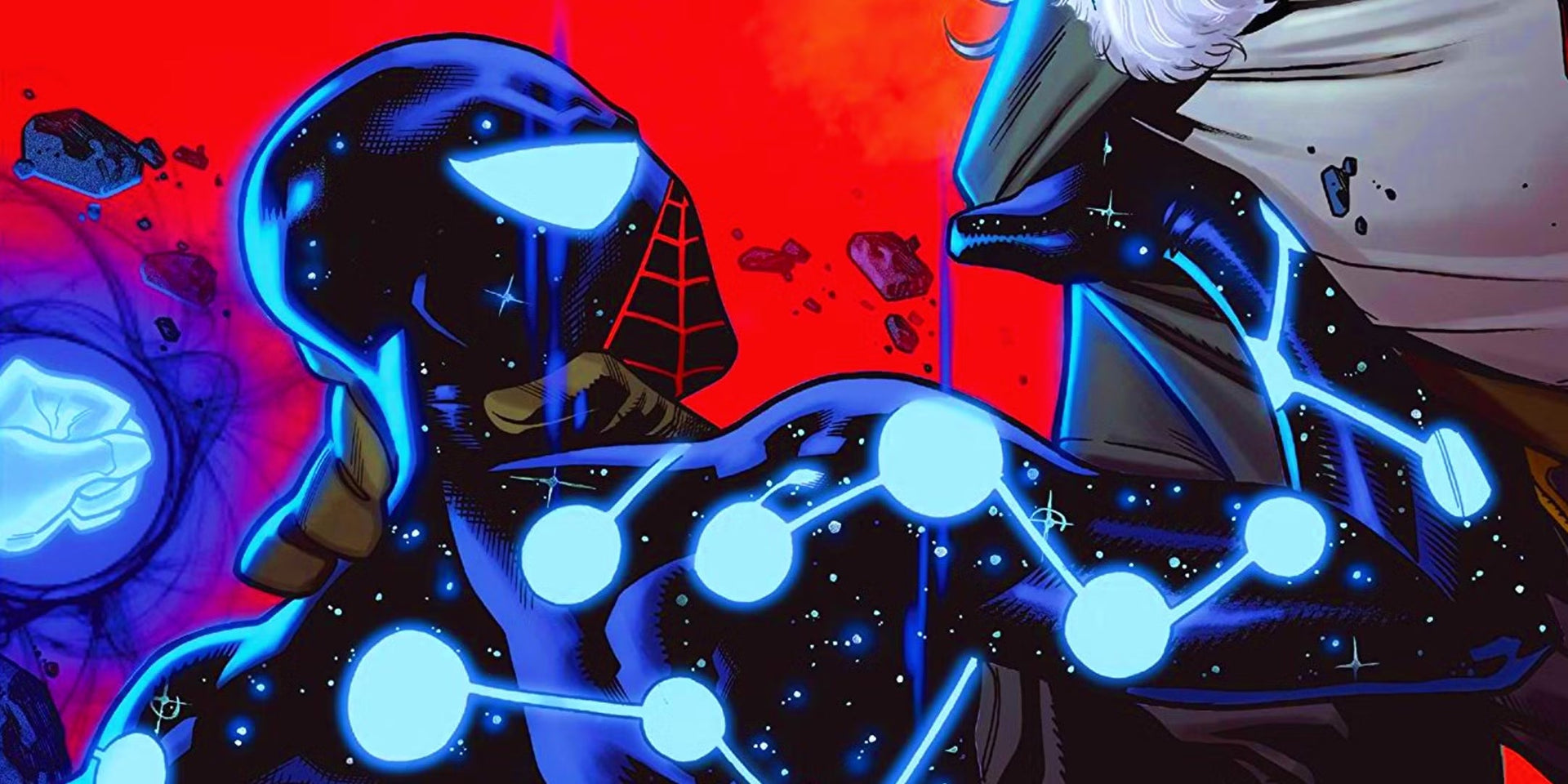
The landmark arc in which Peter Parker meets the Enigma Force plays out in Acts of Vengeance (1989-1990), the Marvel crossover that sees several heroes face villains they are not usually paired with. During that arc, Peter temporarily receives the power of Captain Universe — becoming Cosmic Spider-Man.
The powers he receives go radically beyond anything Spider-Man has ever known. Cosmic Spider-Man can manipulate pure energy, fly through the vacuum of space, perceive the world at subatomic level, teleport at will and reshape matter molecule by molecule. He stops Hulk with a single punch in a scene that has become iconic. He neutralises Goliath effortlessly. He beats Poison in a matter of seconds. The distance between the old Peter and this new Peter is dizzying.
That sudden elevation creates a major storytelling problem. How do you keep writing a likeable hero when he can solve everything in five seconds? Marvel's writers found an elegant answer: the Enigma Force demands that its host maintain universal balance. Cosmic Spider-Man cannot simply use his powers as he pleases — every action carries cosmic consequences. That constraint turns the experience into a moral nightmare. To gauge the ethical dimension, a detour through how hard Peter finds it to balance his private life and heroism is illuminating — his new stature amplifies that tension to a cosmic scale.

The cosmic aura, lit up
Spider-Man Neon Lamp
The Spider-Man neon lamp gives visual form to the idea of pure energy radiating out of the wall-crawler. For fans who want to recreate the cosmic aura of Captain Universe at home — statement lighting, neon mood, a constant visual presence.
99,90 €
View the neon lamp →A psychological transformation for Peter Parker
The Enigma Force may hand Spider-Man powers beyond imagination, but it does not change who he is. And it is precisely that psychological continuity that makes the arc so interesting. Peter Parker as Cosmic Spider-Man is still deeply Peter Parker — he doubts, he hesitates, he worries about Mary Jane, he questions whether his choices are legitimate. That persistence of personality proves that powers do not define the hero — what counts is the person under the suit.
That philosophical dimension is probably the deepest thing in the whole arc. For decades, Marvel and DC comics implied that power makes the hero: the stronger you are, the better you save people. Acts of Vengeance demonstrates the opposite — Peter with cosmic powers is fundamentally the same hero. He makes the same moral choices, hesitates over the same dilemmas, doubts the same solutions. That ethical continuity is rare in super-hero writing. For comparison, a detour through Superior Spider-Man, when Doctor Octopus becomes Peter Parker is illuminating — when the shell changes and the personality changes with it, the result is radically different.
The other crucial psychological dimension is the weight of cosmic responsibility. Peter knew how to handle responsibility for one New York neighbourhood. All of a sudden he is carrying the whole universe. That abrupt elevation produces a deep anxiety, beautifully written in the Spectacular pages of the period. Cosmic Spider-Man is not a power fantasy — it is a nightmare of responsibility. Uncle Ben's ethical line shifts: with great power comes great responsibility, but cosmic power implies cosmic responsibility. And nobody should have to carry that.
The Enigma Force and the multiverse: a power beyond dimensions
The Enigma Force is not confined to a single Marvel universe. It crosses dimensions, selecting hosts in different multiverses according to what cosmic balance requires. That multi-universal reach makes it one of the rare genuinely trans-multiversal entities in the mythology. It has been linked to several versions of Spider-Man across different dimensions — without ever settling on any of them for long.
In some alternative arcs, Captain Universe is not Peter Parker but another figure from the multiverse: a cosmic Captain America, a cosmic Hulk, even a cosmic Doctor Octopus in a dimension where Otto Octavius chose heroism. That flexibility makes the Enigma Force a valuable storytelling device — it lets writers hand cosmic powers to any character temporarily, without breaking the coherence of the canon. To dig into the multiverse side of Spider-Man, a detour through the Spider-Verse explained simply is essential.
The other interesting angle is the relationship between the Enigma Force and the Spider-Totem. The Spider-Verse arcs introduced the idea that Spider-Man is not only a hero but the incarnation of a cosmic totem. That totemic mythology resonates with the Enigma Force — both concepts imply a cosmic energy manifesting through Peter Parker. Are they the same thing? Marvel has never settled the question. But the overlap is enough to keep fans wondering. To dig into that mythology, a detour through Madame Web, guardian of the Web of Life is illuminating — she too sees beyond ordinary dimensions.

Ultimate power, in collectable form
Spider-Man Video Game Collector Figure
This Spider-Man Video Game collector figure captures the look of an overpowered version of the wall-crawler — upgraded gear, commanding stance, cosmic presence. A premium piece for collectors who want to give physical form to the moment Peter pushes past his usual limits.
149,90 €169,90 €
View the collector figure →Cosmic Spider-Man: the power and its price
The arc ends on a deliberately ambiguous note. The Enigma Force leaves Peter Parker after a handful of arcs, with no definitive explanation. It does not thank him, does not pay tribute to him, does not wish him luck. It simply disappears. That absence of emotional closure is probably intentional. The Enigma Force is not a character — it is a force. It does not think, it acts. It does not reward, it uses.
For Peter, the return to normal is almost a liberation. He gets back his usual powers, his rent to pay, his exams to sit, his relationship with Mary Jane. That reclaimed ordinariness is, paradoxically, the purest victory of the arc. Where other super-heroes would have mourned the loss of cosmic powers, Peter breathes a sigh of relief. That reaction proves he stayed himself — a hero who fights because he must, not because he enjoys it. To dig into that tension between duty and vocation, a detour through the key moments when Peter nearly gave up his role as a hero is illuminating — Spider-Man has always dreamed of an ordinary life.
That narrative resolution also carries a valuable lesson for readers. Power is not an end in itself. Greatness is not measured in cosmic energy. Real courage is coming back to human limits after touching the stars, and carrying on fighting anyway. That philosophy runs through all of Spider-Man's finest arcs. To see how consistent it is, a detour through Spider-Man No More is essential — it is the other great arc where Peter willingly gives up power to get his humanity back.
A mysterious power… but not a forgotten one
Brief though it is, the Enigma Force arc left a deep mark on the mythology. Several of the big fan debates revolve around this period. Which is the most powerful version of Spider-Man? Cosmic Spider-Man comes top every time. When did Peter Parker come closest to the gods? This arc. What is the greatest narrative demonstration that the person under the suit matters more than the powers? Again and again, Cosmic Spider-Man.
In recent arcs, the Enigma Force comes back occasionally. Marvel uses it as a storytelling tool when a hero has to push past his usual limits for a while. That sparing use keeps the interest alive — the Enigma Force stays exceptional, never routine. To compare it with the other cosmic transformation arcs, a detour through The Other, when Spider-Man dies and is reborn is worthwhile — it is the other great arc where Peter experiences a cosmic dimension to his existence.
The other reason the arc stays alive is its adaptation potential. No Spider-Man film has yet tackled the Enigma Force head-on. The rumours around a future Avengers: Secret Wars suggest Marvel Studios could reintroduce the concept on screen. That possibility keeps the arc alive in fan culture, despite its relative obscurity in the printed canon. To weigh up those prospects, a detour through Avengers Secret Wars and Spider-Man's role is essential.

Identity preserved beneath the power
Spider-Man Logo T-Shirt
Cosmic Spider-Man keeps the logo, keeps the suit, keeps Peter Parker underneath. This logo t-shirt takes up the timeless look of the wall-crawler — proof that identity survives even the most radical transformations. Classic, timeless style.
29,90 €
View the logo t-shirt →Where the Enigma Force sits in Marvel's cosmic mythology
To place the Enigma Force within Marvel's wider cosmic mythology, you have to compare it with the universe's other major energies. The Phoenix Force (over in the X-Men) shares that dimension of radical transformation, but it is destructive and flamboyant where the Enigma Force is silent and measured. The Power Cosmic (with Galactus and the Silver Surfer) is an individual energy, bound to a single being, where the Enigma Force moves from host to host.
That singularity makes the Enigma Force a fascinating literary creation. It is neither a fully fledged character nor a simple inert energy. It is a cosmic intentionality without a personality. That philosophical ambiguity inspired several Marvel writers in the decades that followed. You find its flavour in some of the storytelling mechanics of Doctor Strange (the power of the Vishanti), of Thor (the Odinforce), and even in certain modern Hulk arcs.
The other fascinating aspect is the Microverse, the dimension the Enigma Force emerges from. That subatomic dimension, home to the Micronauts, is one of the most exotic in the Marvel universe. It has had its editorial ups and downs — disputed rights, long silences, triumphant returns. The fact that the Enigma Force is tied to it gives the arc an unexpected historical depth. To dig into how Marvel builds its cosmic dimensions, a detour through Knull, the god of the symbiotes and his cosmic threat is illuminating — Knull and the Enigma Force embody two opposite approaches to the cosmic dimension.
Conclusion: Cosmic Spider-Man, the wall-crawler's outer limit
The Enigma Force holds a unique place in Spider-Man mythology — a cosmic parenthesis that looks like nothing else in his journey. For a few arcs, Peter Parker touched the stars. Then he came back down. And that descent is, paradoxically, probably the clearest proof that the hero is genuinely human. Where other super-heroes would have fought to keep their cosmic powers, Peter welcomed their disappearance as a relief.
To take the exploration further, there are a few essential routes. First, read Acts of Vengeance — the crossover that brought the Enigma Force into Spider-Man's world. Then read the Spectacular arcs of the period to understand the psychological dimension of the transformation. Finally, follow the recent arcs (the Spider-Verse ones in particular) that partly reintroduce the cosmic mythology. To turn that passion into a collection, the Spider-Man figures collection, the posters collection and the lamps collection all offer visual ways into the hero's whole cosmic ecosystem.
One thing is certain: as long as Marvel publishes comics, the Enigma Force will come back. Not as a regular character, but as an essential reference point. That cosmic parenthesis remains one of the finest narrative demonstrations of what Spider-Man really is — a hero who could rule the universe if he chose to, and who chooses instead to stay a struggling photographer paying his rent late. And that is probably, in the end, what makes him so endearing: his greatness lies in his refusal of greatness.

