

14-Day Money-Back Guarantee
0
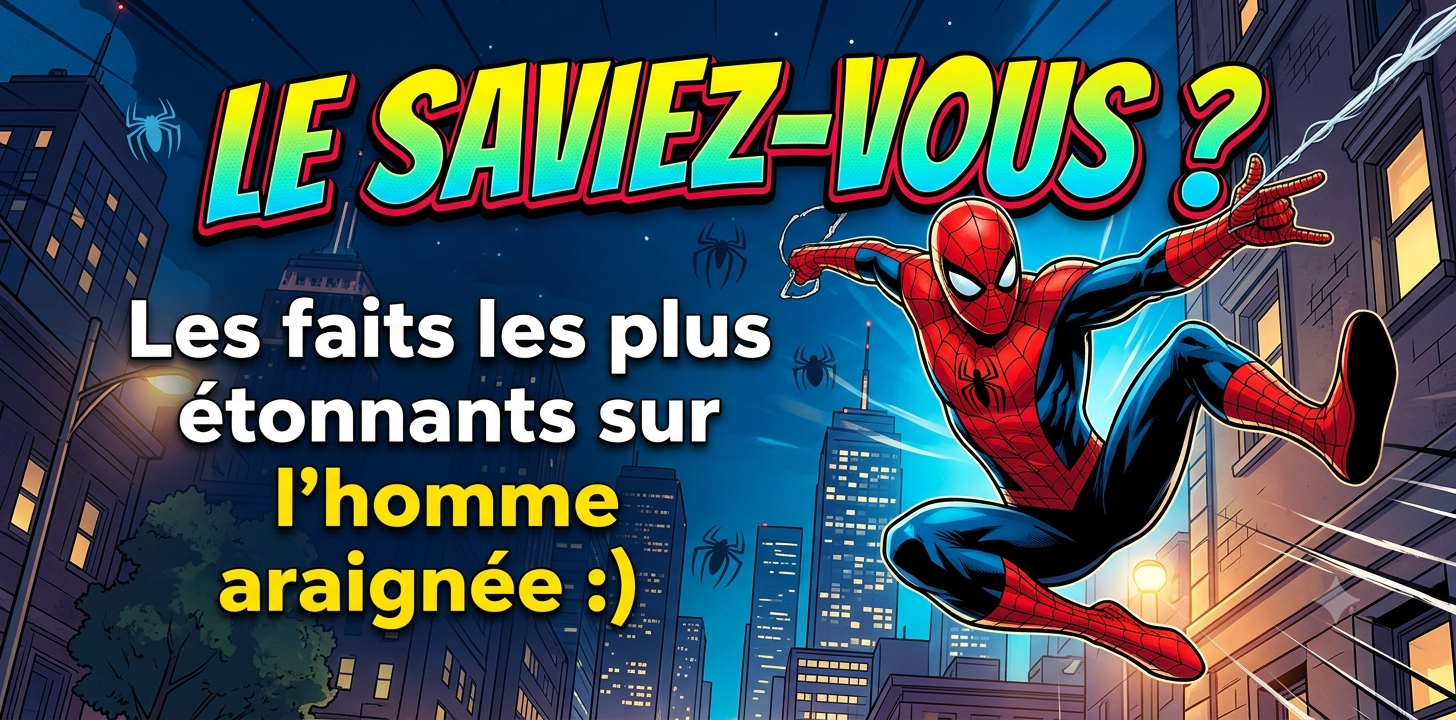
The short answer
The famous line about power and responsibility appears as a plain narration caption in Amazing Fantasy #15: writers only put it in Uncle Ben's mouth much later. The black suit, meanwhile, was bought from a reader for 220 dollars. More revelations below.
Contents
Spider-Man was born in a magazine already doomed to foldHis own publisher was convinced it would never workThe hero's most famous line was never spoken by Uncle BenThe full-face mask was a small revolutionHis web-shooters prove Peter is a genius… something the films forgotThe black suit was dreamt up by an ordinary fan… paid 220 dollarsGwen Stacy's death tipped a whole era of comicsIn Japan, Spider-Man piloted a giant robot
Beneath the red and blue mask there is far more than a teenager bitten by a spider. Since 1962, Spider-Man has become one of the most popular superheroes on the planet. But behind the acrobatics lie accidents, happy coincidences and secrets that even seasoned fans sometimes miss. Brace yourself: here is a dive into the most astonishing, surprising and 100% true facts about the web-slinger. Some of them will make you see Spider-Man in a completely different light.
Spider-Man was born in a magazine already doomed to fold
In August 1962, Spider-Man made his very first appearance in the pages of Amazing Fantasy #15. What people often forget is that this magazine was already on its way out: sales were collapsing and Marvel had decided to make it the final issue. It was precisely because the title was on its last legs that writer Stan Lee could afford to test a character as risky as a spider-teen, with very little to lose. Backed by artist Steve Ditko, the web-slinger was a hit… and the issue meant to be a funeral became one of the publisher's best sellers. We tell the whole story in our article on the legendary comic that gave birth to Spider-Man.
A final issue that became a classic
In August 1962, Amazing Fantasy #15 was meant to be the last issue: Stan Lee used it to test Spider-Man, who turned it into one of the publisher's best sellers.
His own publisher was convinced it would never work
By Stan Lee's own recollection, his publisher Martin Goodman hated the idea from the start, and he had plenty of arguments. First, a lot of people are frightened of spiders: building a hero around that animal risked scaring readers off. Next, at the time a teenager could only be a sidekick, glued to an adult's heels, never the lead. Finally, a character so weighed down by personal problems looked anything but commercial. Stan Lee was convinced of the opposite: he wanted a hero young people could identify with, with real money worries, heartache and loneliness. History proved him spectacularly right.
Martin Goodman's objections
- Fear of spiders A spider hero risked scaring readers off.
- A teenage hero A teenager could only be a sidekick.
- Too many problems A hero weighed down by troubles looked anything but commercial.
The hero's most famous line was never spoken by Uncle Ben
'With great power comes great responsibility': this is THE Spider-Man maxim, the one that sums up his whole moral code. But hold on — in Amazing Fantasy #15, Uncle Ben never says it. Originally the line appears as a simple narration caption, slipped into the very last panel of the story, without being attributed to any character. Only much later did writers retroactively put it in Uncle Ben's mouth, turning it into his final moral testament. Today it is impossible to imagine the web-slinger without it. We even devoted a whole breakdown to it: the line that defines Spider-Man.
A caption, not a line of dialogue
In Amazing Fantasy #15 the maxim appears as a narration caption in the final panel; Uncle Ben never says it.
The full-face mask was a small revolution
The costume drawn by Steve Ditko hides a real stroke of genius: a mask that covers the entire face, eyes included. At a time when heroes proudly showed off their square jaws, that choice was bold. Above all it made one magical thing possible: any reader, whatever their skin colour or background, could imagine themselves under that mask. Add the fine webbing drawn across the whole suit and the famous underarm webs, and you get one of the most recognisable outfits in all of pop culture. Serious fans hunt down a host of small details in it: we have gathered a few in our article on the hidden costume details only true fans have spotted.
A mask anyone can project onto
Steve Ditko's mask covers the whole face, eyes included: any reader, whatever their background, can imagine themselves underneath.
His web-shooters prove Peter is a genius… something the films forgot
Here is a detail that has divided fans for decades. In the comics, Peter Parker does not shoot web straight from his wrists: he builds his own mechanical web-shooters and an adhesive fluid of his own formulation. This matters, because it reminds us that Peter's real superpower, ahead of his strength and agility, is his extraordinary scientific intelligence. In Sam Raimi's trilogy (2002), the choice was to make the webbing 'organic', shooting straight out of his body, much to the purists' dismay. The films that followed, such as The Amazing Spider-Man (2012), went back to the original mechanical web-shooters. Fancy a tour of his full arsenal? We have set out what Spider-Man's powers really are.

The articulated figure
Articulated Spider-Man Figure
Peter Parker is a genius who designed his own gadgets. Celebrate his ingenuity with an articulated figure you can set in the most dynamic poses.
See the product — €99.90His webbing dissolves on its own after an hour
A lovely touch of genius from Stan Lee and Steve Ditko: Spider-Man's fluid dissolves by itself roughly an hour after it is fired. Why that detail? Quite simply to stop New York from being carpeted in sticky webs after every fight. That concern for realism, rather rare at the time, does a great deal to make the character believable: even his gadgets obey a kind of logic. It is a perfect example of the rigour hiding behind the web-slinger's apparent lightness.
The black suit was dreamt up by an ordinary fan… paid 220 dollars
Hold on, this one is delicious: Spider-Man's legendary black suit did not come from the imagination of a star artist, but from that of an ordinary reader. In the early 1980s, a young fan named Randy Schueller sent his black costume concept to Marvel, who bought the idea from him for the modest sum of 220 dollars. Introduced during the Secret Wars saga (1984), the suit eventually turned out to be a living alien symbiote. When Peter managed to reject it, the creature took its revenge by bonding with another man to give birth to… Venom, one of his worst enemies. Not bad for a 220-dollar idea. Black is of course among the web-slinger's most legendary outfits.
1
A fan's idea In the early 1980s, Randy Schueller sent his concept to Marvel.
2
Bought for 220 dollars Marvel acquired the idea for that sum.
3
Secret Wars (1984) The suit turns out to be an alien symbiote.
4
Venom is born Rejected, the symbiote bonds with another man.
Gwen Stacy's death tipped a whole era of comics
In June 1973, one issue landed like a bomb: the Green Goblin throws Gwen Stacy, the love of Peter's life, from the top of a bridge. Spider-Man tries to catch her at the last second with his web… but a small 'SNAP!' drawn near her neck suggests it was the shock of the sudden stop that killed her. For the first time, the hero fails to save the person he loves, and nothing can put that right. Comics historians often see this episode as the end of the Silver Age and the start of a far darker, more adult era. Rarely has a single panel left such a mark on the medium.
June 1973, the end of an age
Gwen Stacy's death, thrown from a bridge by the Green Goblin, is often seen as the end of the Silver Age of comics.
In Japan, Spider-Man piloted a giant robot
In 1978, the Japanese studio Toei launched its own live-action Spider-Man series, and it has almost nothing to do with the original. Here the hero is called Takuya Yamashiro and, as well as climbing walls, he pilots a gigantic battle robot named Leopardon to take down giant monsters. This unlikely mix of superhero and mecha had a colossal influence: it directly inspired the Super Sentai genre, the ancestor of the famous Power Rangers. Long overlooked in the West, this completely bonkers version was eventually folded officially into the spider's multiverse.
Toei series, 1978
The hero is called Takuya Yamashiro.
The Leopardon robot
A giant battle robot pitted against monsters.
Legacy
Inspired the Super Sentai, ancestors of the Power Rangers.
The 'Spider-Man pointing at Spider-Man' meme dates from 1967
You have certainly come across the image: two identical Spider-Men pointing at each other, now one of the most used memes on the internet for illustrating two interchangeable things. Its origin? An episode of the 1967 animated series titled 'Double Identity', in which Spidey comes face to face with an impostor dressed as him. More than half a century later, that kitsch scene is enjoying a second, worldwide life on social media. The same series also gave us the classic theme tune 'Spider-Man, Spider-Man, does whatever a spider can', which nobody has ever forgotten.

The symbiote poster
Spider-Man Comics Alien Costume Saga Poster
The black suit deserves a tribute on your wall. This poster of the alien costume saga captures all the legendary darkness of the symbiote.
See the product — €22.90Miles Morales changed everything in 2011
In 2011, Marvel took a huge risk: what if, in a parallel universe, Peter Parker died and left the mask to someone else? That is how Miles Morales was born, an Afro-Latino teenager from Brooklyn, written by Brian Michael Bendis and drawn by Sara Pichelli. Greeted with suspicion by part of the fanbase at first, Miles became within a few years one of the best-loved characters in the whole franchise, the star of video games and the hero of the Oscar-winning animated film Into the Spider-Verse. He embodies the founding idea of the character perfectly: anyone can be behind the mask. We tell you everything about who Miles Morales is, the new Spider-Man fans adore.
Miles Morales, born in 2011
Created by Brian Michael Bendis and Sara Pichelli, this Afro-Latino teenager from Brooklyn has become one of the best-loved characters in the franchise.
There is an almost infinite number of Spider-Men
Spider-Ham, Spider-Man 2099, Spider-Gwen, 1930s Spider-Man Noir… did you know there are dozens of different versions of Spider-Man scattered across the multiverse? This dizzying idea exploded with the comics event 'Spider-Verse' (2014), which brought together for the first time all these web-slingers from parallel dimensions. Taken to the big screen in 2018, Into the Spider-Verse went on to win the Oscar for Best Animated Feature, a first for Sony. The idea is as simple as it is brilliant: every world has ITS spider. Dive into the Spider-Verse, the event arc that redefined the web-slinger's universe.
Spider-Verse (2014)
The comics event brings together all the web-slingers for the first time.
Into the Spider-Verse
Brought to the screen in 2018, Oscar for Best Animated Feature.
The 'spider-sense', a sixth sense that warns him before danger
Among his whole arsenal there is one power Spider-Man owes neither to his strength nor to his agility: the famous spider-sense. It is a kind of sixth sense that alerts him to imminent danger, often described as a tingling at the back of his skull, sometimes before the threat has even properly appeared. This internal radar is what lets him dodge bullets, feel an ambush behind him or sense a trap. Without it, even with all his agility, the web-slinger would be far more vulnerable than you might think. We devoted a full breakdown to the spider-sense, Spider-Man's invisible weapon.
An internal radar
The spider-sense, a tingling at the back of the skull, warns Spider-Man of imminent danger and lets him dodge bullets, ambushes and traps.
Spider-Man has smashed box-office records
The web-slinger did not only conquer the page, he also set the cinema tills ringing. In 2002, Sam Raimi's first film became the very first feature in history to pass 100 million dollars in takings over a single weekend in the United States. Almost twenty years later, Spider-Man: No Way Home (2021) crossed the 1.9 billion dollars mark worldwide, settling in among the biggest successes of all time, an all the more remarkable feat for a film released in the middle of a pandemic. The secret of that triumph? The unprecedented on-screen reunion of the three actors who have played Spider-Man in cinema: Tobey Maguire, Andrew Garfield and Tom Holland.
Box-office records
Spider-Man (2002), one weekend in the United States100 million dollars
Spider-Man: No Way Home (2021), worldwide1.9 billion dollars
Stan Lee appears in almost every Marvel film
It is impossible to talk about Spider-Man without mentioning his spiritual father, Stan Lee. The web-slinger's co-creator made a habit of turning up for a knowing wink in almost every Marvel film: a passer-by, a delivery man, a wedding guest, a bus driver… These cameos became a real treasure hunt for fans, who look out for them with every new release. In the spider's own features, he was seen several times slipping in an amusing line before disappearing. His appearance in Into the Spider-Verse, in late 2018, took on a particular flavour: it is among his very last, the writer having died in November of that same year.
Peter Parker owes his name to Stan Lee's poor memory
Peter Parker, Reed Richards, Bruce Banner, Matt Murdock… spotted what they have in common? Stan Lee loved names whose first name and surname begin with the same letter. The reason is surprisingly down to earth: he admitted his memory was unreliable, and those repeated sounds helped him remember his many characters far more easily. So Peter Parker's lovely name is not the fruit of mystical inspiration, but of a small memory trick. A behind-the-scenes secret as ordinary as it is endearing, and one that says a great deal about the craft of comics at the time.
A 75-million-dollar musical… and stunts that went wrong
Few people know it, but Spider-Man had his own Broadway musical: 'Spider-Man: Turn Off the Dark'. With songs written by Bono and The Edge of U2, and a budget of around 75 million dollars, it remains one of the most expensive productions in Broadway history. But the show is mostly remembered for its troubles: during performances, several stunt performers suspended on wires were injured, causing a genuine media scandal. Flying like Spider-Man, even on a theatre stage, clearly cannot be improvised.
Spider-Man: Turn Off the Dark
SongsBono and The Edge, of U2
BudgetAround 75 million dollars
A copy of his first appearance sold for 3.6 million dollars
What can Spider-Man's very first appearance be worth? In 2021, a near-perfect copy of Amazing Fantasy #15 went under the hammer for the dizzying sum of 3.6 million dollars, a record for a comic book at the time. A useful reminder that these old magazines, originally sold for a few cents, have become genuine heritage treasures. Not everyone can afford a piece like that, of course, but you can celebrate the web-slinger in other ways, for example with our Spider-Man figures standing proudly on a shelf.
'Pizza time': the meme born from a video game
If you spend any time online, you have surely come across the phrase 'pizza time'. It comes from the pizza delivery missions in the video game Spider-Man 2, released in 2004 and adapted from Sam Raimi's film. Timed and backed by a stressful little tune that became a classic, these missions meant crossing the city in record time to deliver pizzas while they were still hot. Hated by some players, loved by others, over the years they have become a genuine nostalgia meme. Which goes to show that even as a pizza delivery boy, Peter Parker manages to leave a mark.

The Sam Raimi icon
Classic Sam Raimi Spider-Man Figure
From the classic game to 'pizza time', the Raimi era marked a whole generation. This classic figure pays tribute to the Spider-Man who started it all on screen.
See the product — €89.90That should be enough to shine at your next fan night or drop an unbeatable piece of trivia into a conversation. Behind every web he fires, Spider-Man carries sixty years of stories, happy accidents and strokes of genius. So which of these facts surprised you most?
Frequently asked questions about Spider-Man
Who created Spider-Man, and in what year?
Spider-Man was created by writer Stan Lee and artist Steve Ditko. The character first appeared in the comic Amazing Fantasy #15, published in 1962 in the United States. It follows Peter Parker, a shy, brilliant secondary school pupil who gains his powers after being bitten by a radioactive spider.
Why does Spider-Man sometimes wear a black suit?
The black suit appears in the 1980s, during the Secret Wars saga. It turns out to be a living alien symbiote that gradually tries to take control of Peter. Rejected by the hero, this symbiote then gives birth to Venom, one of his most iconic enemies.
Who is Miles Morales?
Miles Morales is a second Spider-Man, created in 2011. An Afro-Latino teenager living in Brooklyn, he takes up the mantle in a parallel universe after the loss of his Peter Parker. He is notably the hero of the animated films Into the Spider-Verse and Across the Spider-Verse, which introduced him to a wide audience.
Who really said 'With great power comes great responsibility'?
Contrary to a very widespread belief, this line is not spoken by Uncle Ben in the very first story: it appears there as a simple narration caption, in 1962. Only later was it attributed to Uncle Ben, eventually becoming his moral testament. It is now one of the iconic lines that have marked the history of cinema and comics.
Why are there so many different Spider-Men?
Because the Marvel universe rests on the concept of the multiverse: a multitude of parallel worlds, each with its own version of Spider-Man. Peter Parker, Miles Morales, Spider-Gwen and Spider-Man 2099 all coexist across the dimensions. That is exactly the subject of the Spider-Verse event, which brings them together in one place for the first time.
The web-slinger's creators
Spider-Man was created by Stan Lee and Steve Ditko, and first appeared in Amazing Fantasy #15, published in 1962.

