

14-Day Money-Back Guarantee
0
The short answer
This 2011 action game switches you between two Spider-Men linked by a rift in time: every move made in one era instantly rewrites the other. The follow-up to Shattered Dimensions, it embraces a dark, almost thriller-like tone. Its story, its gameplay and its legacy are broken down below.
When past and future intertwine
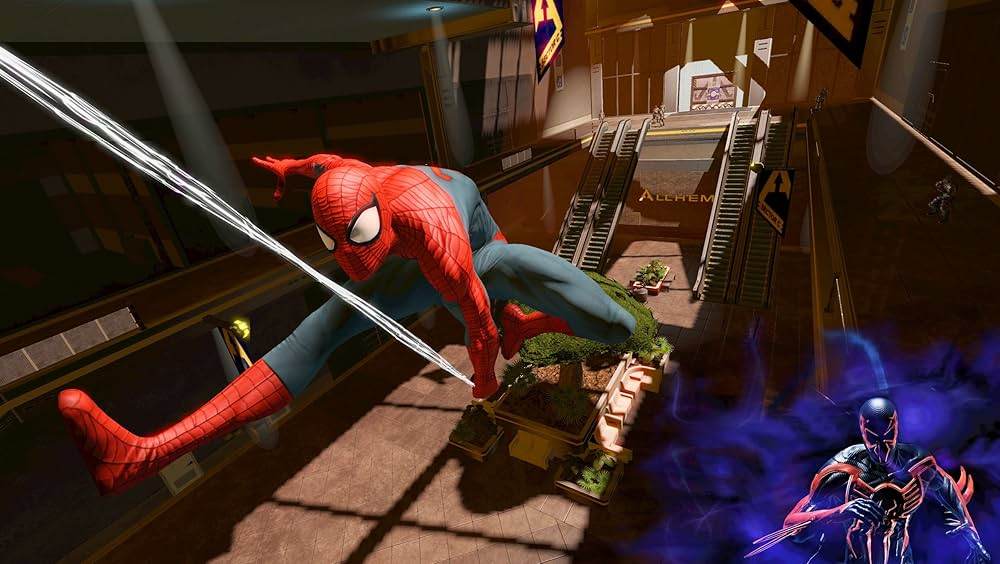
Released in 2011, Spider-Man: Edge of Time (known in France as Frontière du Temps) throws players into a gripping adventure where two incarnations of the web-slinger have to work together across time to stop a multiversal catastrophe. On one side, Peter Parker, our classic Spider-Man, rooted in the present day. On the other, Miguel O'Hara, the Spider-Man of the year 2099, living in a dystopian future controlled by the all-powerful Alchemax corporation.
The plot opens hard: Peter dies within the first few minutes. Yes, you read that correctly. His death triggers a fracture in time that Miguel picks up on, and he quickly works out that he has to alter the course of past events to stop reality collapsing. Through an unstable link across time, the two heroes have to act simultaneously in their own timelines to restore the balance.
Two Spider-Men, two ways of seeing the world
One of the game's great strengths lies in how Peter and Miguel complement each other. Where Parker leans on humour and spontaneity, O'Hara is colder, more methodical, almost military in the way he thinks. That clash of temperaments produces razor-sharp dialogue and a genuinely gripping narrative tension, reinforced by the presence of iconic villains reimagined in the futuristic style of 2099.
The player alternates between the two Spider-Men, each with their own skill set: Peter focuses on powerful combos and classic acrobatics, while Miguel draws on his illusions, his accelerated vision and his advanced technology. The system creates real synergy between present and future, built on one brilliant idea: every action in the past has an immediate impact on the future.
Innovative gameplay in the service of the story
Unlike its predecessor Spider-Man: Shattered Dimensions, which explored four universes, Edge of Time goes for a tighter, more immersive experience. The environments are wired together by the timeline itself, and you feel the weight of every decision at all times. Break a structure today? It opens a route in 2099. Reverse a process in the future? It rewrites the present. The level design rewards intelligence and anticipation, making every sequence of play narratively justified. To go further on this subject, see also Spider-Man: Shattered Dimensions - the cult game that brought together 4 of the web-slinger's universes.
And even if the game never found the commercial success it was hoping for at launch, it remains today a cult favourite among Spider-Man fans and multiverse lovers. It laid the groundwork for concepts later revisited in titles such as Spider-Man: Into the Spider-Verse or No Way Home.
To carry the adventure further, explore our collection of Spider-Man figures including models inspired by 2099, or take a look at the T-shirts in multiverse colours. You can also dive into the story of Peter Parker to better understand what is at stake in this adventure outside of time.
An intense, emotional story at the heart of the multiverse
One of the things that makes Edge of Time so memorable is the way it handles its story. Gone is the simple good-versus-evil framing: here the game touches on deeper stakes such as individual responsibility, the effects of our actions on future generations, and the fear of watching the world as we know it collapse. The emotional bond between Peter and Miguel grows steadily, from a purely tactical alliance into a genuine brotherhood forged under pressure.

The player is kept in a state of constant dramatic tension. Every moment of action is underpinned by an invisible countdown: the disintegration of the timeline. The cutscenes sharpen that sense of urgency, with genuinely moving scenes - notably the one where Peter realises he is already 'dead' in the future, and has only a short window to reverse his fate.
The game also commits to a darkness rarely seen in superhero video game adaptations. The 2099 environments are cold and dystopian, marked by the dominance of Alchemax. The present, meanwhile, is starting to crack under the weight of temporal paradoxes. That oppressive atmosphere gives the game a narrative depth closer to a science fiction thriller than to a straightforward action title.
A Spider-Man up against determinism
Edge of Time also questions the idea of fate: can you really change the future? Are we doomed to repeat the same mistakes? Peter and Miguel fight not only concrete enemies, but also a feeling of powerlessness. It is a race against the inevitable, where courage and intelligence become the only weapons against temporal chaos.
That kind of reflection sits perfectly within the wider mythology of the wall-crawler. Ever since the earliest days of Peter Parker, responsibility has been the central theme. In this game it takes on a new dimension: it is no longer only about protecting his city or the people he loves, but about saving the very fabric of time.

And if this subject interests you, you can also read our article on what a canon event actually is in the Spider-Man multiverse, or explore the many alternative versions of the hero through our Spider-Verse page.
Fast, punchy gameplay built on two complementary Spider-Men
What sets Spider-Man: Edge of Time apart from the other games in the franchise is its dual-protagonist system, in which Peter Parker and Miguel O'Hara (Spider-Man 2099) share control of the action. That back-and-forth is not just cosmetic or narrative: it feeds directly into the mechanics and the pacing of the game.
Peter embodies the classic combat style: fluid combos, acrobatic web-work, heightened reflexes. Miguel, by contrast, brings a more futuristic feel, with his combat talons, his time-slowing moves and his exceptional agility. Alternating between the two gives the player constant breathing room while keeping the intensity climbing.
But where the game really shines is in its temporal resonance sequences: what Peter does in the past reshapes Miguel's environment in the future. Knock down a wall as Parker? It collapses in the 2099 timeline. Repair an object in the present? It becomes available in the future. These knock-on effects create real synergy between the two timelines and force the player to think outside the usual frame.
An action game... and a thinking game too
While the fights against enemies - often drawn from the Alchemax world - are fast and full of rhythm, other sequences rely on observation and logic. That alternation is what keeps boredom at bay: hitting things is not enough, you also have to understand how each action fits into an overall temporal logic.
The progression system stays conventional (experience points, skill upgrades), but the abilities you unlock reinforce each Spider-Man's own identity. You do not play Miguel the way you play Peter, and that is exactly what makes the experience so rich.
This asymmetric gameplay actually echoes elements found in the alternative versions of Spider-Man explored in series such as Spidey and His Amazing Friends or in more recent games. Every incarnation of the hero has its own way of fighting, of moving, of interacting with its universe - and this game makes brilliant use of that.
An underrated game, but a cult favourite among Spider-Man fans
On release, Spider-Man: Edge of Time was no runaway commercial success. And yet it left its mark, thanks to its original approach, its unprecedented pairing of Spider-Men and a taut, almost cinematic narrative. For die-hard web-slinger fans, this game remains an alternative reference point, a gem far too rarely mentioned when the best Spider-Man titles come up.

The game's art direction - dark, futuristic, full of neon and high-tech scenery - stands apart from the more traditional New York atmospheres of the other games. That visual boldness, paired with a story carrying real stakes, makes it essential for any fan looking to explore other facets of the Spider-Verse.
To relive this cult adventure, you can still track down copies for the older PS3, Xbox 360 and Nintendo DS consoles. A fine excuse to rediscover this forgotten classic.
Between the future, nostalgia and the fight for the balance of the multiverse, *Edge of Time* is more than a game: it is a tribute to resilience, to courage, and to the complexity of heroes who move in the shadows... and across time.

