

14-Day Money-Back Guarantee
0
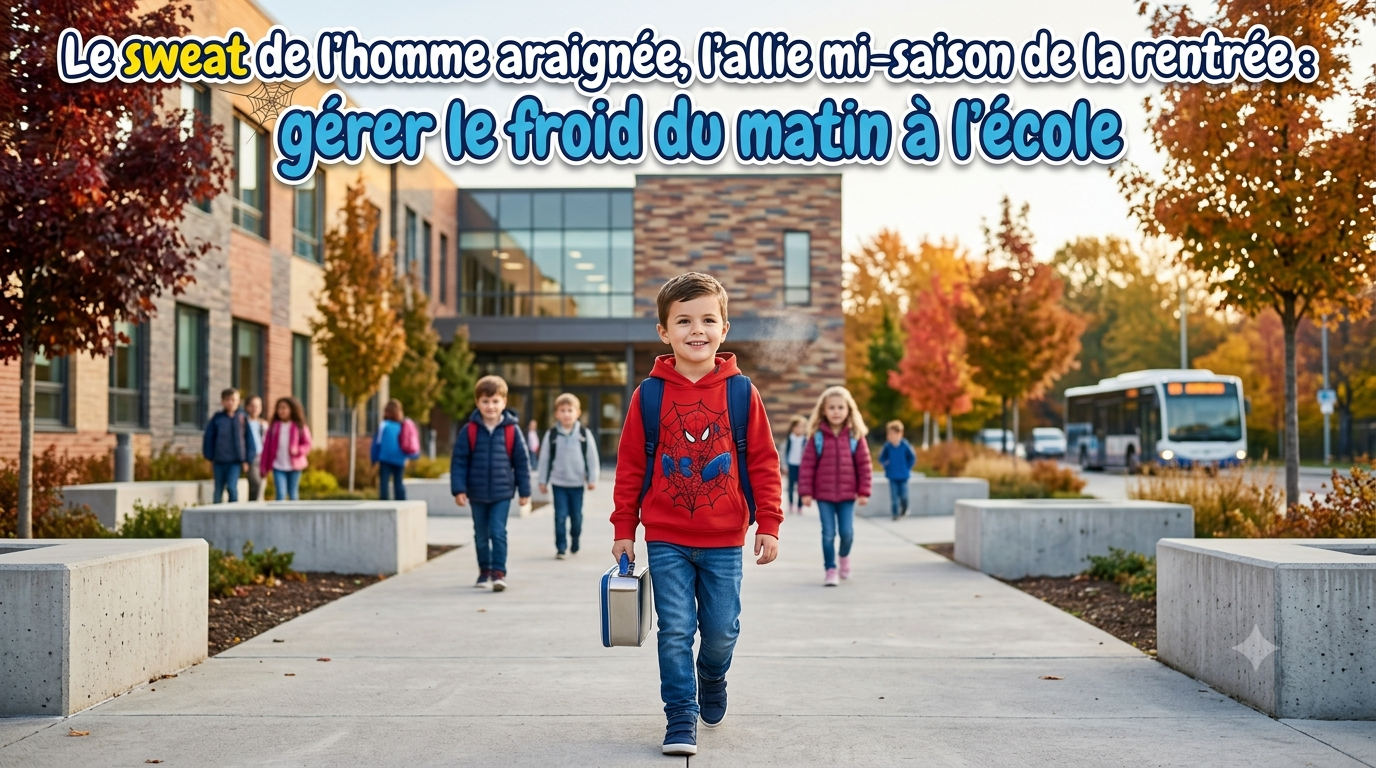
The essentials before you choose
Three criteria separate the models: the type of fastening, which determines whether your child can get dressed again on their own, the density of the fleece-back fabric and how breathable the material is when faced with damp. Zip or crew neck, each has its own logic; we go through the criteria below.
It is 8.05am, the playground is still damp with dew and your child is shivering under the shelter, waiting for the bell. Three hours later, wedged between the radiator and the south-facing window of the classroom, they are sweating buckets over their exercise book. At lunchtime, it is back out into the freezing playground for break, then the same again in the afternoon. In a single mid-season school day, your young Spider-Man fan easily goes through three different climates, and that is exactly where the battle for comfort is won. Too warmly dressed and they overheat and turn irritable; not warm enough and they catch a cold in the very first week of September. The Spider-Man sweatshirt, if it is well chosen, becomes the secret weapon that lets your child adapt to these swings on their own, without you having to dash to school with a spare layer. But you first need to understand how thermoregulation works across a school day, and above all which type of fastening really allows a child to manage on their own.
In this guide, we are not going to talk about style or rehash the hood-or-no-hood debate. We are going to focus on something very concrete: how a sweatshirt helps your child stay at the right temperature from morning to evening, and how to choose between a zip-up model and a crew neck depending on the way your child lives their day. If you want to compare the available models straight away, you will find everything in the collection of Spider-Man jumpers and sweatshirts for kids, but before you click, let us take the time to understand what really makes the difference on the ground at school.
The mid-season school day: 3 temperatures in 8 hours
Mid-season is that awkward stretch of September-October, then March-April, when the weather has not yet picked a side. In the morning the thermometer reads 9 or 10 degrees, the air bites, and your child heads off to school wrapped in their sweatshirt like a suit of armour. But the school day is not one uniform block: it breaks down into a series of micro-climates that put a child's body through the wringer. Understanding that breakdown is already half the battle won.
Morning in the playground: the peak of the cold
Between 8am and 8.30am, children often wait outside, standing still, in a playground shaded by the buildings. It is the coldest moment of their day, and paradoxically the one when they move the least. A child waiting for the bell without running loses heat very quickly, especially around the chest and the back of the neck. This is where the Spider-Man sweatshirt plays its front-line role: it has to keep them warm without turning your child into a mummy. The key is a material that genuinely insulates, such as a dense fleece-back cotton, while staying breathable so it does not become an oven the moment the temperature climbs.
The overheated classroom: the sweat trap
Once in class, everything flips. French classrooms are often overheated, with the heating turned up from the first cold snap, radiators under the windows and twenty-five little bodies giving off heat in an enclosed space. It can feel like 23 or 24 degrees. Your child, still bundled up in their morning sweatshirt, starts to sweat. And a child who sweats in a badly chosen garment is a child who will be cold at the next break, because the moisture trapped against their skin cools them sharply as soon as they step outside. This is the well-known evaporative cooling effect, the number one cause of back-to-school colds.
This is exactly why the ability to take the sweatshirt off easily matters more than the garment's raw warmth. A child who can take their sweatshirt off as soon as they feel hot, then put it back on when they go outside, will never sweat into their clothes. A child who keeps their sweatshirt on all morning because it is too fiddly to remove will build up moisture. We will come back to this in detail, but remember from now on that autonomy comes before everything else.

Kids' sweatshirt
Spider-Man Zip-Up Jumper for Kids
Warm, soft and easy to put on all by themselves: the perfect sweatshirt for chilly back-to-school mornings.
Break time outside: the thermal shock
At break, your child goes in a matter of seconds from a room at 24 degrees to a playground at 12 degrees, often running and sweating. It is the most dangerous moment of the day for their health: a warm, damp body suddenly exposed to the cold. Here, the sweatshirt has to go straight back on, and the sweat built up in class must not have saturated the garment. You can see straight away why a mid-season usage guide cannot simply tell you to 'put a warm jumper on them'. The right strategy is a garment the child puts on and takes off at the right moment, and a material that wicks moisture away rather than holding on to it. To get their whole September kit ready, the guide to the essential back-to-school kit rounds out this thinking on managing temperature perfectly.
Zip or crew neck? The real autonomy test at school
Here is the heart of the matter, the criterion too many parents overlook when buying: the fastening. Zip or crew neck is not a question of style, it is a question of day-to-day thermal survival. Because at school, you will not be there to help your child take their sweatshirt off or put it back on at the right moment. They, and they alone, will have to handle the three climates of the day. The right fastening is what turns a passive garment into a self-regulation tool.
The zip-up sweatshirt: the autonomy champion
The zip-up sweatshirt has one decisive advantage for a child: it opens and comes off without going over the head. That changes absolutely everything in daily school life. Is your child hot in class? They pull the zip down to air their chest, or take the sweatshirt off completely in three seconds, without disturbing the child next to them, without standing up, without messing up the fringe you combed so carefully that morning. Are they cold at break? They slip it back on in one movement, even with fingers a bit numb from the cold. For children who wear glasses, who have long hair, or who simply hate the feeling of a collar scraping past their nose, the zip is a liberation. It is also the ideal format for fine-tuning the temperature: half open, wide open, fully closed, your child adjusts their insulation like a thermostat.
The crew neck: warm simplicity, but less adjustable
The crew neck sweatshirt, for its part, is all about simplicity and enveloping warmth. No zip that can break, no fastening to handle, and a collar that shields the back of the neck nicely from the morning wind. It is an excellent choice for days when the weather stays steady and cool from morning to evening, or for very young children who cannot manage a zip yet. Its weak point is precisely that lack of adjustability: to take it off, the child has to pull it over their head, which means crossing their arms, tugging, often ending up with messy hair, and sometimes getting a hand stuck in a sleeve. In an overheated classroom, a child who finds that manoeuvre annoying will tend to keep the sweatshirt on and therefore sweat. The crew neck is warmer and more reassuring, but it asks the child to plan ahead better: to put the right garment on in the morning knowing they will not be able to adjust it easily during the day.
A clear comparison to choose based on your child
To help you decide according to your child's profile and age, here is a summary of the two formats set against the realities of a mid-season school day.
| Criterion | Zip-up sweatshirt | Crew neck sweatshirt |
| Taking it off alone in class | Very easy, no pulling it over the head | Trickier, arms have to cross over |
| Keeping hair tidy | Ideal, nothing rubs the head | Risk of messy hair |
| Temperature adjustment | Excellent, opens gradually | Poor, all or nothing |
| Collar warmth in the morning | Good if the zip is done up | Excellent, neck protected |
| Ideal for | Independent child, day with big swings | Young child, steady weather |
Our recommendation for mid-season, when the temperature swings within the day are at their sharpest, leans clearly towards the zip for children aged 6 and over who can handle a zip fastening. For the youngest ones in nursery, the crew neck is often more practical, with a light layer underneath that the teacher can adjust. You will find both options in the selection of Spider-Man sweatshirts for kids, with the type of fastening specified for each model.

Kids' sweatshirt
Spider-Man Hoodie for Kids in Soft Fabric
Warm, soft and easy to put on all by themselves: the perfect sweatshirt for chilly back-to-school mornings.
Which material for which back-to-school weather
The type of fastening settles the question of autonomy, but the material of the sweatshirt determines its thermal performance. Not all sweatshirts are equal when faced with morning damp, an overheated classroom and the sweat of break time. Three big families of material share the kids' sweatshirt rail, and each one suits a very specific use depending on the mid-season weather you get in your region.
Fleece-back cotton: the perfect mid-season balance
Fleece-back cotton, that thick cotton brushed on the inside, is the king of mid-season sweatshirt materials. Its soft, slightly looped inner face traps a thin layer of air that insulates against the morning chill without being stifling. It is the best compromise for those days when the temperature swings between 9 degrees in the morning and 22 degrees in class. Fleece-back cotton keeps them warm in the playground, breathes enough in class to limit sweating, and dries relatively quickly. For the vast majority of children and September terms, a good-quality fleece-back Spider-Man sweatshirt is the safest default choice. If you are still unsure about the overall level of warmth that suits your child, the guide dedicated to choosing the best jumper for comfort and warmth explores that dimension beyond school use alone.
Polar fleece: for genuinely cold mornings
When mid-season tips towards winter, when late October mornings drop below 6 degrees, polar fleece takes over. This lightweight synthetic material insulates remarkably well for its weight, dries very quickly and wicks moisture away efficiently. Its big advantage: it does not hold on to sweat, which makes it an ally for children who move a lot and sweat quickly. Its drawback: it is sometimes too warm for overheated classrooms, and it shields less from the wind than a dense fleece-back cotton if it is not lined. Polar fleece is therefore ideal in a zip-up format, so the child can open it wide as soon as they get hot. It is an excellent choice for cold regions or very active children.
Lightweight cotton: for a mild late season
Finally, for those still-mild early September days or for springs that are warming up, a lightweight cotton sweatshirt, thinner than a fleece-back one, is plenty. It brings just enough warmth to cut the morning chill, without risking overheating in class. Lightweight cotton has the advantage of feeling pleasant against the skin and washing easily, but it holds moisture longer than polar fleece, so it is better paired with a t-shirt that manages sweat. It is the perfect garment for those days when you hesitate over how much to put your child in, neither too warm nor too light.
| Material | Ideal weather | Strong point |
| Fleece-back cotton | 9 to 22 degrees, typical mid-season | Balance of warmth and breathability |
| Polar fleece | Cold mornings below 6 degrees | Warm, light, dries quickly |
| Lightweight cotton | Mild late season, spring | Soft, prevents overheating |
Layering intelligently: the t-shirt and sweatshirt duo
The truth every parent ends up discovering is that no sweatshirt on its own, however well chosen, can handle three climates in one day by itself. The secret is layering, what hikers call the multi-layer system. And for a child at school, the simplified version comes down to two pieces: a t-shirt underneath, a sweatshirt over the top. That combination is infinitely more effective than one thick jumper, because it gives the child two levels of adjustment instead of just one.
The bottom layer: the t-shirt that manages sweat
The layer in contact with the skin is the most important one for thermal comfort, because it is the one that manages sweat. A Spider-Man t-shirt in soft cotton or a cotton blend wicks moisture from the skin outwards. When your child takes their sweatshirt off in an overheated classroom, they are left in a t-shirt, perfectly at ease, without getting hot. When they put the sweatshirt back on to go outside, the bottom layer stays dry and comfortable. Choosing the right base t-shirt is therefore just as strategic as choosing the sweatshirt, and the guide to choosing the perfect Spider-Man t-shirt by age will help you build that first layer. You will find a lovely selection in the collection of Spider-Man t-shirts for kids, designed to pair with the sweatshirts in the same range.
The top layer: the adjustable sweatshirt
The sweatshirt, for its part, plays the role of the adjustable insulating layer. It is the piece the child takes off and puts back on through the day, hence the crucial importance of the fastening we talked about above. With a t-shirt plus zip-up sweatshirt duo, your child has three levels of comfort: sweatshirt zipped up for the freezing morning playground, sweatshirt open or half open for the transition, t-shirt alone for the overheated classroom. They move between these three states without ever having to choose between shivering and suffocating. It is this freedom to adjust, far more than the raw warmth of a single garment, that makes all the difference on a mid-season day.

Kids' sweatshirt
Spider-Man Sweatshirt for Kids
Warm, soft and easy to put on all by themselves: the perfect sweatshirt for chilly back-to-school mornings.
Adapting the layering to your child's age
A nursery child does not manage their layers the way a Year 6 child does. The youngest need life made as simple as possible: a t-shirt and a sweatshirt that is easy to put on, often handled by the teacher. Older ones are perfectly able to learn to read their own sensations and adjust their layers themselves, which is also a fine step towards independence. To set up the whole wardrobe by age group, the guide to dressing a Spider-Man fan for the 2026 school year by age sets out the specific needs of each school stage, from nursery through to the final years of primary.
Storing, sweating, moving: the sweatshirt through the day
A school sweatshirt does not only live on your child's back. For a good part of the day it ends up stuffed in the school bag, hung on a peg or rolled into a ball under the desk. That logistical life matters as much as its thermal qualities, because a sweatshirt nobody dares take off because there is nowhere to put it is a sweatshirt that stays on and makes them sweat.
Storing it in the school bag: bulk and creasing
When your child takes their sweatshirt off in class, they need to be able to put it away quickly and neatly. A polar fleece or thin fleece-back sweatshirt packs down easily and slides into a school bag without taking up all the room. A sweatshirt that is too thick, on the other hand, becomes bulky and often ends up on the floor. Think about creasing too: synthetic materials such as polar fleece drop their creases on their own, whereas a thick cotton can come out crumpled. The rucksack plays a key role here, and if you are refreshing your child's kit anyway, the guide to choosing a Spider-Man rucksack by age and use will help you work out the capacity you need to fit a sweatshirt in alongside the exercise books.
Sweat and hygiene: frequent washing
A sweatshirt worn every day at school, exposed to sweat, sticky snacks and games in the mud at break, has to be washed often and stand up to the drum of the machine. It is a criterion many parents forget when buying and regret three weeks later. Go for materials and Spider-Man prints that survive repeated washing at 30 degrees, with solid seams and a quality print or flock that will not crack. A child sweats far more than an adult for the same effort, so it is realistic to plan for two or three sweatshirts in rotation across the week, which means there is always a clean, dry one while the others are in the wash.
Moving freely: freedom of movement at break
Break time is when your child climbs, runs, jumps and imagines they are Spider-Man scaling a building. Their sweatshirt must never get in the way of those movements. A slightly roomy cut across the shoulders, sleeves that do not ride up when they raise their arms, a hem that does not grip the waist: that is what lets a child play to the full. Be careful not to fall into the opposite trap, though: a sweatshirt that is too big trails, gets in the way and picks up more dirt. The right size is the one that lets them move without swimming in it. That freedom of movement also contributes to thermal comfort, because a child who moves well regulates their temperature better naturally.
Recap: the winning sweatshirt strategy for mid-season
If you take only one thing from this guide, let it be this: in mid-season, a good Spider-Man sweatshirt is not the warmest one, it is the most adjustable. The school day puts your child through three successive climates, and only a garment they can open, take off and put back on by themselves lets them get through it without shivering or overheating. The zip wins for independent children, the crew neck keeps its place for the youngest or for steady weather, fleece-back cotton remains the reference material, and the t-shirt plus sweatshirt duo offers the most complete adjustment system. Add a garment that is easy to store and stands up to washing, and you have the formula for a calm start to the school year. To compare the models and their type of fastening, everything is gathered in the full collection of Spider-Man jumpers and sweatshirts for kids, where you will find everything you need to kit out your little hero for the whole mid-season. And if the hood debate is still going round your head, the article dedicated to the question of the sweatshirt with or without a hood usefully rounds out this thinking from another angle.
FAQ: mid-season Spider-Man sweatshirts for kids
Zip or crew neck, which should I choose for school?
For a child aged 6 and over who can handle a zip, the zip-up sweatshirt is the best choice at school, because it comes off without going over the head and lets them adjust to an overheated classroom just as easily as to a cold playground. For a nursery-age child, or when the weather stays steady all day, the crew neck, warmer and with no fastening to handle, still makes sense.
Which sweatshirt material for the September mid-season?
Fleece-back cotton is the ideal material for a typical September mid-season, with temperatures swinging between 9 degrees in the morning and 22 degrees in class. It insulates from the morning chill while staying breathable enough to limit sweating. For very cold late-autumn mornings, polar fleece is preferable, and for the still-mild start of the season, a lightweight cotton is plenty.
How do I stop my child sweating in their sweatshirt in class?
The best solution is layering: a t-shirt that wicks moisture under a sweatshirt that is easy to take off. As soon as the classroom overheats, the child takes the sweatshirt off and stays in their t-shirt, dry and at ease. A zip-up sweatshirt makes that reflex much easier, because it also lets them simply unzip a little to air out without taking everything off.
How many sweatshirts should I plan for the school week?
Plan on two or three sweatshirts in rotation for the week. A child sweats a lot, plays in the mud and spills their snack: having several sweatshirts means there is always a clean, dry one while the others are in the wash. Choose models that stand up well to frequent washing at 30 degrees, with a quality Spider-Man print that will not crack.
Is a sweatshirt that is too warm a problem at school?
Yes, a sweatshirt that is too warm and cannot be adjusted is often more of a problem than one that is slightly light. In an overheated classroom, a child who cannot easily take their garment off sweats, then catches cold at the next break when the moisture cools against their skin. That is why the ability to adjust or remove the sweatshirt matters more than its raw warmth for your child's health in mid-season.

