

14-Day Money-Back Guarantee
0
The essentials before you choose
The model you pick matters less than you might think: three things really count — breathable fabric, a fixed place for the garment in the evening sequence, and gradually bringing bedtime forward by a quarter of an hour every two or three days. We break these markers down below.
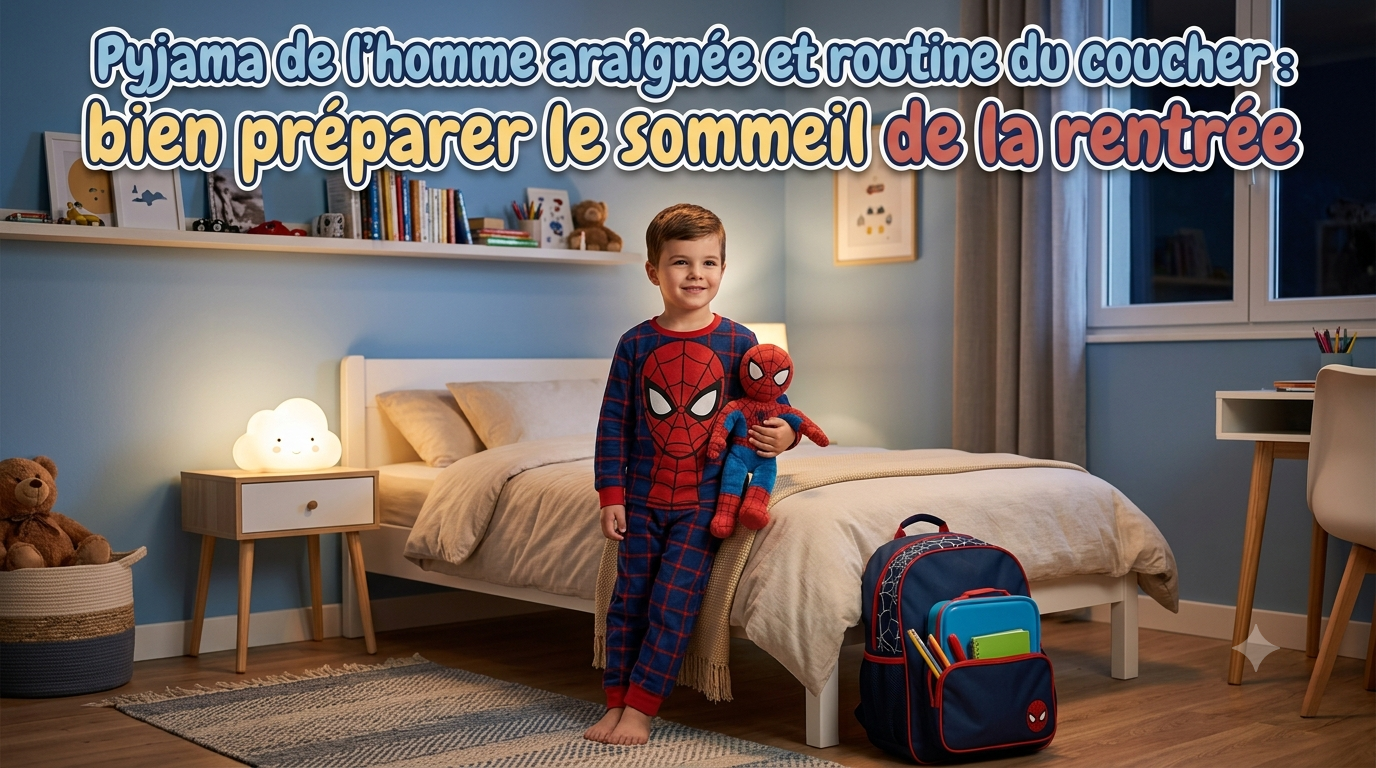
The new school year is coming, and with it that familiar headache every parent knows: getting the children back into bed at a reasonable hour after a summer in which bedtimes have quietly drifted towards midnight. The long holidays have their charm, but they often leave behind body clocks that are completely out of step. The good news: there is an unexpected ally for taking back control of your child's sleep, and it wears a red and blue mask. The Spider-Man pyjama set, far from being a simple piece of nightwear, can become the centrepiece of a calm, cheerful and above all conflict-free evening ritual. In this article, I am not going to tell you which model to buy according to the season or your child's age: I am going to show you how these pyjamas, chosen with care, concretely help your child find their way back to deep, regular sleep as the new term approaches.
Your child's sleep is no small detail: it is the foundation of their school results, their mood and their growth. A child who sleeps badly learns less well, loses their temper more easily and falls ill more often. And yet, setting up a calm bedtime can feel like an obstacle course. That is exactly where the ritual comes in, and where the collection of Spider-Man pyjamas for children can give you a real helping hand. Not by magic, but because a child's brain loves clear signals, reassuring repetition and, let's be honest, a hero to admire as they close their eyes.
Back to school = back to a sleep schedule: the real challenge for parents
Over the summer, everything loosens up, and that is normal. The days stretch out, the light lingers, grandparents let them stay up a little longer, and your child falls asleep when tiredness catches up with them rather than at a fixed hour. Within a few weeks, their internal clock — what we call the circadian rhythm — shifts by one to two hours. The problem is that this shift does not vanish on its own on the first day of term. A child used to falling asleep at 10.30pm will find it very hard to drop off at 8.30pm, even if their body needs more sleep to get through a school day.
The challenge for parents, then, is not to force sleep, which is impossible and often counterproductive, but to recreate the conditions that send the brain this message: the day is over, it is time to slow down. That message comes through light, through temperature, through a calm atmosphere, and through a series of predictable steps. This is what sleep specialists call good bedtime hygiene. And within that sequence, the moment when the pyjamas go on holds a far more strategic place than you might imagine.
The ideal is to plan ahead: rather than waiting for the first day of school to put everything back in order, you start shifting bedtime forward by a quarter of an hour every two or three days, ten to fifteen days before term begins. This gradual approach avoids the brutal shock and the Sunday-evening tears. If you are also getting the rest of the school kit ready, our Spider-Man guide to going back to school will help you orchestrate the whole thing, from the school bag to the alarm clock, in step with the evening ritual.

Children's pyjamas
Spider-Man Pyjama Set for Children
Softness and breathability for peaceful nights: Spider-Man watches over their sleep.
Pyjamas as a signal: easing your child gently into sleep
A young child's brain works largely through association. When an action always happens in the same order, it becomes a trigger. That is exactly the principle of the conditioned reflex: the body gets ready for what is coming before it even happens. Putting on pyjamas, if that gesture always sits at the same point in the evening, gradually becomes a powerful physiological signal. Your child does not consciously think 'I am going to sleep', but their body starts slowing down all the same.
That is why it is better not to leave your child in pyjamas all day during the holidays, nor to put them on too early in the evening. Pyjamas must stay associated with the night, and with nothing else. When they become the evening costume, the one you slip on just after the bath and just before the story, they take on a symbolic value. And that is where Spider-Man changes everything: instead of enduring the moment, your child cannot wait to put on their hero's outfit. The dreaded pyjamas become pyjamas they look forward to.
This psychological shift is precious. A child who asks to put on their Spider-Man pyjamas is a child who cooperates with the ritual rather than fighting it. A chore turns into a small daily pleasure. The hero becomes a bedtime companion, a reassuring figure who accompanies the delicate crossing between being awake and being asleep. Some parents tell me their child 'becomes' Spider-Man for the length of the bedtime routine, a role play that relaxes the atmosphere and defuses the usual resistance.
For this signal to work, consistency matters above all else. The same pyjamas, or at least the same kind of pyjamas, put on in the same time slot, in the same calm, softly lit room. The more stable the ritual, the more effective it becomes, week after week. Pyjamas are not a decorative accessory: they are the first link in a chain that leads straight to sleep.
A simple, conflict-free evening ritual with Spider-Man
Most bedtime battles come from a lack of markers. Your child does not know exactly what is coming, so they negotiate, they test the limits, they push the moment back. The answer is not more firmness, but more predictability. A well-built evening ritual comes down to a few always-identical steps, short enough not to drag on, gentle enough to soothe. And Spider-Man pyjamas can act as the thread running through the whole sequence.
A short sequence, always in the same order
Picture a typical evening: the warm bath that relaxes, then putting on the Spider-Man pyjamas as the first step after the bathroom, then brushing teeth, then the story in bed, and finally lights out. Five steps, always the same, always in that order. The pyjamas come early in the sequence, which is what gives them their role as the starting whistle. Once they are on, your child knows where this is going: to bed. There is no longer a grey area or any ground for negotiation.
The hero in the service of calm, not excitement
Be careful, though, not to confuse pleasure with excitement. A child who adores Spider-Man can quickly tip into wild play, leaping about imitating the web-shooters, which is the opposite of what you want at 8pm. The trick is to channel that enthusiasm towards calm. You can, for example, explain that Spider-Man also has to rest to recharge his superpowers, and that a tired hero cannot protect the city. Your child then understands that sleeping is a way of topping up their strength. The pyjamas become the symbol of that recovery, rather than an excuse for a play fight.
This gentle storytelling works remarkably well with young children. You can extend the idea with a Spider-Man soft toy sitting on the pillow, guardian of sleep, keeping watch while your child sleeps. The pyjamas and the soft toy then form a reassuring duo that carries your child into sleep without another word. The ritual becomes a story they tell themselves, and that story helps them let go.

Children's pyjamas
Long-Sleeve Cartoon Spider-Man Pyjamas for Children
Softness and breathability for peaceful nights: Spider-Man watches over their sleep.
No screens, no negotiation once the pyjamas are on
One non-negotiable point for good-quality sleep: once the pyjamas are on, the screens go off. The blue light from tablets and phones delays the production of melatonin, the sleep hormone, sometimes by more than an hour. It is the number one enemy of falling asleep. Pyjamas can act here as a symbolic border: 'when you put on your Spider-Man pyjamas, we switch the screens off, that is the rule of the night'. A child takes on a rule attached to a concrete gesture far more easily than an abstract instruction. The garment becomes the marker of a clear switch between day and night.
Comfort and deep sleep: why the fabric matters at night
We often underestimate the impact of physical comfort on sleep quality. A child who is too hot, who sweats or who is bothered by a stiff seam wakes more often during the night, usually without even remembering it in the morning. These micro-awakenings fragment sleep and prevent them from reaching the deep phases, the ones that repair the body and consolidate what was learnt during the day. Pyjamas are therefore anything but neutral: the fabric directly influences how deep the sleep goes.
Body temperature, the key to falling asleep
To fall asleep, the body has to lower its core temperature slightly. It is a fundamental physiological mechanism. If your child is too heavily covered, this natural cooling is hampered and sleep is slow to come. Conversely, a child who is cold wakes up and goes looking for the blankets. The right pyjamas are therefore the ones that breathe, that wick moisture away and that support this thermal regulation rather than working against it. A soft, breathable fabric, such as a good-quality cotton, helps the body find its point of balance.
That is also why you should match the thickness of the pyjamas to the temperature of the bedroom, ideally around 18 to 19 degrees for good sleep. At the start of the school year, the evenings are often still mild: light, airy pyjamas will be more comfortable than a thick all-in-one. Without turning this into a shopping comparison, do bear in mind that choosing the right fabric for the time of year makes a real difference to the nights. If you want to dig into that particular point, our dedicated article explains how to decide between winter or summer pyjamas depending on the season, a useful companion read for fine-tuning night-time comfort.
The reassuring feel that helps them let go
Beyond temperature, there is sensation. The touch of a soft fabric against the skin switches on a feeling of safety in a child. It is almost a permanent caress, a cocoon wrapped around them. This sensory dimension matters particularly for children who are sensitive or anxious and who need bodily markers in order to relax. Spider-Man pyjamas that feel pleasant to the touch, with no scratchy label or rubbing seam, become a transitional object that eases the passage into sleep. The fact that they carry the hero's image adds a further layer of comfort: your child feels protected, watched over, safe.
Here is a short table summing up the concrete influence of comfort on the different stages of bedtime, without turning you into a sleep expert overnight.
| Comfort factor | Effect on sleep |
| Breathable fabric | Avoids overheating and night-time micro-awakenings |
| No uncomfortable seams | Reduces restlessness and unconscious awakenings |
| A cut that is neither too tight nor too loose | Allows movement without restriction, encourages deep sleep |
| Soft, reassuring feel | Switches on relaxation and a feeling of safety |
As you can see, comfort is not a luxury: it is a direct lever on the quality of the nights. A child who feels good in their pyjamas falls asleep faster and sleeps more deeply, which shows the next day in an easier wake-up and a steadier mood.
Independence: the child who puts their pyjamas on all by themselves
There is one often-forgotten dimension of the bedtime ritual: independence. Learning to put your pyjamas on by yourself is a small daily victory that feeds a child's self-confidence. And that confidence, earned in the evening, spills over widely into the rest of the day, school included. A child who feels capable of managing their own bedtime is a child who approaches the new school year with more assurance.
Spider-Man pyjamas lend themselves particularly well to this learning. Their simple shape, with no complicated buttons or awkward fastenings, lets a child put them on without an adult's help. And when you are too small to manage it first time, the desire to wear your hero's outfit is a tremendous motivation to keep trying. Children often learn to dress themselves faster when they like the garment. Desire becomes the engine of learning.
To encourage this independence, you can turn getting dressed into a game: 'can Spider-Man put his costume on all by himself, like a grown-up?'. You praise every bit of progress and resist the urge to step in and do it for them. This little bit of theatre takes the sting out of failure and celebrates every success. Little by little, the gesture becomes automatic, and one more automatic gesture in the ritual means one less reason for conflict for parents.
This logic of independence does not stop at pyjamas, of course. It fits into a wider whole in which your child takes charge of their routine, from choosing their daytime clothes to getting their school bag ready. Many parents put together a coherent little Spider-Man wardrobe that stays with their child from morning to night. The Spider-Man T-shirts for children thus naturally complement the pyjamas for anyone who wants to extend the hero's world beyond the night, while still leaving your child the pleasure of choosing their own outfit.

Children's pyjamas
Summer Spider-Man Pyjamas for Children
Softness and breathability for peaceful nights: Spider-Man watches over their sleep.
Rebuilding the rhythm after the holidays, night after night
Putting a sleep schedule back in place does not happen in one night. It is a patient piece of work spread over one to two weeks, and the pyjama ritual is the thread running through it. The guiding idea is regularity: fixed times for going to bed and getting up, weekends included at the start, so as not to ruin the progress built up during the week. The body needs these regular markers to reset its internal clock.
Bringing bedtime forward in small steps
Rather than abruptly imposing an 8pm bedtime when your child was falling asleep at 10pm in August, you bring bedtime forward by ten to fifteen minutes every two days. Each evening the ritual stays identical, only the time slips almost imperceptibly. This gentle method respects your child's biological rhythm and avoids long stretches spent turning over in bed without finding sleep, a source of anxiety and of negative associations with bedtime. The Spider-Man pyjamas, put on a little earlier each evening, accompany that shift without your child experiencing it as a punishment.
Morning light, the other forgotten lever
We often think about the evening and rarely about the morning. Yet exposing your child to natural light as soon as they wake is one of the most powerful signals for resetting the body clock. Opening the shutters, having breakfast near the window, walking to school: this morning light naturally brings forward the time they fall asleep in the evening. The bedtime ritual and the waking ritual thus form a virtuous circle. The pyjamas you take off in the morning mark the end of the night, just as the ones you put on in the evening mark its beginning.
Holding firm through the first difficult evenings
The first few nights of readjustment can be hard going. Your child will not necessarily be sleepy at the chosen hour, and that is normal: their body needs time to adapt. The important thing is to hold the framework without making a drama of it. You keep the ritual, you dim the lights, you stay calm, you reassure. Consistency always pays off in the end. Within one to two weeks, most children get back to falling asleep smoothly, and the Spider-Man pyjamas, faithfully there every evening, will have played their part as a reassuring beacon all the way through the transition.
If you are looking to round out this ritual with new pieces suited to the season, or to a child who has grown over the summer, the selection of Spider-Man pyjamas for children gives you plenty to refresh the evening kit while keeping that precious falling-asleep reflex intact. And if pyjamas also strike you as a lovely thing to give, our article on giving Spider-Man pyjamas as a gift will give you further ideas, without ever losing sight of the essential: a child who sleeps well is a happy child.
To take the consistency of the wardrobe further, some parents like to think of the hero's world for all the siblings, or even for the grown-ups. Our round-up of Spider-Man pyjamas for the whole family may inspire anyone who wants to turn bedtime into a shared, companionable moment. And to get the sizing right over the years, the reference point provided by our guide to which Spider-Man pyjamas to choose by age remains a practical read, worth keeping to hand for the next growth spurt.
FAQ: pyjamas and children's sleep at the start of the school year
From what age is a bedtime ritual with pyjamas useful?
A bedtime ritual is beneficial from the first months, but it really becomes structuring from the age of two or three, when a child understands the sequence of steps. Pyjamas can play their part as a signal from that age. The earlier the ritual is put in place and the more consistently it is kept up, the more effective and the easier to follow it becomes, for child and parents alike.
How long does it take to reset sleep after the holidays?
In general, one to two weeks are enough to reset a child's body clock, provided you bring bedtime forward gradually, by ten to fifteen minutes every two days, and keep regular hours at weekends too. Morning light speeds up that readjustment. Ideally you start this work about ten days before term begins, to avoid any brutal shock.
Do pyjamas really have an impact on sleep quality?
Yes, on two levels. Physically, a breathable fabric and a comfortable cut prevent the overheating and micro-awakenings that fragment sleep. Psychologically, pyjamas that always go on at the same moment become a sleep signal that prepares the brain for the night. A child who feels good in their pyjamas and associates them with bedtime falls asleep faster and sleeps more deeply.
How do I stop my child getting over-excited when putting on superhero pyjamas?
The key is to channel the enthusiasm towards calm rather than play. You can explain that the hero also has to rest to recover his strength, which gives sleep a purpose. You keep the lighting soft, switch the screens off as soon as the pyjamas go on, and move quickly on to the story in bed. That way the pyjamas stay linked to rest, not to an evening play fight.
Do I need different pyjamas for the start of term when it is still warm?
At the start of the school year, evenings are often still mild, and light, breathable pyjamas will be more comfortable than a thick outfit. The aim is to support the slight drop in body temperature needed to fall asleep. You simply match the thickness to the temperature of the bedroom, ideally around 18 to 19 degrees, without turning it into a complicated buying criterion: thermal comfort is what counts for deep sleep.

