

14-Day Money-Back Guarantee
0
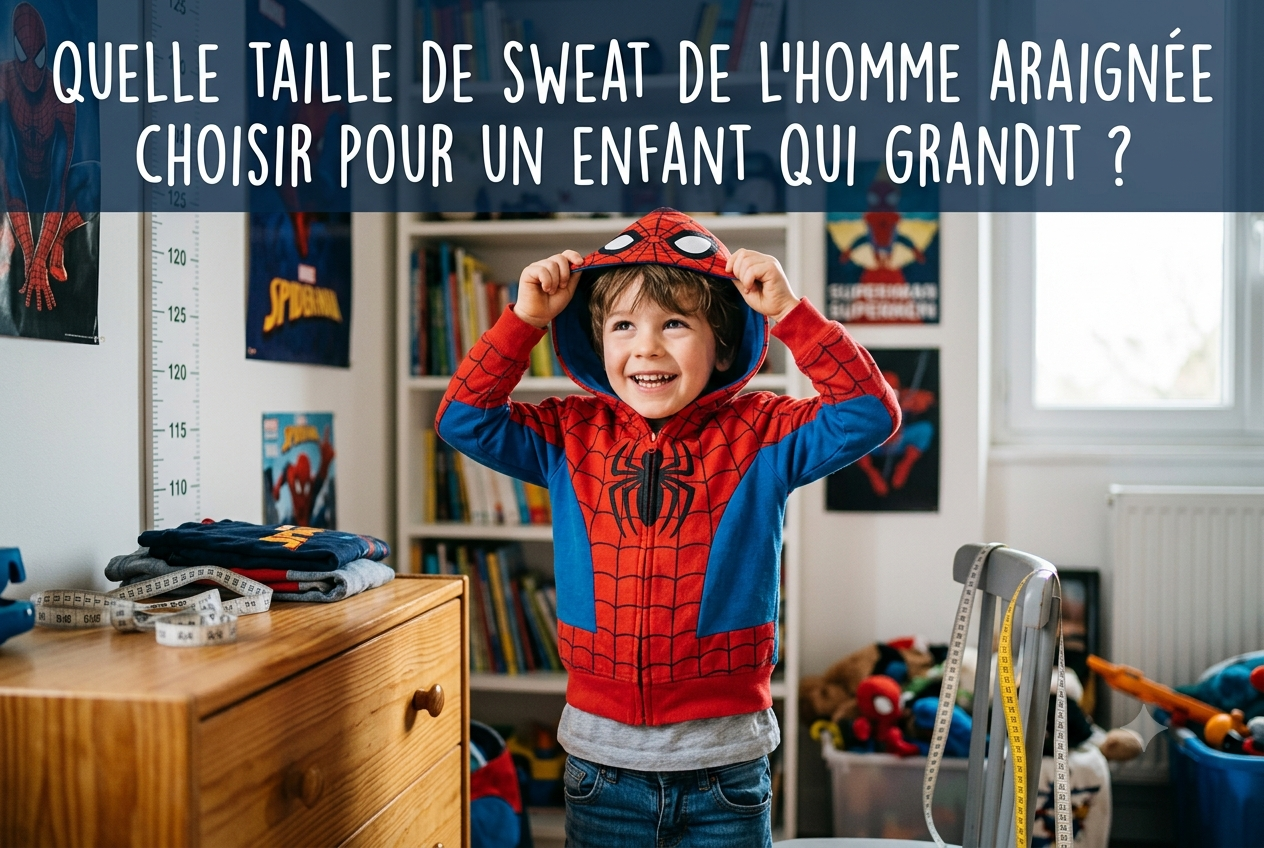
You know the scene by heart. You have finally got your hands on the Spider-Man jumper your child has been asking for for weeks, you check the label, and then the doubt hits you. That age 6 size, how long will it actually fit? Three months? Two winters? Your little hero grows several centimetres a year, performs stunt after stunt on the sofa and flatly refuses anything that itches, pinches or restricts his movement. Choosing the right jumper size for a growing child is no small detail: it is the difference between a garment worn happily for two seasons and a purchase that ends up forgotten at the back of the wardrobe because it pulls at the shoulders or drowns the child in fabric.
Good news: there is a simple, reliable and repeatable method for getting it right every time. No superstition, no risky bet on future growth. Just three measurements to take, a size guide to read properly, and a clear-headed choice between the exact size and the size up. In this guide I walk you through it step by step, so you can choose a Spider-Man jumper that fits perfectly today and stays with your child as long as possible without ever sacrificing comfort or freedom of movement. If you are looking for the ideal model, our whole range of Spider-Man jumpers and sweatshirts for children comes with a detailed size guide on every product page, which makes the choice far less stressful.
The size headache with a growing child
Children grow fast, and above all they grow unpredictably. Between the ages of 3 and 10, most children gain an average of 5 to 7 centimetres a year, but these spurts are neither regular nor announced in advance. Your son may stay the same for six months and then shoot up four centimetres in a single term. That is exactly what makes choosing a jumper size so tricky: at the moment you buy, you have no idea where he will be in four months' time. And a jumper, unlike a T-shirt you replace often, is something you want to keep for a long time, because it represents a real emotional and financial investment.
The classic trap is to think only in terms of age. 'He is 6, so I will take the age 6.' Except that sizes in years are an average indication, not a universal truth. Two children of the same age can be ten centimetres apart. A tall, slim child will not wear the same size as a small, sturdy one, even if they were born in the same month. Trusting age blindly means tossing a coin with your child's comfort. The only data that never lie are the real measurements: chest, arm length and body length.
There is a psychological dimension not to be overlooked either. A child who loves Spider-Man wants to feel good in his jumper, to recognise himself in it, to pull it on by himself, to run, climb and mime web-shooting without the fabric getting in the way. A garment that is too tight frustrates him and he will sulk about wearing it. A garment that is too big makes him look swamped, the sleeves fall over his hands and he loses the freedom that is the whole joy of a super-hero outfit. The aim, then, is not simply 'that it fits', it is that your child feels both free and proud. To get there, everything starts with accurate measurements.

Children's jumper
Cartoon Spider-Man Jumper for Children
Warm, soft and easy to pull on all by themselves: the perfect jumper for chilly back-to-school mornings.
Measuring your child properly: the 3 measurements that count
Forget the scales and the height chart in the red book. For a jumper, what really counts is neither weight nor even standing height, but three precise measurements you can take in five minutes with a simple dressmaker's tape measure. If you do not have one, a piece of string and a ruler will do the job perfectly. Take them on a child wearing a thin T-shirt, not a thick jumper, otherwise everything will be off. And turn the moment into a little game: 'let's take Spider-Man's measurements!' Children love it, and you will get far more reliable numbers than with a child who keeps wriggling.
The chest measurement, the one that rules
This is the most important measurement for a jumper, the one that decides whether the garment will pinch or hang loose. Place the tape measure horizontally around your child's torso, at the fullest part of the chest, just under the armpits. The tape should lie flat, neither tight nor slack: you should be able to slip one finger underneath without it gaping. Ask your child to breathe normally and keep his arms by his sides. Write the number down in centimetres. This is the figure you will compare first with the size guide, because a jumper that catches at the shoulders or squeezes the ribcage will always end up rejected by the child.
Arm length, for sleeves that fall just right
Nothing annoys a child more than sleeves that cover his hands or, the other way round, stop halfway down the forearm. To measure properly, ask him to hold his arm out slightly bent, as if he were about to shoot a web. Start at the top of the shoulder, follow the outside of the arm past the elbow, and stop at the wrist. This measurement is crucial, because children often have long arms in relation to their torso during growth phases. A jumper that fits perfectly at the chest but is too short in the sleeve will always feel like a garment that has been outgrown. Write this figure down: it will help you enormously in settling the famous size-up dilemma.
Body length, for the right overall length
The third measurement, often forgotten, concerns the total length of the jumper. Measure from the base of the neck at the back, down along the spine to the point where you want the jumper to stop, usually at the top of the hips. This figure avoids two pitfalls: the jumper that rides up and exposes the lower back when the child raises his arms, and at the other extreme the jumper that is too long, reaching down the thighs and hampering walking. With these three measurements noted on a scrap of paper, you are equipped to read any size guide without going wrong. Keep them safe, they will serve you for every future purchase until the next big growth spurt.
Exact size or one size up? Making the right call
Here is THE question that torments every parent faced with a jumper for children. Do you take your child's exact size today, or anticipate growth by going up one size? There is no universal answer, but there is a clear logic that depends on three factors: the time of year, your child's temperament, and where he is in his growth. Let me give you the keys to decide calmly, with no regrets and no waste.
The golden rule is to always start from the real chest measurement. If your child's measurement falls squarely in the middle of a band in the size guide, take that size: it will fit him perfectly and leave him room for a few months. The real dilemma arises when the measurement falls at the top of a band, on the edge of the next size up. In that case, if you are at the start of the cold season, in autumn, go for the size up: the child will grow over the winter and you want the jumper to last until spring. If you are buying at the end of winter, you may as well take the exact size; you will get your money's worth over the end of the season and it will still be wearable the following winter as a thin layer. The subject is covered in more detail in Spider-Man compression T-shirt: what it is for and how to choose it.
One size up, yes, but not two
The most common mistake, and the most understandable, is wanting to 'go big' by jumping two sizes so as to be sorted for two years. Do not do it. A jumper that is too big is not a jumper that will last, it is a jumper your child will refuse to wear. The sleeves fall over his fingers, the shoulders droop, the length reaches mid-thigh, and above all he does not feel he is in a super-hero garment but in a sack. A child needs to feel the garment moving with him to feel as agile as Spider-Man. Two sizes up means comfort sacrificed on the altar of a durability that will not materialise anyway, since he will snub the jumper for the first six months.
One size up, and only one, is the right compromise. It gives a few centimetres of leeway that your child will fill as he grows, without swamping him straight away. To make that leeway even easier to live with in the first few weeks, a few simple tricks: roll the sleeves up once or twice, choose a model with ribbed cuffs and hem that 'take up' some of the length, or pair the jumper with a layer underneath that adds volume at the chest. That way the size up falls almost right from day one and becomes perfect over the months.

Children's jumper
Marvel Spider-Man Hoodie for Children
Warm, soft and easy to pull on all by themselves: the perfect jumper for chilly back-to-school mornings.
Adapt the decision to your child's temperament
Not all children react the same way to a garment that is slightly big. A child who is not fussy, who puts on whatever he is given without complaint, will get on very well with a size up. A child who is sensitive to how things feel, who hates anything hanging or flapping, will be far happier with an exact fit, even if it means buying another jumper a little sooner. You know your child better than anyone: factor that in. The best jumper is not the one that theoretically lasts the longest, it is the one your child wants to wear every day. To choose between different cuts according to age and build, our guide to dressing your child in Spider-Man by age group is the perfect companion to this discussion of sizing.
Reading a Spider-Man size guide without going wrong
A size guide is there to be read, not guessed at. Many parents skim the table, spot the age and click. That is where nasty surprises are born. Take three minutes to cross-check your measurements against the columns of the table and you will cut the risk of getting it wrong tenfold. Here is how to go about it in practice, and what a well-built size guide for a children's Spider-Man jumper looks like.
| Indicative size | Chest (cm) | Arm length (cm) | Body length (cm) |
| 3-4 years | 54-57 | 31-33 | 38-40 |
| 5-6 years | 58-61 | 34-37 | 41-44 |
| 7-8 years | 62-66 | 38-41 | 45-48 |
| 9-10 years | 67-71 | 42-45 | 49-52 |
This table is indicative: every brand has its own cut, and that is precisely why your measurements always take precedence over the age shown. The method is simple: take the chest measurement you noted, find the row it falls into, then check that your child's arm length and body length correspond roughly to the same row. If all three figures point to the same size, you have your winner. If they diverge, give priority to the chest, because it is comfort at the torso that determines everyday wear, even if that means rolling up sleeves that are a touch long.
The trap of 'garment' measurements versus 'body' measurements
Watch out for one detail that catches out a huge number of parents. Some guides give the measurements of the child's body, others give the dimensions of the garment laid flat. These are not at all the same thing! A 'body' chest measurement of 60 cm corresponds to a garment whose circumference is wider, because you need ease to move. If the guide specifies 'product measurements', always mentally add 4 to 8 centimetres of ease over your child's body, otherwise the jumper will cling. If in doubt, the wording is usually given at the top or the bottom of the table. A serious guide always says which; on our product pages this information appears clearly so you avoid any misreading.
One last recommendation: always read the customer reviews where they exist. Comments such as 'comes up small, take a size up' or 'comes up big' are worth their weight in gold, because they reflect real experience of that particular model. Cross-check that information with your measurements and you will reach an almost foolproof decision. The same reasoning applies to your hero's other clothes, by the way: our guide to the ideal Spider-Man T-shirt by age uses the same measuring method for a lighter garment.
Cut: sleeves, shoulders and length for easy movement
A good size on paper is not enough if the cut does not follow. Two jumpers of the same size can hang very differently depending on their cut: one fitted and close to the body, the other loose and relaxed. For a child who never stops moving, the cut is almost as important as the size itself, because it is what determines freedom of movement. Let us break down the key areas to watch so your little hero can climb, jump and fire his imaginary webs without ever being held back.
Shoulders and armholes, the critical area
This is the point that forgives least. A jumper can be a little wide at the chest without any problem, but if it is tight at the shoulders, that is a deal-breaker: the child can no longer raise his arms freely, the fabric pulls, he feels restricted. Check that the shoulder seam falls right at the edge of the shoulder, neither on the upper arm nor halfway across. A slightly roomy armhole is preferable to a tight one, because it allows full scope for quick movements and climbing. It is also the area that becomes too small first when the child grows and broadens out, which is why it pays not to cut it too fine there.
Sleeves and cuffs, allies of growth
Sleeves are your best margin for manoeuvre against growth. A jumper whose sleeves are slightly long to begin with turns out to be ideal: they are rolled up at first and unrolled progressively as the arms lengthen. Favour models with ribbed cuffs, those elasticated edges that hold the sleeve in place, stop the fabric sliding over the hand and add a few centimetres of useful life to the garment. Sleeves that are already too short on the day of purchase are a bad sign: they will look ridiculous in two months. A good benchmark: at rest, the sleeve should cover the wrist without swallowing the hand.
Body length and the ribbed hem
The ideal length for a jumper stops at the top of the hips or just onto the top of the bottom. Too short and it rides up as soon as the child raises his arms, exposing the lower back, which is hardly comfortable in winter. Too long and it comes down the thighs and hampers movement and walking. Here again, a ribbed hem makes all the difference: it hugs the waist, holds the fabric a little and gives an elegant margin for growth, because even as the child grows the hem rides up gracefully without the jumper looking too small. The cut also influences the overall look; if you are hesitating between several styles, our guide to Spider-Man jumper styles will help you choose the silhouette your child will like best.
A final word on the hood, which changes the cut at the shoulders and the nape. A hooded model hangs slightly differently from a crew-neck jumper, with a little more volume at the top of the back. It is not strictly a sizing criterion, but it does affect how comfortable the jumper feels. If you are wondering about this choice, our article devoted to the question with or without a hood for a Spider-Man jumper covers it fully without overlapping the sizing considerations set out here.
Making it last 2 seasons without sacrificing comfort
The ultimate goal of every canny parent: a jumper that sees out two winters. It is possible, but it is set up at the moment of purchase and cultivated through care. A well-chosen, well-cared-for jumper really can stay with your child for two seasons, going from 'a bit big in the first year' to 'spot on in the second'. That is the ideal scenario, and there is nothing magic about it: it rests on concrete choices and a few simple habits that I set out here.
Anticipating growth without drowning your child
To last two seasons, the winning strategy is to buy one size up at the start of the cold season, but only one, betting on models with ribbed cuffs and hem that take up the leeway. In the first year you roll the sleeves up slightly and the jumper hangs correctly thanks to a layer underneath. In the second year the child has grown, the leeway is used up, the sleeves are unrolled, and the jumper fits spot on. Comfort is never sacrificed, because the initial margin stays reasonable and perfectly wearable. That is the whole art of the decision discussed above, applied with a two-year view rather than a single season.
Care, the detail that makes it last
A badly washed jumper shrinks, and a jumper that shrinks becomes too small before its time, ruining your fine two-season strategy. The rule is simple: wash at 30 degrees, avoid the tumble dryer, which is cotton's worst enemy, and dry in the open air, flat or on a hanger. Turn the jumper inside out to protect the Spider-Man print, whose bright colours are the whole charm of the garment in your child's eyes. A print that stays vivid keeps a jumper wanted; a cracked, faded print ends up snubbed even if it still fits. Good care therefore preserves both the size and the desire to wear it.
How do you know when the jumper really has become too small? Three signals do not lie. First, the sleeves sit well above the wrist even when fully unrolled. Next, the hem rides up over the tummy and no longer covers the hips. Finally, and most tellingly, the child complains that 'it is tight' at the shoulders or refuses to put it on. As soon as two of these signals appear, it is time to move up a size. Never force a child to wear a jumper that has become too small: not only is it uncomfortable, it can genuinely hamper his freedom of movement and his enjoyment of playing.

Children's jumper
Classic Spider-Man Hoodie for Children
Warm, soft and easy to pull on all by themselves: the perfect jumper for chilly back-to-school mornings.
One last tip to maximise both lifespan and comfort: think in layers. A jumper that is a little roomy in the first year goes perfectly over a light Spider-Man T-shirt, which adds a warm layer and fills out the volume. That way you get your money's worth out of two complementary garments. Our Spider-Man T-shirts for children coordinate ideally with the jumpers from the same range to build a complete outfit that grows with your child. And if you are looking for a gift that is guaranteed to hit the mark, our complete guide to Spider-Man gifts is packed with ideas, with the jumper at the top of the list.
You now have everything you need to choose the perfect size: three reliable measurements, a clear-headed decision between the exact size and the size up, a careful reading of the size guide and an eye on the cut. This method turns a stressful purchase into a calm decision. To put everything you have just read into practice straight away, browse our selection of Spider-Man jumpers for children: every model displays its detailed size guide, so all you have to do is compare it with your measurements to get it right first time. And if you would like to widen your thinking to overall comfort, warmth and style beyond the question of size alone, our complete buying guide to the Spider-Man jumper takes over and rounds off everything we have just covered.
FAQ: size and cut of the children's Spider-Man jumper
Should you go one size up for a children's Spider-Man jumper?
Going one size up makes sense if you are buying at the start of the cold season and your child's chest measurement falls at the top of a band in the size guide. One size up only, never two, so as not to swamp the child. Then choose a model with ribbed cuffs and hem that take up the leeway: the jumper hangs correctly from day one if you roll the sleeves up a little, then becomes perfect over the months.
How do I measure my child to choose the right jumper size?
Take three measurements with a tape measure, on a child wearing a thin T-shirt. The chest, around the torso under the armpits, tape lying flat. The arm length, from the top of the shoulder to the wrist, past a slightly bent elbow. The body length, from the base of the neck down to the hips. Then compare these figures with the size guide, giving priority to the chest, which determines everyday comfort.
My child grows fast, how do I make his jumper last two winters?
Buy one size up at the start of the season, with ribbed cuffs and hem, and wash at 30 degrees with no tumble dryer to avoid shrinkage. In the first year, roll the sleeves up and layer a T-shirt underneath to fill out the volume. In the second year the child has grown and the jumper fits spot on. Careful care that protects the Spider-Man print also keeps the desire to wear it intact across both seasons.
How do I know if the jumper has become too small?
Three clear signals. The sleeves sit above the wrist even when fully unrolled. The hem of the jumper rides up over the tummy and no longer covers the hips. And above all, the child complains that it is tight at the shoulders or refuses to put it on. As soon as two of these signs appear, move up a size: a jumper that is too small genuinely hampers freedom of movement and the enjoyment of playing.
Is the age shown on the label enough to go by?
No, age is only an average indication. Two children of the same age can be ten centimetres apart depending on their build. The only reliable data are your child's real measurements cross-checked with that model's size guide. Also check whether the guide gives body measurements or those of the garment laid flat, and read the customer reviews, which often flag whether a model comes up big or small.

