

14-Day Money-Back Guarantee
0
The short answer
Spider-Man video games span more than forty years, from the Atari 2600 title released in 1982 to Marvel's Spider-Man 2, which landed on PS5 in 2023. The decisive turning point came in 2004: Spider-Man 2 on PS2 invented free open-world web-swinging, a formula Insomniac Games brought to maturity from 2018 onwards.
Few fictional characters have kept video games company for as long as the web-slinger. When the first cartridge bearing his name arrived on the Atari 2600, the medium was still finding its feet and fitted into a few kilobytes. Forty years later, a home console rebuilds Manhattan street by street and lets you cross the entire island without a single loading screen. Between those two markers, some thirty titles tell a double story: that of a hero studios took decades to understand, and that of a technology that took just as long to do his movement justice.
This feature retraces that trajectory generation by generation, stopping on the games that genuinely mattered and on the reasons some have aged better than others. It also works as a starting point towards the detailed analyses devoted to each major title, and complements the general overview of Spider-Man video games which catalogues the library as a whole.
The first steps: when Spider-Man fitted into a few kilobytes
The story begins in 1982 with a game published by Parker Brothers on the Atari 2600. The principle fits into one sentence: climb up a building by firing webs, defuse bombs, avoid the Green Goblin perched at the top. No memorable soundtrack, no narration, a hero reduced to a handful of red pixels. And yet the essentials are already there: verticality, the web as a means of travel, the climb as a gameplay loop. The very first Spider-Man video game on the Atari 2600 deserves a closer look, because it sets out a constraint every successor would have to solve: how to give the sensation of falling without making the player afraid to jump.
The following decade multiplied the attempts without many of them succeeding. The Amazing Spider-Man arrived on Game Boy in 1990, in black and white, mixing platforming with short puzzles. Spider-Man vs. The Kingpin landed on the Mega Drive in 1991 and became one of the most played titles of its generation, with its gallery of villains borrowed from the comics and a countdown that pushes the player to finish fast. In 1994, Spider-Man and Venom: Maximum Carnage transposed one of the most violent arcs of the era into a beat 'em up on Super Nintendo and Mega Drive, with a backup system that calls in Venom or Captain America to the rescue. These games share one common flaw: they treat Spider-Man as just another platform character. Web-swinging is an animation here, not a mechanic.
That period nevertheless remains the one collectors chase hardest, and it is often what inspires the retro artwork you find today on Spider-Man posters in pixel or screen-print style. Anyone who loves that aesthetic will find enough to cover a whole wall in the poster guide organised by style.
The PlayStation golden age: 3D learns to swing
The real technical turning point arrives in 2000. Developed by Neversoft, the Spider-Man of the first PlayStation makes a radical choice: dropping side-scrolling for a free camera and a hero able to climb any surface. The game also brings in the voices from the 1990s animated series, which creates a lasting association between a vocal tone and the character for an entire generation. Its sequel, Enter Electro, released the following year, adds powers and enemies but stays in the same mould, with a New York suggested by a haze rather than genuinely modelled.
In 2002, the adaptation of Sam Raimi's film rode the tidal wave of the feature on PS2, GameCube and Xbox. It works commercially, far less so artistically: the swinging attaches to thin air, literally, since the webs anchor to nothing at all. It is that detail, invisible to a player in a hurry but decisive with a controller in hand, that the next game would fix and turn into a revolution.
CONSOLE — PS5 faceplate

Marvel Spider-Man 2 PS5 Console Cover
34,90 €
The console that runs the game deserves to wear its colours: the faceplate swaps over in seconds, no tools needed.
Discover →2004, the year everything changed
Developed by Treyarch, Spider-Man 2 came out on PS2 in 2004 and did something nobody had attempted: anchoring every web to a real building in the environment. The consequence is enormous. The player stops enduring an animation and starts piloting a pendulum. You have to aim, anticipate the height of the next building, let go at the right moment to convert the fall into speed. The city is no longer a corridor but a physical playground, and Manhattan becomes, for the first time, a map you learn by heart.
That system has aged so well that twenty years on, players still cite it as the benchmark in debates about the best traversal system in the medium. The detailed analysis of the web-swinging revolution revisits the design choices that made it possible, and what the studios that followed took fifteen years to rediscover.
The following year, Ultimate Spider-Man pushed the logic somewhere else. Adapted from Brian Michael Bendis's run, it adopts cel-shaded rendering that mimics Mark Bagley's line work and alternates sequences between Peter Parker and Venom. Playing the symbiote, with its greater speed and a health gauge that drains constantly, offered a contrast in pacing that was rare at the time. This game remains the best argument in favour of a committed art direction rather than approximate realism — a debate that has never left the franchise and that is carried on today by the Spider-Man figures released in both comics and film versions.
The experimental years: multiverse, black suit and fatigue
From 2006 to 2014, the franchise searched for its direction. Spider-Man 3, timed to the 2007 film, suffers by comparison with its predecessor: the open world is bigger but less dense, and the missions repeat themselves. Web of Shadows, in 2008, tries an interesting idea by letting the player switch at will between the red suit and the black suit, each with its own skill tree and its own narrative consequences. The execution stays uneven, but the principle of a hero choosing his darker side mid-action foreshadows mechanics that would resurface much later.
Beenox then takes over, with the best idea of the period. In 2010, Shattered Dimensions has four versions of the character coexist in the same game: the classic Amazing, the 1930s Noir built on stealth, the 2099 specialising in free-fall sequences, and the Ultimate carried by the symbiote. Each universe has its own visual style, its own pacing and its own voice cast. This four-universe game remains one of the best entry points into the idea of a spider multiverse, long before cinema seized on it. Its sequel, Edge of Time, brought together in 2011 the fates of Peter Parker and Miguel O'Hara, the anti-hero from the future, with a causality principle in which one character's actions alter the other's era.
The two adaptations of The Amazing Spider-Man, in 2012 and 2014, closed the period on a commercially flat note. At that point, many players thought the licence was worn out. It was worn out above all by a model: the licensed game shipped at the same time as a film, on a schedule that rules out any risk-taking.
SETUP — Mouse mat

Marvel Spider-Man Mouse Mat
34,90 €
The extra-large format covers keyboard and mouse in one piece: the desk becomes a backdrop, not just a work surface.
Discover →2018: Insomniac Games reshuffles the deck
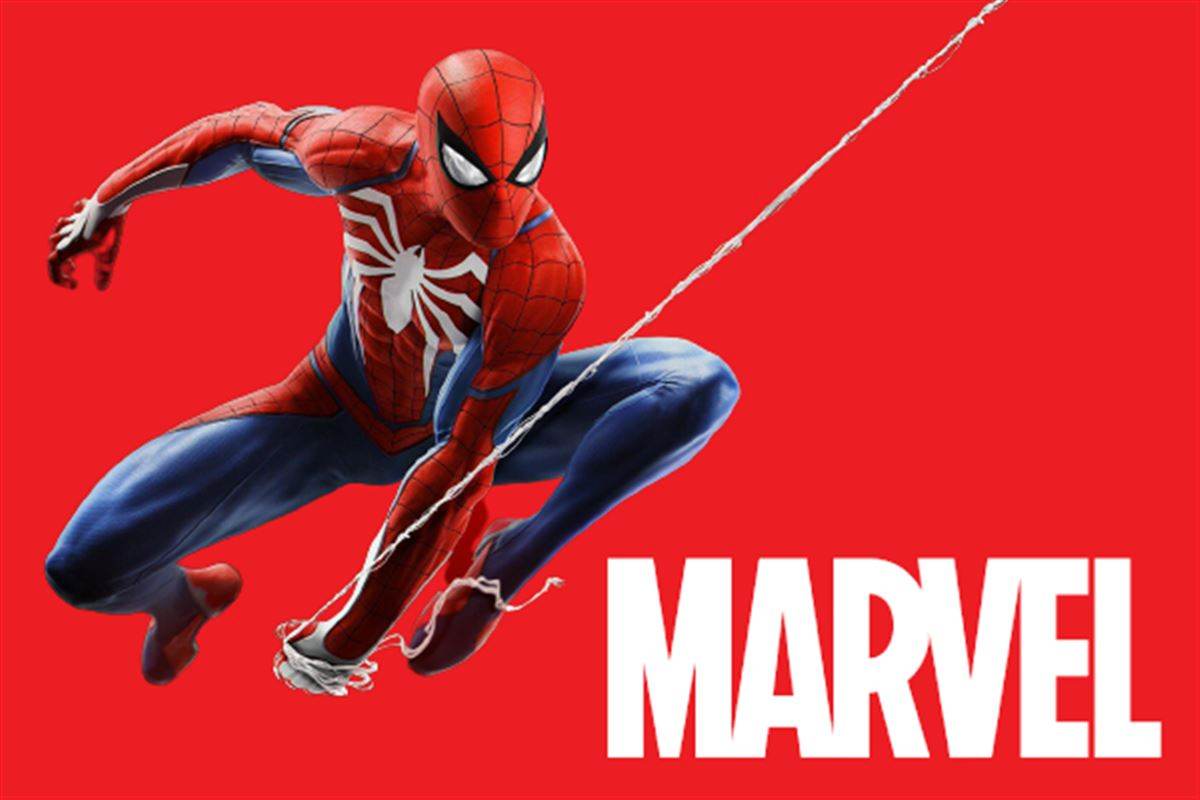
Marvel's Spider-Man came out on PS4 in 2018 and immediately put the franchise back on top. Insomniac Games made one structuring decision: not to adapt a film. The story is original, and the Peter Parker you play is twenty-three, with eight years of experience, overdue rent and a complicated relationship with Mary Jane. That maturity changes everything, because it frees the game from having to retell an origin the audience already knows by heart.
Technically, the swinging finally recovers the precision of 2004 and adds a layer of accelerations, wall runs along façades and free tricks that make the simple trip between two missions a pleasure. The combat, inherited from the Arkham formula but rewritten for a hero who dodges rather than absorbs, forces you to stay in constant motion. The full analysis of the 2018 masterpiece details the way these two systems answer each other.
The game also introduces a collection of unlockable suits drawing on forty years of comics and films, from the Punk suit to the Raimi trilogy suit. That wardrobe has become a subject in its own right, to the point of deserving its own guide to the best suits and how to unlock them.
Miles Morales, the spin-off that changed a character's status
In 2020, Marvel's Spider-Man: Miles Morales accompanied the PS5 launch. Shorter format, different ambition: the point is less to remake the previous game than to give Miles his own tools. Optical camouflage and bioelectric venom blasts change how you read a fight, and the Harlem setting, in the depths of winter, gives the game an instantly recognisable visual identity. This 2020 title launched a new era by establishing Miles once and for all as a fully fledged Spider-Man rather than a stand-in.
Three years later, Marvel's Spider-Man 2 brings the two heroes together on an enlarged map that adds Queens and Brooklyn, and writes the symbiote into the very mechanics of the game. Switching between the two characters, each with their own skill tree, becomes the backbone of an adventure that finally embraces its scale. The breakdown of this new era for Spider-Man looks at what the dual playability brings, and at what it costs the pacing of the story.
COLLECTION — Articulated figure

Spider-Man Articulated Figure - Miles Morales
59,90 €
The hero of the 2020 game, articulated to recreate those gliding poses above Harlem.
Discover →What forty years of games have taught us about the character
One constant runs through this whole history: the games that work are the ones that understood traversal is the real subject. With this hero, getting around is not dead time between two fights, it is the main pleasure. The titles that treated swinging as a technical constraint aged within months; the ones that made it a system in its own right still hold up today.
Second lesson: fragility works better than power. The best moments of the saga are not the boss fights, but the sequences where you play Peter without the suit, where the camera tightens and the pace drops. The franchise took twenty years to accept that the civilian is as interesting as the mask — a balance the comics had found back in the 1960s.
Third lesson, more cultural: video games have become the main gateway into the spider universe for a whole generation. Plenty of players met Miles Morales, the black suit or the multiverse with a controller in hand long before opening their first comic. That shift explains why merchandise around the character has moved towards the living room and the desk, from PS5 console covers to mouse mats, by way of headsets and earphones.
Where to start today, depending on your profile
For a player discovering the franchise with no particular nostalgia, the most comfortable order is to begin with the 2018 game, follow up with Miles Morales for its short format, then finish with the 2023 instalment. The narrative continuity is real and the comfort of play keeps improving, which avoids any sense of technical backtracking.
For a player curious about the history of the medium, the route is different: the 2004 title on PS2 is still playable and instructive, Shattered Dimensions shows what artistic variety brings to a licence, and Ultimate Spider-Man documents an era when cel-shading was still a gamble. All three are best appreciated when you know the context of their release.
For a parent looking for a first experience suited to a child, the question is different again: the recent games carry an age rating that does not suit every age group, and the guides devoted to Spider-Man toys or to LEGO Spider-Man often offer a gentler way into the universe. The brick-by-brick LEGO guide and the guide to collectable figures cover both of those routes in detail.
Getting the setup around the game right
One last point, often overlooked by round-ups: the experience does not stop at the screen. A console on show in a living room is part of the decor, and many players now treat their setup like a display case. Changing the faceplate on a PS5 takes seconds and completely transforms the object; the guide to PS5 console covers by design and setup runs through the models according to the finish you are after, matt or glossy, understated or saturated.
On the desk, the reasoning is the same. A large mat covering keyboard and mouse visually unifies the work surface and removes the patchwork effect of mismatched accessories; the mouse mat guide by design goes through the formats and the surfaces. For the general mood of a room, Spiderman lamps and Spiderman decorations do the rest of the work, without overloading the space.
Finally, for anyone who wants to carry the universe beyond the living room, Spider-Man T-shirts happily reuse the artwork from the box art and the unlockable suits, which makes them the most discreet nod for a long-standing player. The merchandise guide puts these objects back into a logic of collecting rather than one-off buying.
A saga that is far from done reinventing itself
Forty years after the Atari cartridge, the trajectory is clear: every major technological leap has been an opportunity to redefine the character rather than decorate him. The move to 3D gave him a city, physically anchored webs gave him a movement, the power of recent consoles gave him a face and silences. Every time, the studios that succeeded are the ones that agreed to rebuild the formula instead of copying it.
That is probably what explains the longevity of the licence where so many superhero adaptations have burned out. Spider-Man is not a character of power, he is a character of trajectory, and video games are the only medium able to make you feel that trajectory directly, web line after web line, building after building. The next generations of machines will ask the same question as in 1982: what more can be made to feel real, now that everything can be displayed.

