

14-Day Money-Back Guarantee
0
The essentials before you choose
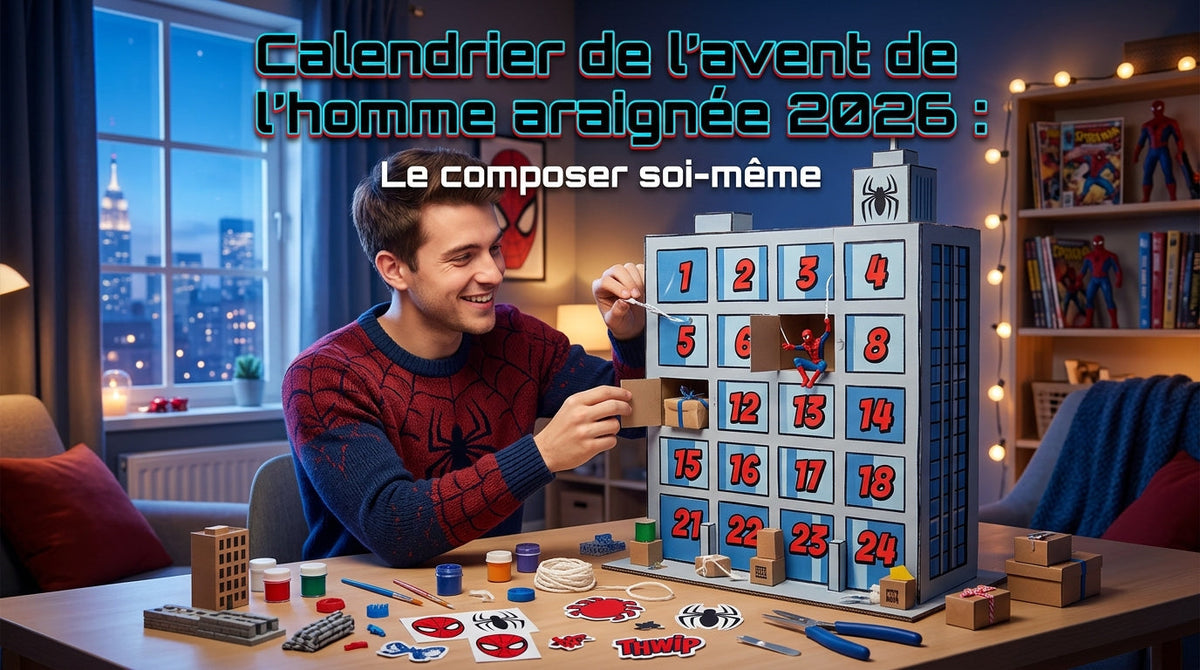
A ready-made Spider-Man advent calendar barely exists in the UK, and the ones you do find are often disappointing. Putting one together yourself costs less, holds what your child actually wants, and can be prepared in a single evening. You need 24 doors, a budget per door, and one rule: the last three days have to be the strongest.
Contents
Every year it is the same story: licensed calendars are expensive, filled with mass-produced chocolate or tiny figures, and the child has run out of interest by 8 December.
Making it yourself solves all three problems at once. Here is how to build it, what to put inside, and the mistakes that spoil the effect.
Why put it together yourself
Three reasons, and not one of them is purely about budget.
You choose what goes in
A shop-bought calendar is generic by design. Yours is tailored to one specific child: their favourite character, what they already collect, what they will genuinely need in January.
That is the difference between twenty-four objects and twenty-four objects that get used.
You control the pacing
The main flaw of ready-made calendars is flatness: every door feels the same. By putting yours together, you place the highlights where you want them — the weekends, 6 December, and above all the final stretch.
The budget is genuinely under control
You decide the price per door and you stick to it. Across twenty-four days, a two-euro difference per door adds up to almost fifty euros — that is where shop-bought calendars make their money back.
The contents
A shop-bought calendar is generic by design. Yours targets one specific child: their character, what they already collect, what they will need in January.
The pacing
The flaw in ready-made calendars is flatness: every door feels the same. You place the highlights where you want them, and above all on the final stretch.
The budget
You decide the price per door and you stick to it. It is across the twenty-four days combined that shop-bought calendars make their money back.
The structure: how much per door
This is the calculation to do first, before buying anything at all.
The three-tier rule
Do not put the same value everywhere. Spread it across three tiers: mostly small doors, a few mid-range doors placed on the weekends, and three headline doors — the 6th, the 24th, and one surprise in the middle.
This structure prevents the fizzle. A child who gets the same thing twenty-four times switches off after a week; a child who does not know which day will be a big day opens every door with the same attention.
A rough order of magnitude
Budget for around fifteen small doors at three to five euros, six mid-range doors at ten to fifteen euros, and three headline doors. The total stays comfortably below the price of one big present, for twenty-four times as many moments.
The budget, in three lines
15 small doors × €3 to 5€45 – 75
6 weekend doors × €10 to 15€60 – 90
Total excluding the headline doors€105 – 165
The container
Twenty-four numbered paper bags hung from a piece of string are enough, and they are often prettier than a box. The advantage: the volumes can vary hugely from one day to the next, which a box of identical compartments rules out.

Spider-Man Logo Pin Badge
The ideal format for the small doors: barely takes up any space, collectable, and it comes in around ten different designs. The full range is in our pin badges.
View product — €14.90What to put in the small doors
This is the bulk of the calendar — around fifteen days to fill without repeating yourself.
Things to collect
The pin badges and the brooches are the ideal filler: small, flat, available in plenty of designs, and they build up. A child who receives six over the course of the month ends up with a collection on their bag or their jacket.
The same logic applies to iron-on patches, which then go on a piece of clothing or a bag — see our patches and our brooches.

Spider-Man Spider Logo Iron-On Patch
A patch to put on a bag or a jacket afterwards: the door costs very little and the object stays visible all year. The full range is in our iron-on patches.
View product — €14.90Useful things
A keyring, a pair of socks, a small piece of school kit: these are the doors that look as though they cost nothing and then get used every single day.
It is also the most elegant way to replace worn-out back-to-school gear halfway through the year, without it feeling like a chore. Our keyrings and our socks cover this category.
For the detail of which formats work at each age, our pencil case guide by age and our water bottle guide cover the two school items that come up most often in a calendar.
The doors with no object
One underrated idea: slipping in vouchers rather than objects. A voucher to choose the film that evening, a voucher for a later bedtime, a voucher for a trip to the cinema.
Those doors cost nothing, break up the rhythm, and are often the ones the child remembers. Plan for three or four.
For the ‘choose the film tonight’ vouchers, our guide to the running order of the films lets you build a coherent programme across the holidays.
To collect
Pin badges, brooches and iron-on patches: small, flat, available in plenty of designs, and they build up on a bag or a jacket.
Useful
Keyrings, socks, a small piece of school kit. The doors that look as though they cost nothing and then get used every single day.
No object
Three or four experience vouchers: choosing the film that evening, a later bedtime, a trip to the cinema.
The mid-range doors and the highlights
This is what separates a pleasant calendar from a genuinely good one.
The weekends
Put the mid-range doors on Saturday and Sunday, when your child has the time to enjoy what they open. A small soft toy, a game, a fancy-dress accessory: something that fills the day rather than three minutes before school.
A soft toy is the safe bet for those doors, provided you pick the right size — our benchmarks are in our article on soft toys, and a web-shooter makes an excellent highlight depending on age, as our web-shooter guide explains.
6 December
Not a date the UK marks, but one that usefully breaks up the first half of the month. It is a good slot for the first real surprise.

Spider-Man Web Shooter
The kind of object that carries a headline door: it fills the afternoon and it gets kept. Find it in our web-shooters.
View product — €34.90The 24th
The last door must never disappoint — it is the one that gets remembered. It can also work as a trailer: an object that hints at what is waiting the next day.
For the main present itself, our Christmas gift guide and our toy guide by age set out the options by age bracket.

Small Spider-Man Soft Toy
The right size for a weekend door: big enough to make the day, small enough to fit in a paper bag. Find it in our soft toys.
View product — €24.90Where to place the three highlights
6 December — the first real surprise1 headline door
A weekend in the middle — the one they are not expecting1 headline door
The 24th — the one that gets remembered1 headline door
The 24 ideas, split by tier
Here is the full breakdown: fifteen small doors at three to five euros, six weekend doors at ten to fifteen euros, and three headline doors placed on 6 December, on a weekend mid-month and on the 24th.
| Tier | Doors | Budget | What to put in | Which days |
|---|---|---|---|---|
| Small | 15 | €3-5 | Pin badges, patches, keyrings, socks, vouchers | School days |
| Weekend | 6 | €10-15 | Soft toy, fancy-dress accessory, book, puzzle, T-shirt | Saturdays and Sundays |
| Headline | 3 | above that | Web-shooter, figure, a longed-for piece of clothing | 6 Dec, mid-month, 24th |
The detail of each tier, and why this split holds up across twenty-four days.
The fifteen small doors
Three or four pin badges in different designs, two or three patches for a bag, a keyring, a pair of socks, a pen or a rubber with the character on it, a small notebook, a sticker for a water bottle.
The principle: objects that get seen, worn or collected. Anything that ends up in a drawer produces no effect at all the next day.
The six weekend doors
A small soft toy, a fancy-dress accessory — mask or gloves — a book or a comic, a pack of cards, a small puzzle, a T-shirt.
These are the doors that fill an afternoon. They alone justify the three-tier structure: without them, the calendar has no relief whatsoever.
The three headline doors
On the 6th, an object that lands — a web-shooter, a figure, a longed-for piece of clothing. On a weekend mid-month, the surprise the child is not expecting. And on the 24th, the door that trails the next day.
Our toy guide by age, type and budget and our guide to choosing a gift for your child help you calibrate those three doors, the only ones where the choice genuinely matters.
The assembly, step by step
Once the shopping is done, allow one evening. The order matters.
Lay everything out before filling anything
Get everything out on a table before you put a single thing in a bag. It is the only way to spot the duplicates, the gaps, and to check that you really do have twenty-four objects — the classic mistake being to have nineteen and to notice far too late.
Distribute before numbering
Place the three headline doors first, then the six weekend ones with a real calendar in front of you, then fill in with the small ones. Check that no two objects from the same family fall less than five days apart: two pin badges back to back and the collection effect disappears.
Number last
Once the distribution is settled, number the bags and close them. If you number first, every change of mind forces you to undo the lot.
Keep a spare door
Set aside one small object, unassigned. It comes in handy the day a door lands less well than expected, or if a bag tears. That happens more often than you would think.
1
Lay it out. Get everything out on a table before you put a single thing in a bag. It is the only way to spot the duplicates and to check that you really do have twenty-four objects.
2
Distribute. Place the three headline doors first, then the six weekend ones with a real calendar in front of you, then fill in with the small ones.
3
Check the gaps. No two objects from the same family less than five days apart: two pin badges back to back and the collection effect disappears.
4
Number last. If you number first, every change of mind forces you to undo the lot.
5
Keep a spare door. One small unassigned object, for the day a door disappoints or a bag tears.
Adapting it by age
The same calendar does not work at four and at eleven.
Three to six years
Favour the visual and the hands-on. At this age, a child does not measure the value of objects but measures size and colour very well indeed — a small colourful object beats a pricier but duller one.
Watch out for small parts. Pin badges and brooches have a sharp fastening: save them for older children, or swap them for patches and keyrings.
Seven to ten years
The ideal age for this format. The child understands the wait, collects happily, and starts to have precise preferences between versions of the character.
This is where things to collect really come into their own, and where experience vouchers work best.
Our Spider-Man guide for children sets out these age benchmarks across the whole range, and our guides and advice hub brings together the buying guides by category.
For the very youngest, under three, the format is not really suitable and our 0-3 years gift guide suggests better-adapted alternatives.
Eleven and over
The calendar is still appreciated provided you move upmarket and cut the number of childish doors. Steer towards the useful and the wearable — accessories, clothing, desk items — rather than towards toys.
Our merchandise guide, our selection of ideas for every age and our selection under €20 offer suitable leads.
3 to 6 years
The visual and the hands-on win. Leave out the pin badges and the brooches: the fastening is a sharp pin. Patches and keyrings instead.
7 to 10 years
The ideal age for the format. The child understands the wait, collects happily, and experience vouchers work best.
11 and over
Move upmarket and cut the number of childish doors. Steer towards the useful and the wearable rather than towards toys.
The container: three formats
The support matters as much as the contents, because it determines what you can put inside.
Hanging bags
The most flexible format, and the cheapest. Twenty-four paper or fabric pouches, numbered, hung from a taut string or from a branch.
Its big advantage: the volumes can be completely different from one day to the next. A soft toy on Saturday, a pin badge on Tuesday, and nothing sticks out. That is what makes the three-tier structure possible.
The compartment box
Visually smarter, and reusable for years. But it imposes one severe constraint: every compartment is the same size, so every object has to fit in the same volume.
If you go for this format, plan the headline doors outside the box — a parcel set beside it, with the number on top.
The wall or the door
Twenty-four envelopes taped into the shape of a tree on a door or a wall. It is the most decorative format, ideal for experience vouchers and small flat objects — patches, stickers, cards.
It sits very well alongside an existing bedroom scheme, as we set out in our article on simple, affordable decorating ideas.
Hanging bags
Twenty-four numbered pouches on a string. The volumes can be very different from one day to the next — that is what makes the three tiers possible.
Compartment box
Smarter and reusable for years, but every compartment is the same size. Plan the headline doors outside the box.
Wall or door
Twenty-four envelopes in the shape of a tree. Ideal for experience vouchers and flat objects — patches, stickers, cards.
Doing it for two children
The trickiest case, and the most common.
Two separate calendars are the simplest solution, but it doubles the budget and it invites comparisons every time. The alternative that works: one calendar, two objects per door where possible, and alternating doors the rest of the time.
In that case, note down who opens which day right at the assembly stage and put it on display. Without a rule written in advance, every morning turns into a negotiation.
And for the doors with a single object — a game, a puzzle — present them explicitly as shared doors. An object agreed to be shared in advance causes no problem at all; the same object discovered to belong to one of the two very much does.
The rule to set before 1 December
Note down who opens which day right at the assembly stage, and put it on display. For the doors with a single object — a game, a puzzle — present them explicitly as shared doors. An object agreed to be shared in advance causes no problem at all; the same object discovered to belong to one of the two very much does.
The mistakes that spoil a calendar
Buying everything on the same day. You end up with twenty-four similar objects. Spread the shopping out and note what you already have so you avoid duplicates.
Putting the best doors at the start. The most frequent mistake of all. The excitement drops off and the last two weeks become a chore.
Neglecting the container. A box of identical compartments forces you to choose objects of the same size, which impoverishes the whole calendar.
Forgetting the school days. An object that needs an hour of play on a Tuesday morning frustrates more than it pleases. Save those for the weekend.
Preparing it too late. The small items are the first to sell out in November. This is an October job, not an end-of-November one.
The five mistakes to avoid
- Buying everything on the same day. You end up with twenty-four similar objects. Spread the shopping out.
- Putting the best doors at the start. The excitement drops off and the end of the month becomes a chore.
- Neglecting the container. A box of identical compartments forces you to choose objects of the same size.
- Forgetting the school days. An object that needs an hour of play on a Tuesday morning frustrates more than it pleases.
- Preparing it too late. The small items are the first to sell out in November.
When to get started
The most practical question, and the one that decides everything else.
Aim for mid-November to have everything in hand, which means starting the shopping in October. The small few-euro objects are exactly the ones that go first as the festive season approaches, because they suit everybody.
Then allow one evening for the assembly: numbering, distributing across the three tiers, checking that no object repeats less than five days apart. It takes longer than you would think, and it goes badly in a rush.
If you are hunting for a bargain, our Black Friday guide falls right inside that window.
The reverse planning
October — the shopping, spread out4 to 6 weeks
Mid-November — everything must be in handdeadline
The assemblyone evening, 2 to 3 hrs
The questions people ask
How much does it cost in total?
It all depends on the level you set, but a well-composed calendar generally works out cheaper than a licensed calendar of equivalent quality — and above all, you know exactly what is inside it.
Can it be reused from one year to the next?
The container, yes, and that is a real advantage: numbered fabric bags or a compartment box last for years. Only the contents change.
And for an adult?
The principle works just as well, with suitable objects: accessories, collectables, desk items. The three-tier structure stays exactly the same.
Should there be chocolate in it?
Nothing requires it, and that is precisely the point of doing it yourself. A few treat doors spread through the month are enough if your child is keen on it, without it being the default contents.
What if the child opens several doors early?
It happens, and it is no disaster. The most effective answer is preventive: do not hang the bags in their bedroom, and keep the three headline doors out of reach until the day they are due. The rest comes down to the agreement made beforehand rather than to surveillance.
Can it be given from a distance?
Yes, and it is actually a very good present to send: a calendar put together and assembled arrives ready to hang. Just plan for objects that survive the journey — avoid the fragile and the bulky in that case.
How do you stop the child guessing?
Vary the bag sizes with no correlation to value, and slip padding paper into the small doors. A big light bag holding a voucher creates exactly the right effect.

Spider-Man Keyring
The classic of the small doors: cheap, available in plenty of designs, and it always ends up on a school bag. Find it in our keyrings and our gift ideas.
View product — €14.90The question that comes up most
‘How much does it cost in total?’ — and the answer fits on one line: a calendar you put together yourself works out cheaper than a licensed calendar of equivalent quality, because you are paying for objects and not for packaging. The difference is that you know exactly what is in the twenty-four doors.
What to take away
Twenty-four doors split across three tiers, the highlights placed on the 6th, on a weekend mid-month and on the 24th, things to collect for the filler, and three or four experience vouchers to break up the rhythm.
The whole thing gets prepared in October and assembled in one evening. It is the only gift format that lasts twenty-four days instead of twenty-four minutes.

