

14-Day Money-Back Guarantee
0
The essentials before you choose
To replace the tablet, a toy has to give what the screen doesn't: movement, busy hands or a second player. This article sorts Spider-Man toys by type of play, suggests realistic session lengths, explains how to announce the new rule without a row, and puts a figure on the budget for a starter trio.
Contents
What the tablet gives, and what a toy has to give back insteadBurning off energy indoors: aim, throw, repeatOutdoors: the ball solves half the problemBuilding and concentrating: the games that settle a childPlaying in pairs: the games that need someone elseImaginative play: the costume as a triggerThe routine that replaces the screen: when, where, how longLifespan, rotation and budget: what it really costs
What the tablet gives, and what a toy has to give back instead
A tablet doesn't hold a child's attention by accident. It strings together short rewards, needs no setting up and never stops on its own. Any toy claiming to replace it therefore starts at a disadvantage: it has to be opened, the rules have to be understood, and sometimes someone has to be found to play with. The right instinct isn't to look for a toy as gripping as a screen, but to choose games that give what the screen doesn't.
MOVEMENT
A screen pins the body down. A target game or a ball gets a child back on their feet, moves their eyes around, tires them out a little. That's often what you're really after first, without putting it into words.
HANDS
Jigsaws, bricks, felt-tips: the hands work and attention follows. These games calm things down without anyone having to ask for calm, which saves the early-evening negotiation.
THE OTHER PLAYER
Plenty of games only exist if someone answers back. A walkie-talkie, a ball, a two-player game create a social obligation that the tablet removes completely.
The character helps a lot. A child who already knows Spider-Man doesn't need the plot explaining: they know who aims, who climbs, who protects. That shortcut wins you the first five minutes, the ones in which a game either takes off or gets abandoned. If you want the overview, the complete Spider-Man guide for children, sorted by need covers the main product families. Here, the sorting works differently.
Sorting by age is handy in a shop, far less so on a Saturday afternoon at home. A six-year-old who needs to burn off energy and a nine-year-old in the same state want exactly the same thing: to aim, to run, to throw. The age-by-age ranking already exists in another guide and it stays useful when it's time to buy. To replace a screen, the question isn't age, it's how much energy is going spare.
The sections below run in this order: burning off energy, building, playing together, playing a part. Then come the three points parents always raise afterwards: when to set the game up, how long a toy really lasts, and what the whole lot costs. Each type of play has its realistic running time, and none of them matches a series watched back to back.
Burning off energy indoors: aim, throw, repeat
When going out isn't an option, a target game is still the easiest thing to offer in exchange. It keeps the body busy, it produces a score, it starts again without any explaining. A target propped up two or three metres away, against a clear wall, is enough to turn a flat into a training ground, as long as you set three rules before you start: never aim at a face or an animal, never cross the firing line, and nothing breakable stays behind the target.
The web-shooters are the most in-demand family, and the models differ a lot: some fire foam discs, others a gel or water, and others nothing at all, making do with the gesture. The foam balls are still the most forgiving ammunition indoors: they rarely damage what they hit, they barely roll, they're picked up in one go. Even so, test one on a light-coloured wall before the first game, because printed foam can leave a mark.

Spider-Man Web Shooter Toy with Balls and Target
A black and red wrist launcher, three foam balls with a web pattern, a matching red glove and a 17 x 12.5 cm card target marked out in 20, 50 and 100-point zones. Enough to take aim from the hallway.
View the product — €34.90Target shooting has a rare advantage: it works solo. The child aims, misses, starts again, counts their points. You don't have to stay beside them, and the session stops by itself when the score stops climbing. Reckon on a quarter of an hour of genuinely intense play, sometimes more if an adult agrees to keep score for two or three rounds.
Choosing the model is worth five minutes' reading. The comparison between automatic, water and manual web-shooters explains what each mechanism demands in upkeep, and the guide that helps you choose a web-shooter by age and use heads off the classic mistake: a model that's too stiff for small hands to cock ends up at the back of the cupboard within a week.
Outdoors: the ball solves half the problem
As soon as the door opens, the screen question comes up far less. A ball on its own sorts out most late afternoons: it needs no setting up, it works with two players or six, it stores in a net hung behind a door. It's also the only toy on this list that lends itself to an impromptu game with children yours has never met.

Spider-Man Football
A stitched white and red ball whose panels draw out the mask: black webbing, white eyes, visible red stitching, glossy surface. The kind of thing a child picks up without being asked, for the garden as much as the park.
View the product — from €25.90The real gain isn't sporting, it's logistical. A child dragged away from a tablet protests; a child offered ten minutes with a ball before dinner comes along without arguing. The ball works as an airlock: it burns off the stored-up energy, it tires them out just enough, and it makes settling down much easier once you're back indoors.
A ball branded with the character has one precise effect: it belongs to someone. A child who recognises their ball at a glance fetches it, puts it away, asks for it, and far more readily accepts being the one who carries it home. That attachment doesn't last for ever, but it's often enough to get past the first few weeks, the ones in which the toy has to prove it beats a game on the tablet.
The Spider-Man toys section holds other things that come out as fast as the ball: anything you can grab one-handed and play with without assembly or instructions follows the same logic. For long empty days, the guide to outdoor activities during the school holidays lists formats that hold up for a whole half-day, which an indoor game almost never does, however well chosen.
Building and concentrating: the games that settle a child
After the exertion comes the other need: a game that settles a child without putting them back in front of a screen. Construction sets and jigsaws fill that role because they keep the hands busy throughout. Attention fixes on a visible task with a clear end point, and the child gets something to show for it at the end of the session, which a level completed on a tablet doesn't really provide.
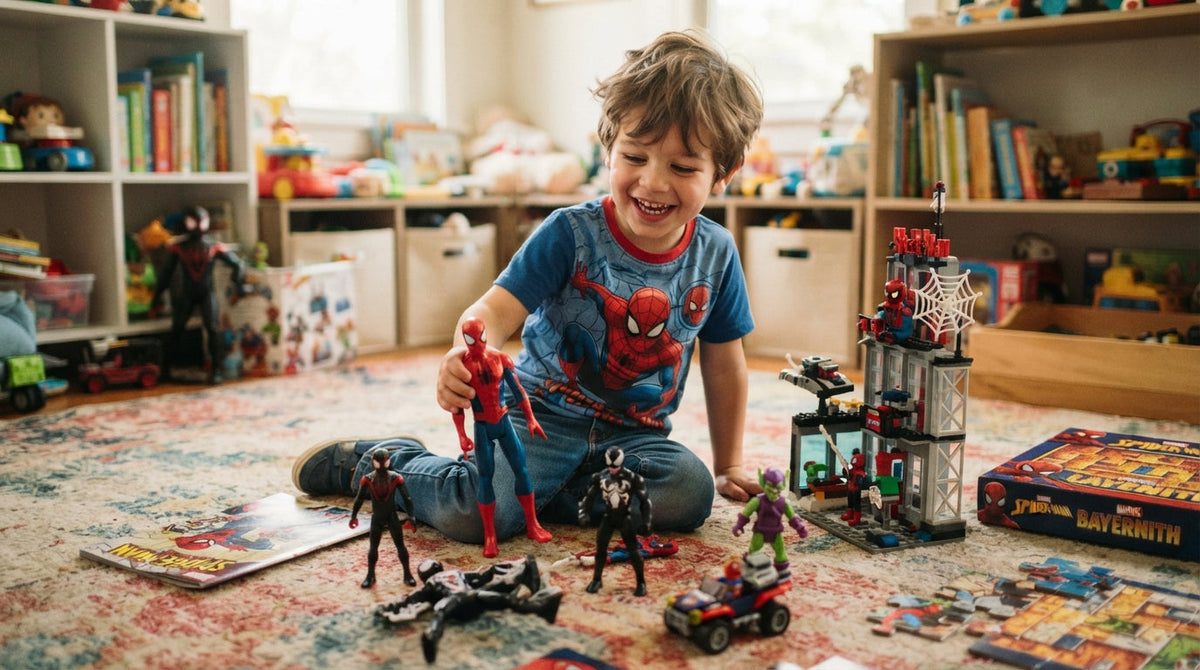
The Spider-Man jigsaws suit short sessions, as long as you pick a size the child finishes in one go: a jigsaw abandoned halfway becomes a heap of pieces nobody gets out again. The building bricks work the other way round: a set gets built, taken apart, rebuilt differently, and its lifespan is counted in months rather than evenings.
Colouring keeps a useful place, especially in the evening and on the move. The free printable Spider-Man colouring pages cost no more than a sheet of paper and stand in very well for an end-of-day tablet slot, when there's half an hour left before dinner and nobody has the energy to get a big box out. Print several in advance and keep them in a wallet: the session then starts without anyone having to fetch a thing.
| Type of play | Realistic session length | What you'll need |
|---|---|---|
| Flat jigsaw | twenty to thirty minutes | a free table and good light |
| Building bricks | thirty to sixty minutes | a storage box and clear floor space |
| Printed colouring page | fifteen to twenty minutes | felt-tips that still work |
| Figures and a set-up scene | an hour, spread over several goes | a corner you can leave undisturbed |
Two practical details change everything. A clear work surface first: a cluttered table cancels the game before it begins. A comfortable floor second, because most building happens on the ground; the guide to Spider-Man rugs room by room sets out the sizes that mark off a play corner. For the rest of the catalogue, the complete guide to toys by type and budget serves as the base.
Playing in pairs: the games that need someone else
The tablet has a flaw parents rarely see as one: it plays perfectly well alone. Games that need a partner, by contrast, force a negotiation, turn-taking, sometimes a falling-out and a making-up. They're the hardest games to establish and the most rewarding over time, because they build a habit between two children rather than a solitary reflex.

Spider-Man Walkie-Talkie Toy
Two red and blue handsets, a blue aerial, a big black spider logo on a blue roundel and The Amazing Spider-Man artwork printed under the speaker. No screen, one button that matters: the one you talk with. For two children, or a parent and a child.
View the product — €29.90The walkie-talkie deserves a mention of its own in a house. It turns a hallway into mission territory: one child hides, the other guides, and the game lasts as long as the batteries do. It also works between a parent busy in the kitchen and a child upstairs, which fills a good part of the end of the day with no screen. A walkie-talkie keeps you in contact, it never replaces supervision: the rule about being present stays exactly the same as without it.
One simple precaution avoids disappointment: check the real range indoors before promising a mission across the whole neighbourhood. Load-bearing walls and floors cut the distance quoted on the box. Test between two rooms first, then between upstairs and the ground floor, and set the playing area according to what you can actually hear.
This kind of play makes most sense when there are people in the house, a cousin visiting or a friend over for the afternoon. The guide to the Spider-Man birthday party suggests team games that keep a whole group busy without complicated kit, and the Spider-Man gift ideas often contain what's needed for a two-player game. The guides and advice hub brings together the rest of the practical sheets.
Imaginative play: the costume as a trigger
Role play is the only kind that needs no equipment at all and yet works far better with some. A child plays the hero with nothing on; with a mask, they stay in character much longer. The costume doesn't create the imagination, it triggers it and shields it from interruptions, because it clearly marks the crossing between ordinary time and play time.
The Spider-Man dressing-up costumes for children get worn well beyond fancy-dress day, and that's precisely the use that counts here: a costume that only comes out once a year is expensive per hour of play. The masks are often enough, especially indoors: they go on in two seconds, come off just as fast when the child gets hot, and don't get in the way of movement.
1
Give a mission, not a theme 'Play Spider-Man' isn't enough. 'The bag is booby-trapped, you've got five minutes to get it out of the living room' launches the game in a single sentence.
2
Set a minimal scene Two cushions on the floor, an upturned chair, a rug marking out the mission zone. The scene acts as a boundary and stops the game spreading into the kitchen. Nothing stretched across the floor: in this game, children run.
3
Step into the game once An adult who plays the witness for thirty seconds restarts a game that's running out of steam. Then withdraw, without announcing that you're going.
4
Set the ending before the beginning Announce the finish signal as the game starts, never during it. A child accepts a rule set in advance far better than an interruption imposed on them.
Comfort decides everything. A mask that slips or gets too hot ends up on the floor within ten minutes. The guide to dressing-up accessories: mask, web-shooter and gloves reviews what can be worn for an hour without irritating, and the sheet explaining how to choose a costume by age and comfort heads off sizes that are too tight.
The figures carry the same play on in miniature, handy when a child hasn't the room to run. And the effect goes beyond entertainment: the article on how Spider-Man helps shy children build confidence describes what the mask allows in a child who says little. The role gives them a voice that isn't quite their own.
The routine that replaces the screen: when, where, how long
A toy doesn't replace a screen on its own. What replaces the screen is a time slot. As long as the tablet stays available at any hour, no game wins the argument, because the screen asks less effort for the same energy. The routine therefore comes down to making the game more accessible than the screen at the exact moment the child is looking for something to do, which is to say in the two or three minutes after they walk into the room.
Three moments work better than the rest. Coming home from school, when a child needs to move before sitting down. The slot before dinner, the one where tiredness makes every clash more likely. And Saturday morning, the only time a long game can start without being cut short. Pick just one to begin with: three changes at once won't last a week.
Where it sits matters as much as when. A toy stored up high in a closed cupboard is never chosen. A toy left in plain sight, within reach, in the room where the child happens to be, wins almost every time. Conversely, the tablet should take one extra step: another room, a drawer, a request made out loud.
The mistakes that make the new rule fail
- Announcing the rule mid-game Cutting a screen off mid-session guarantees a row. The rule gets announced cold, in the morning or the night before, when nothing is at stake.
- Taking everything away at once A total ban makes the screen desirable. Shortening the slot and moving it to a less touchy moment lasts far longer.
- Presenting the toy as a punishment 'Since you've lost the tablet, play with this' condemns the toy. Better to get the game out beforehand, without mentioning the screen.
- Getting all the toys out at once A child facing eight open boxes chooses none of them. Two visible options are enough to prompt a quick choice.
- Renegotiating every evening A rule reopened every day is no longer a rule. Set the slot once, hold it for a week, then adjust.
Time is managed better by an object than by a voice. A timer or a Spider-Man alarm clock on the bedroom shelf makes the end of the slot impersonal: it's no longer the parent cutting things off, it's the alarm. And if the child is asking for electronics, the guide to interactive and connected toys shows that an object can be technical without displaying a single screen.
Lifespan, rotation and budget: what it really costs
A toy has two lifespans: the material one and the interest one. The second almost always runs out first. A web-shooter lasts months if the mechanism holds up, but the enthusiasm drops off after a few weeks, as with any game. That isn't a manufacturing fault and it isn't a bad purchase, it's how a child's attention normally works.
Rotation answers that problem without buying anything. Put half the toys out of sight for three or four weeks, then swap the two batches over. A toy that disappears and comes back regains a good part of its novelty. It takes ten minutes a month and extends useful life far more effectively than another purchase.
Some things escape rotation because they serve a purpose other than play. The Spider-Man soft toys go to bed with them and rarely leave the line-up as long as the child is attached to one; the sheet explaining how to care for a soft toy and make it last sets out how to wash one without ruining it. For things that are kept and handed down, the guide to Spider-Man merchandise gives the reference points.
On budget, the sum fits on one line. The Spider-Man Web Shooter Toy with Balls and Target is listed at €34.90, the Spider-Man Walkie-Talkie Toy at €29.90, and the Spider-Man Football starts at €25.90. Three games, three different uses: indoor aiming, two-player play, outdoor play. Nothing obliges you to take all three at once, and it's actually better not to.
What a starter trio costs, one game per need
Spider-Man Web Shooter Toy with Balls and Target€34.90
Spider-Man Walkie-Talkie Toy€29.90
Spider-Man Footballfrom €25.90
Total for the trio, at starting prices€90.70
The key takeaways
Replacing screen time isn't decided by the toy, but by the moment. A game that's available, visible and offered before the child asks for the tablet wins the argument almost every time. A toy stored up high and brought out after a refusal loses it every time, whatever its price and however good its finish. Availability weighs more than the product itself.
Keep three families in mind and cover them in order: something to burn off energy, something that keeps the hands busy, something that needs a second player. One family covered per game is plenty; there's no point hunting for the one object that does everything. Adding a fourth toy before you've established the time slot changes nothing about screen time, it only adds one more box to tidy away.
If the purchase doubles as a gift, the guide to choosing a Spider-Man gift for a child cross-references uses and budgets, which avoids duplicating a toy already in the house. And keep rotation in mind: the surest way to make a toy last is still to make it disappear for a while, before it palls, rather than buying another one.
Three markers are enough: a game for burning off energy, a game that keeps the hands busy, a game that needs someone else. Set up a single time slot, leave the toys in sight, rotate half the box every month, and announce the rule cold rather than in the middle of a game. The rest sorts itself out in two or three weeks.

