

14-Day Money-Back Guarantee
0
The essentials before you choose
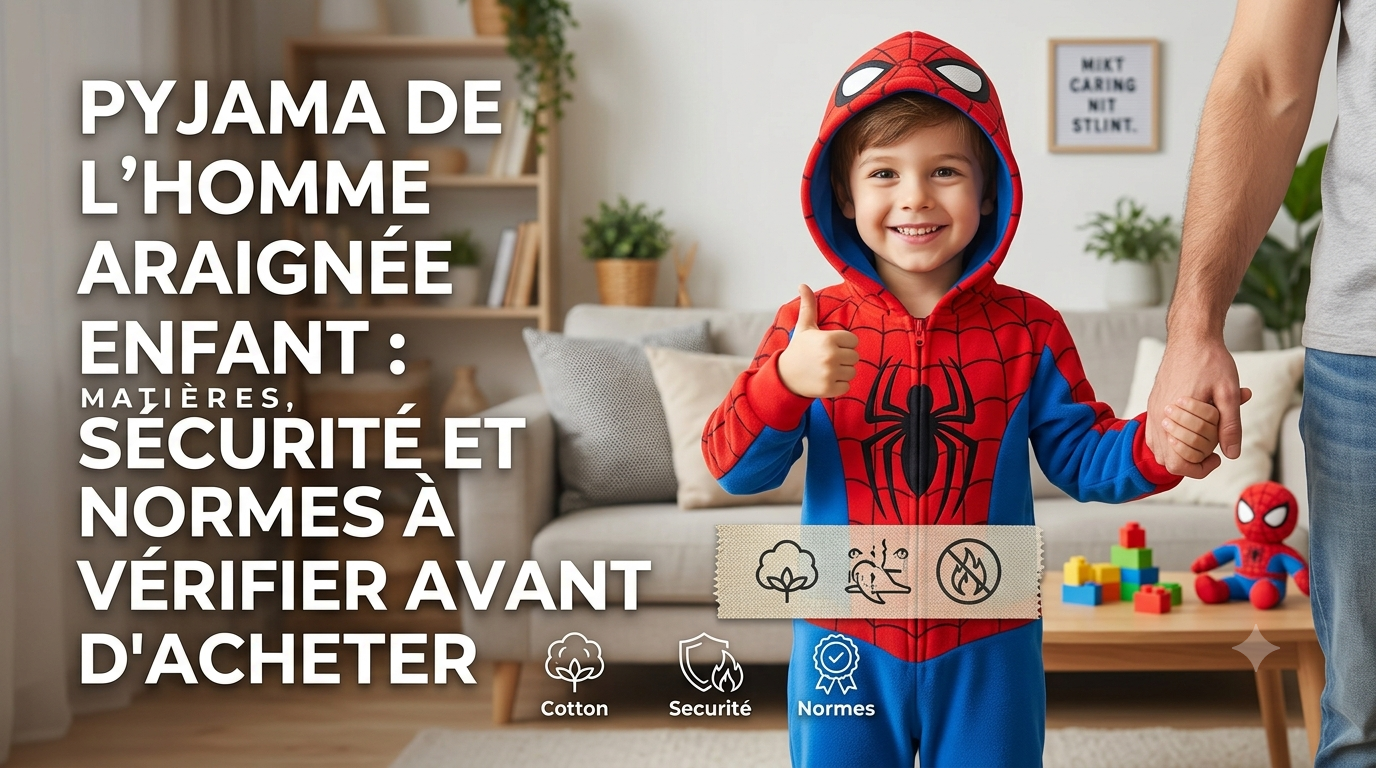
Three markers guide the purchase: the exact composition read on the label, the presence of a textile certification such as OEKO-TEX, and the finishings to check before the first night. Cotton, flannel or breathable polyester each answer a different need depending on skin and season; we compare their limits below.
You're holding these Spider-Man pyjamas in your hands, your child's eyes are lighting up, and a small inner voice whispers a very simple question: is this fabric, against their skin, night after night, really healthy? You're right to ask. Pyjamas aren't a garment like any other. They're the only textile your child wears for hours on end, motionless, perspiring, skin in direct contact with the cloth while their body regenerates. In other words, it's the garment where fabric quality matters most, and paradoxically the one we often choose fastest, won over by a pretty web pattern. This article isn't a standard buying guide. It's a guide for the responsible parent: what you need to check on the label, understand about fabrics, and inspect for safety before you say yes.
We're going to break down cotton, flannel and breathable polyester together, decode certifications such as OEKO-TEX, examine the sleep safety points that too many parents overlook, understand night-time thermoregulation and, finally, learn how to care for the fabric so it lasts and stays healthy. If you then want to act on your choice, you'll find everything in our collection of Spider-Man pyjamas for children, selected precisely against these quality criteria. But let's start at the beginning: why fabric is never a detail.
Why the fabric of children's pyjamas is not a detail
A child's skin is physiologically different from yours. It's thinner, roughly thirty per cent thinner than adult skin, its protective barrier is immature, and it absorbs more of the substances it comes into contact with. Add to that the fact that a sleeping child's body perspires far more than an adult's, because their thermoregulation isn't yet fully settled, and you understand why the fabric wrapped around them at night deserves real attention. Pyjamas aren't eight neutral hours: they're eight hours of constant exchange between skin and fibre, with heat, moisture and friction.
What's at stake here is twofold. First, perceived comfort, which directly shapes sleep quality: a child who is too warm, who scratches because of a rough fabric, or who wakes up clammy in cloth that doesn't breathe, sleeps badly, wakes in the night, and so do you. Then there's skin health: some low-grade fibres, or fibres treated with harsh chemicals, can cause irritation, redness, even allergic reactions in children with atopic skin, which is very common today. The Spider-Man pattern catches the eye, but it's the fibre underneath that does the real work. You'll find the same thread in Spider-Man compression T-shirt: what it's for and how to choose one.
We also need to dispel a received idea: a high price doesn't guarantee good fabric, and an affordable price doesn't automatically mean a poor-quality textile. What counts is the actual composition and the treatments the fibre has been through, information you'll always find on the label if you know how to read it. And if your priority is to combine a controlled budget with honest quality, our guide to the best value-for-money Spider-Man pyjamas will help you tell a genuine bargain from a false one. But hold on to this principle already: you don't judge pyjamas by their price, you judge them by their fibre and their finishings.
Seeing fabric as a front-rank criterion, rather than an accessory to the pattern, changes everything about the way you buy. You stop choosing with your child's eyes and start choosing with a parent's sense of responsibility, while still giving them their favourite hero. The two aren't incompatible, far from it. That is precisely the point of this article: to give you the technical keys so that your child's delight goes hand in hand with genuine safety.

Children's pyjamas
Spider-Man Cotton Pyjamas for Children
Softness and breathability for peaceful nights: Spider-Man watches over their sleep.
Cotton, flannel, breathable polyester: the strengths and limits of each fabric
Let's get concrete. Three broad fabric families dominate the children's pyjama market, and each has its own personality, its advantages and its watch points. Understanding what each fibre really does against your child's skin lets you choose knowingly, according to their sensitivity and the climate inside your home.
Cotton, the safe bet for sensitive skin
Cotton is the historic benchmark for children's nightwear, and for good reasons. It's a natural fibre, soft, which lets the skin breathe and absorbs moisture. A child perspires at night, and cotton captures that perspiration instead of letting it sit against the skin, which limits clamminess and irritation. In its pure form it's also hypoallergenic, so it's particularly suited to reactive or atopic skin. Its limit lies in how it handles moisture by saturation: once it has absorbed a lot, it dries slowly and can stay damp, which chills the child towards the end of the night. That's why the quality of the weave matters.
A step up, organic cotton deserves your attention. Grown without pesticides or synthetic chemical fertilisers, it is processed with far fewer harsh chemicals than conventional cotton. In practice, that means fewer potential residues against your child's skin, a fibre that is often softer because it has been handled less roughly, and a reduced environmental impact. For a garment worn for hours at night, that extra guarantee genuinely matters. Organic cotton is the choice I recommend first for a toddler or a child with fragile skin.
Flannel, gentle warmth for cool nights
Flannel isn't a fabric in its own right, but a finishing method, most often applied to cotton. The surface of the cloth is lightly brushed to raise the fibres, which creates that downy texture and that immediate sensation of warmth to the touch. Its strength is obvious for cool nights and lightly heated bedrooms: flannel traps a fine insulating layer of air against the skin, which warms the child without piling on fabric. It's also remarkably soft, which children love at bedtime.
Its limit is the exact flip side of its quality: it's warm. In a well-heated bedroom or in the milder seasons, thick flannel can make a child perspire excessively and disturb their sleep. So check that the flannel is still cotton and not synthetic, because low-grade polyester flannel combines the warmth of the brushed finish with the poor breathability of the fibre, a bad match for the night. To understand precisely when to favour a warm fabric and when to avoid it, our analysis of choosing pyjamas suited to the season by the child's age usefully rounds out this point on fabric.
Breathable polyester, technical performance provided you choose well
Polyester drags a poor reputation behind it, often deserved for the cheapest versions, but unfair to modern technical fabrics. A quality breathable polyester is designed to move moisture out towards the surface of the cloth, where it evaporates, instead of holding it against the skin. That's the principle behind so-called technical textiles. The result: the child stays dry even when perspiring, the fabric dries quickly after washing, stands up well to wear and keeps its colours, which makes a handsome Spider-Man pattern last longer. Its robustness is a real asset for pyjamas that go through frequent washes.
The danger is cheap, non-breathable polyester, which does exactly the opposite: it traps heat and moisture, clings to clammy skin and encourages irritation. The difference isn't always visible to the naked eye, hence the crucial importance of the label and the certifications we're about to look at. In practice, a well-designed cotton-polyester blend, often mainly cotton for skin contact and completed with technical fibre for hold, offers an excellent compromise for an active child. The table below sums up these three families.
| Fabric | Main strength | Watch point |
| Cotton (organic above all) | Soft, hypoallergenic, breathable, absorbs moisture | Dries slowly once saturated with moisture |
| Flannel (brushed cotton) | Immediate gentle warmth, ideal for cool nights | Can cause perspiration in a heated bedroom |
| Breathable polyester | Wicks moisture away, dries fast, very hard-wearing | Low-grade non-breathable versions to be avoided |
So there is no perfect fabric in the absolute, only a fabric suited to a child, a season and a bedroom climate. Organic cotton for sensitive skin, flannel for cool nights, technical breathable polyester for the child who perspires and moves a lot. What stays constant is the requirement: check the actual composition and steer clear of low-grade non-breathable synthetic fibres.
Reading the label: certifications and standards to look for
This is probably the most useful part of this article, the part too few parents have mastered. The label on children's pyjamas isn't an administrative formality: it's your first line of health defence. It tells you what the fibre has been through, which substances it does or doesn't contain, and whether an independent body has tested the product. Learning to decode it in thirty seconds in a shop or online radically changes the quality of your purchases.
The OEKO-TEX label, reflex number one
If you were to remember only one certification, it would be this one. Standard 100 by OEKO-TEX is an independent certification guaranteeing that the textile has been tested for the absence of harmful substances, going beyond even the legal requirements. That covers problematic azo dyes, formaldehyde, certain heavy metals, pesticide residues and other undesirable compounds. A crucial point for us: the certification comes in classes, and the strictest applies precisely to articles for babies and young children, those in the closest contact with the skin. Pyjamas certified OEKO-TEX for the children's category therefore give you a serious, verifiable guarantee that the fabric doesn't release dangerous chemical substances against your little one's skin.
In practice, look for the OEKO-TEX wording and logo on the label or the product page. Its presence isn't compulsory, which means a manufacturer who displays it has voluntarily undertaken a testing process and paid to have it verified. That's a strong signal of seriousness. Its absence doesn't automatically condemn a product, but its presence is a major argument for trust, especially for nightwear.
The other mentions that really count
Beyond OEKO-TEX, a few elements on the label deserve your eye. The percentage composition first of all, compulsory in Europe: it tells you exactly what the cloth contains, and lets you favour a high proportion of cotton for skin contact. Be wary of vague compositions or a majority synthetic percentage for nightwear intended for a toddler. For organic cotton, the GOTS certification goes further than OEKO-TEX by certifying both the organic origin of the fibre and compliance with ecological and social criteria throughout manufacturing. It's the peak of what you can ask of a children's textile.
Finally, check for the clear presence of care instructions and of the size matching the age, as well as the product's general compliance with European children's textile safety standards, which cover cords and small parts in particular. We'll come back to that in the safety section. A complete, legible, neatly stitched label is in itself an indication of a serious manufacturer. Conversely, a missing, faded or incomprehensible label on children's nightwear is an alarm signal that should make you put the item back.
Get into the habit of this little checking ritual: composition, OEKO-TEX or GOTS certification, care instructions, the state of the label itself. Thirty seconds is enough, and they make all the difference between an impulse buy and an informed one. Once acquired, this reflex will serve you for all your child's clothes, not just their pyjamas. It's the heart of the responsible-parent approach we're defending here.

Children's pyjamas
Spider-Man Pyjama Set for Children in Soft & Warm Flannel
Softness and breathability for peaceful nights: Spider-Man watches over their sleep.
Sleep safety: seams, fit and detachable parts
Healthy fabric is half the job. The other half is the physical safety of the garment during sleep, an area where the stakes vary a great deal with your child's age. Pyjamas aren't just cloth against skin, they're also a set of seams, fastenings and decorative parts that must be beyond reproach, particularly for toddlers who put everything in their mouths and sleep for hours without direct supervision.
Strong, flat seams
The seams on children's pyjamas have two jobs. The first is strength: they must stand up to night-time wriggling, repeated washes and energetic pulling on, without giving way or fraying. A seam that gives can release threads a child wraps around a finger, or create an uncomfortable opening. Discreetly run your finger along the main seams, at the shoulders, the crotch, the armholes: they should be regular, dense and properly finished off. The second job is comfort: flat, supple, well-placed seams avoid the friction points that, multiplied by hours of stillness, mark and irritate thin skin. Thick topstitching across the back or under the arms is worth watching.
The question of small detachable parts
This is the absolute watch point for toddlers. Decorative buttons, stitched-on badges, small applied logos, pompoms, Spider-Man sequins, any part liable to come off becomes a choking hazard for a child who puts everything in their mouth. For a baby or a child under three, the rule is simple and admits no compromise: favour pyjamas whose pattern is printed or woven into the fabric, with no applied parts, or whose few parts are firmly fixed and tested to resist pulling. European regulations do strictly govern these small parts on garments for young children, but your own manual check remains the best guarantee: pull gently on every button or decoration, it shouldn't move.
Watch out too for cords and long ties at the neck or on the hood, formally advised against on nightwear for young children because of the risk of strangulation. Well-designed children's pyjamas have no drawstring at the waist for little ones, but an elastic stitched inside. It's these invisible details that separate a garment designed for safety from one designed purely for the look. A pretty pattern never makes up for a dangerous finish.
Close-fitting or loose: what safety says
Here's a notion parents know little about. The cut of children's pyjamas isn't just a matter of comfort or looks, it touches on safety. Nightwear that is close-fitting, with no excess flapping fabric, limits the risk of tangling during sleep and of restricted movement. Conversely, pyjamas that are far too big, bought to last several years, can let a child get caught up in the surplus fabric, ride up and leave the tummy uncovered, or hamper their movements. The temptation to buy a size up to absorb growth is understandable budget-wise, but it has a safety limit, especially for the youngest.
The right balance is pyjamas in the correct size, comfortable and not tight, letting the child move freely without swimming in them. That fit depends closely on age and build, and it's a subject in its own right that we've developed in our guide to choosing the right size of Spider-Man pyjamas by age. Remember the safety principle here: neither tight nor flapping, but fitted. A child's growth is handled by renewing regularly, not by oversizing a piece of nightwear.
These three pillars, strong flat seams, no dangerous detachable parts and a correct fit, form the foundation of sleep safety. They cost nothing to check but protect enormously. It's precisely because these criteria are demanding that we select every model in our range of Spider-Man pyjamas designed for children with safety front and centre, to spare you having to do this sorting on your own.
Breathability and thermoregulation: sleeping well without overheating
Let's now talk about a night-time phenomenon that fabric entirely governs: thermoregulation. The human body cools naturally in order to fall asleep and stay asleep. Body temperature drops slightly at bedtime, and that drop is a biological signal for deep sleep. If the pyjamas prevent that regulation, by holding in too much heat or trapping moisture, the child fights it unconsciously, stirs and wakes. The fabric of pyjamas is literally an interface between the child's body and their sleeping environment.
What we call breathability is the cloth's capacity to let air circulate and to move out the moisture produced by perspiration. A breathable fabric lets water vapour escape, which keeps the skin dry and at the right temperature. A non-breathable fabric creates a damp, warm microclimate, unpleasant and conducive to irritation. This is where the fabrics we've looked at show their true value: cotton breathes naturally and absorbs, technical breathable polyester actively wicks moisture outwards, while low-grade polyester forms a barrier. Flannel, for its part, insulates and warms, which is an asset only when the bedroom is cool.
The right approach is to think in terms of a system: the fabric of the pyjamas, plus the bedroom temperature, plus the blanket or sleeping bag. A child's bedroom sits ideally at around eighteen to twenty degrees, and it's against that temperature that you adjust the thickness of the fabric. Thick flannel in a bedroom at twenty-two degrees will cause perspiration; fine cotton in a bedroom at sixteen degrees will leave a child shivering towards morning. It isn't the season on the calendar that counts, it's the real temperature of the room where your child sleeps, a point developed in our article comparing pyjama fabrics according to the time of year.
How do you spot that pyjamas aren't regulating your child's temperature well? A few simple signals: they wake up clammy, with a damp neck or back, they push their covers off repeatedly, their sleep is restless in the first part of the night, or conversely they shiver in the early morning. These clues tell you the fabric-bedroom pairing is badly calibrated. Adjust the fibre before anything else: move from flannel to fine cotton in case of overheating, or the other way round if they're getting cold. Fabric is the finest and most effective lever for tuning night-time thermoregulation.
A final word on children who perspire a lot, which is frequent and normal in young children. For them, the absolute priority is moisture management: a quality absorbent cotton or a mainly cotton blend with a breathable technical fibre will move the clamminess away and avoid the chill that follows heavy perspiration in a fabric that holds water. For them, steer clear of low-grade non-breathable synthetics, which turn perspiration into sticky discomfort all night long. Here again, the right fabric is the one that works with the child's physiology instead of against it.

Children's pyjamas
Breathable Spider-Man Pyjamas for Children
Softness and breathability for peaceful nights: Spider-Man watches over their sleep.
Caring for the fabric to preserve it and keep it hygienic
You've chosen a healthy, certified, safe fabric. One step remains that too many parents neglect and that nonetheless determines the pyjamas' lifespan and cleanliness: care. A badly washed textile loses its breathability, is degraded by contact with the wrong products, and can even become a source of skin discomfort. Looking after children's pyjamas properly means protecting the investment in fabric you've just made, and it's also a question of hygiene for a garment in intimate contact with the skin night after night.
The golden rule is to follow the care label, that same label you've learnt to read above. The washing temperature shown isn't a manufacturer's whim: exceeding the recommended temperature can shrink cotton, degrade brushed flannel by flattening its downy fibres, or alter the breathable structure of a technical polyester. Respecting that temperature keeps the cloth's original properties. For children's nightwear, a wash at thirty or forty degrees is generally enough to sanitise without attacking the fibre, and a wash before first use is strongly recommended to remove any manufacturing residues.
On the detergent side, go for a gentle product, ideally a detergent for sensitive skin or a baby-specific one, and dose it correctly: too much detergent leaves residues in the fibre that irritate the skin and block the cloth's breathability. Avoid excess fabric softener on pyjamas, because it coats the fibres in a film that reduces the very capacity of cotton to absorb moisture, degrading one of the qualities you were looking for. The right reflex is minimalism: less product, better dosed, and a careful rinse.
How you handle drying also deserves attention. A tumble dryer on high heat is the silent enemy of fine fabrics: it wears the fibres out prematurely, dulls the colours and distorts the cut. Air drying, or a tumble dryer on low heat when the label allows it, preserves the fabric and the Spider-Man pattern far better over time. For prints and screen prints, turning the garment inside out before washing and drying protects the design that delights your child for the long term. These habits for preserving a printed textile chime with the same logic of care for accessories from the same universe, as shown in our guide to caring for your child's Spider-Man backpack and making it last.
On the hygiene front, pyjamas need washing more often than you might think. In contact with perspiration, dead skin cells and sometimes the saliva of a child who sucks their thumb, they should be changed and washed regularly, ideally every few days and more often in hot weather or during illness. Having several pairs of pyjamas in rotation lets you both keep to that hygiene frequency and spare each garment, which wears out more slowly if it isn't being washed constantly. It's a virtuous circle: more pyjamas, each washed at the right frequency and properly cared for, equals fabrics that last and better sleep hygiene.
That's the full cycle of the responsible parent: choose the right fabric, check the standards, inspect the safety, calibrate the thermoregulation, care for it attentively. Every link counts, and together they guarantee your child healthy, comfortable nights in pyjamas they love. With these criteria in mind, you can browse our selection of Spider-Man pyjamas for children with confidence, chosen against exactly this grid of fabric and safety requirements. And if you're looking to kit out the whole household or to make a gift of it, our guides to Spider-Man pyjamas for the whole family and to giving Spider-Man pyjamas as a gift to a young fan usefully extend this line of thought. For the new school year, our guide to dressing your child in Spider-Man colours rounds out the wardrobe beyond the night alone.
FAQ: children's pyjama fabrics and safety
Which fabric should I choose for Spider-Man pyjamas for a child with sensitive skin?
For sensitive or atopic skin, go for organic cotton, ideally GOTS or OEKO-TEX certified. It's a natural fibre, soft, hypoallergenic, breathable and grown without pesticides or harsh chemical treatments, which reduces the risk of irritation against fragile skin. Avoid low-grade non-breathable synthetics, which hold moisture and heat against the skin and encourage redness and itching during the night.
Is the OEKO-TEX label really important for children's pyjamas?
Yes, it's reflex number one. Standard 100 by OEKO-TEX certification guarantees that the textile has been tested for the absence of harmful substances such as certain dyes, formaldehyde or heavy metals, with an even stricter class for articles intended for babies and young children. For a garment worn for hours in direct contact with the skin, that independent, verifiable guarantee is a major signal of trust. Its presence is a real plus; its absence should prompt you to examine the composition more closely.
Are pyjamas that are too big dangerous for sleeping?
Pyjamas that are clearly too big do present a risk, especially for toddlers, because the surplus flapping fabric can cause tangling during sleep, ride up and leave the tummy uncovered, or hamper movement. The right approach is pyjamas in the correct size, comfortable and not tight, letting the child move freely without swimming in them. Growth is handled by renewing regularly rather than by buying several sizes up for a piece of nightwear.
How can I tell if my child is too warm in their pyjamas?
Several signals will alert you: they wake up clammy with a damp neck or back, they push their covers off repeatedly, their sleep is restless early in the night. Check the bedroom temperature, ideally between eighteen and twenty degrees, then adjust the fabric of the pyjamas as a priority: move from thick flannel to a finer, breathable cotton in case of overheating. The fibre is the most precise lever for tuning your child's night-time thermoregulation.
How often should children's pyjamas be washed, and at what temperature?
Children's pyjamas should be washed regularly, ideally every few days and more often in hot weather or during illness, because they're in permanent contact with perspiration and skin. Always follow the temperature shown on the care label, generally thirty or forty degrees, which sanitises without attacking the fibre. Use a gentle detergent, well dosed, avoid excess fabric softener which reduces breathability, and favour air drying to preserve the fabric and the pattern over time.

