

14-Day Money-Back Guarantee
0
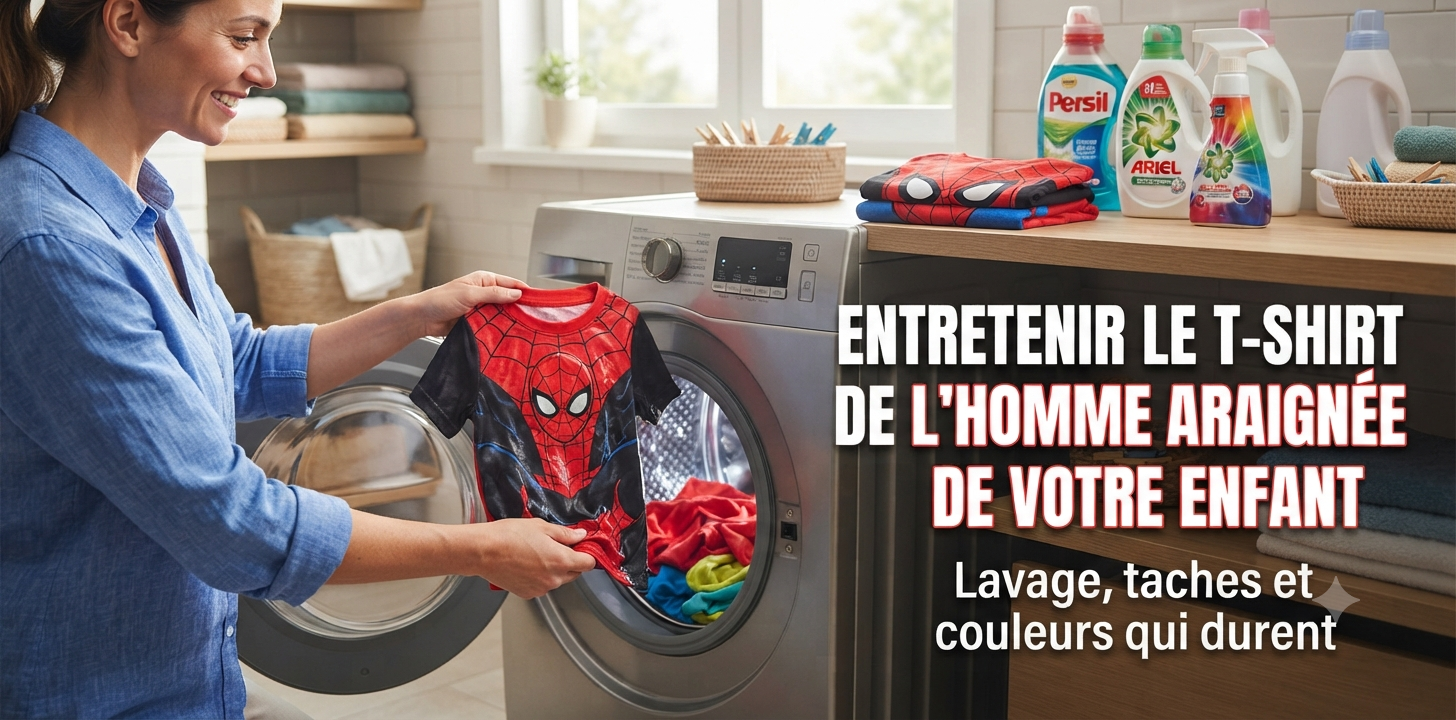
The essentials before you choose
Three settings decide how long it lasts: which way round you wash it, the temperature and the spin speed. Turning the garment inside out, sticking to 30°C and dropping below 800rpm protect the print far better than a hot cycle. Stain removal, drying and storage follow the same logic: we go through the details below.
Your child lives in their Spider-Man t-shirt. They ask for it in the morning, wear it to school, roll around in the grass at break, spill a bit of sauce at lunch, draw with felt-tips at after-school club, and want it again the next day. That little piece of cotton with the red and blue spider isn't just a garment: it's a second skin, a source of pride, sometimes even a daytime comfort blanket. So when the print starts to crack, when the colours turn a dull grey after a few weeks or when a grass stain refuses to budge, the disappointment is real, for them and for you. The good news is that most of this damage doesn't come from the t-shirt itself, but from the way it's washed, dried and stored. With a few simple habits, one t-shirt can get through a whole school year with its spider still bright and its knit still soft.
This isn't a buying guide: I'm not going to tell you which style to choose by age or by look, those subjects are covered elsewhere. Here we're talking only about garment care: protecting the print and the flock in the wash, tackling the toughest kid-made stains, avoiding bobbling and fading, getting drying and storage right, and spotting the fabric details at purchase that guarantee longevity. If your wardrobe is starting to look like a small collection of Spider-Man t-shirts for kids, you'll finally be able to make them last instead of replacing them every term. Grab a coffee, let's get into the detail.
Why a child's t-shirt wears out so fast (and how to avoid it)
Before we talk washing technique, you need to understand why a child's t-shirt takes a beating that bears no comparison with an adult's. A child doesn't wear a garment, they live in it. They crouch, climb, roll on the floor, rub their sleeves against tables and sometimes wipe their hands on their tummy. In a single school day, a t-shirt absorbs dozens of tiny mechanical assaults that an adult's fabric will never know. On top of that comes a much higher washing frequency: where you might wear a top two or three times before washing it, your child's often goes in the basket every evening. And it's precisely in the wash that most of the damage happens.
The weakest point of a Spider-Man t-shirt isn't the knit: it's the print. Most superhero designs are applied by screen printing, plastisol transfer or flocking. These techniques lay a flexible layer of material on the surface of the cotton. That layer hates three things: excessive heat, direct friction and repeated stretching. A 60°C wash softens the ink binder, a spell in the tumble dryer makes it crack, and an iron pressed straight onto it can melt it outright. Understanding this changes everything: protecting the spider means, above all, shielding it from heat and friction.
The second cause of premature wear is fading. Spider-Man's bright red and deep blue are saturated colours, so they're particularly prone to washing out. Every hot wash, every long spell in the sun, every dose of overly harsh detergent strips away a little pigment. A t-shirt that turns pale pink or washed-out blue after a month hasn't necessarily aged badly: it has simply been washed the wrong way. The care logic is in fact exactly the same as for other textile pieces in your child's wardrobe, as you'll see if you take a look at the Spider-Man jumpers and sweatshirts range for kids, whose flocked designs call for the same precautions.
Finally, there's a factor we often forget: rushing. We load the machine in a hurry, rarely turn garments inside out, mix everything together and set a nice hot standard cycle 'just to be sure it comes out clean'. Yet the cleanliness of a child's textile almost never depends on temperature: a modern detergent breaks down organic stains perfectly well at 30°C. Heat doesn't clean better, it simply damages faster. Remember this founding principle, because everything else in this guide follows from it: we aren't fighting the dirt, we're protecting the garment while we remove it.

Kids' t-shirt
Kids' Spider-Man Comic Book T-Shirt
A comfortable fit and a Spider-Man print that holds up wash after wash: the perfect companion for school days.
Washing without destroying the Spider-Man print: the method
Let's get to the heart of it. If you only remember one habit from this whole article, make it this one: always wash the t-shirt inside out. Turning the garment before it goes into the machine puts the print on the inside, safe from rubbing against the drum and against other garments. It's the most effective, the simplest and the cheapest thing you can do to protect the spider. On its own, it can double the visual life of the design. Get into the habit of doing it as your child undresses: one fold, one flip, and into the basket it goes.
Second pillar: temperature. Wash at 30°C, never hotter. Cold or lukewarm water preserves both the colour pigments and the print binder. It also reduces distortion of the knit and limits shrinkage, that infamous phenomenon that turns an age 8 t-shirt into an age 6 after three washes. If your machine offers a 'delicate colours' or a cold 'synthetics' programme, better still: these cycles combine a low temperature with a gentle spin, exactly what a printed textile needs. Conversely, steer clear of 'intensive', 'hot cotton' or 'boil prewash' programmes, which are a superhero design's worst enemies.
Third pillar: the spin. A 1200 or 1400rpm spin subjects the fabric to violent twisting forces that tire the knit, press creases into the print and encourage micro-cracking. Drop down to 600 or 800rpm for printed t-shirts. The washing will come out a little damper, but it will dry very well in the open air, and the print will thank you. On flocked models, where the material sits in relief, this precaution matters even more: flock doesn't like being twisted.
On detergent, choose a gentle product, preferably liquid rather than powder. Powders often contain bleaching agents and micro-abrasives that dull bright colours and attack inks. Absolutely avoid any product containing bleach or 'percarbonate' on a coloured t-shirt, or you risk irreversible pale halos appearing. Dose sensibly: too much detergent leaves residues that stiffen the fabric and make the print brittle. Fabric conditioner is optional and even inadvisable on flocked designs, as it can create a film that gradually lifts the raised texture.
One last sorting tip: never wash a brand-new Spider-Man t-shirt in very bright colours alongside light-coloured laundry on the first wash. Red pigments are the most likely to bleed over the first two or three cycles. Wash it once or twice with similar dark colours before putting it in a mixed load. Here, summarised, are the temperatures and habits to memorise by action, as a quick reference to keep in mind.
| Action | Do | Avoid |
| Which way round | Always inside out | Print facing the drum |
| Temperature | 30°C or cold | 40°C, 60°C, intensive |
| Spin | 600 to 800rpm | 1200 to 1400rpm |
| Detergent | Gentle liquid, correctly dosed | Bleaching powder, overdosing |
Tackling kid-made stains (school dinners, felt-tip, grass and lawn)
A stain on their favourite t-shirt is a guaranteed evening drama. But most kid-made stains come out perfectly well, provided you follow two golden rules that apply to all of them: act fast and never tumble-dry a garment that's still stained. Heat sets the stain almost permanently. Until you're certain the stain has gone, the t-shirt dries in the open air. Now let's look at the main families of stains, because each one calls for a different approach.
School dinner stains: sauce, grease, chocolate
Greasy stains (tomato sauce, salad dressing, melted cheese, chocolate) are the most common. The winning reflex: as soon as they're back from school, blot the excess with kitchen paper without rubbing, then apply a little washing-up liquid directly to the stain. Washing-up liquid is designed to dissolve grease, so it's perfect for this. Leave it for ten to fifteen minutes, rub the back of the fabric very gently, then wash as normal at 30°C. For stubborn tomato sauce stains, a first pass with Marseille soap or a stain-removing bar works wonders. Always check the stain has gone before drying.
Felt-tip and biro: the craft-session stains
Felt-tips are the sworn enemy of creative afternoons. Good news: school felt-tips are almost always water-based and come out easily in the wash. For a washable felt-tip, a simple pre-treatment with a stain-removing bar is enough. For a permanent marker or a biro, the solution is different: soak a cotton pad in surgical spirit or hand sanitiser gel, place a clean cloth under the stained area to absorb it, then blot from the edge towards the centre. The ink migrates onto the cloth underneath. Change the cloth as you go, then wash. Always test the alcohol on a hidden seam to check it doesn't attack the colour.
Grass and lawn: the playground stains
Grass stains are particularly stubborn because the chlorophyll clings to the fibres. The effective move: gently rub the stain with dampened Marseille soap or, for rebellious cases, blot with a little surgical spirit before washing. Some parents swear by a mix of bicarbonate of soda and a splash of white vinegar left as a paste on the stain for a few minutes. Do avoid, however, putting hot water straight onto a fresh grass stain: it tends to set it. Then wash at 30°C and check before any drying. That same stain-removing common sense applies to the whole back-to-school kit, as our guide to dressing your child in Spider-Man for the new school year explains.
One cross-cutting rule deserves repeating: always treat stains from the reverse side and by blotting, never by rubbing hard on the print side. Rubbing vigorously on the spider tears off the ink along with the stain. Place the stained area face down on a clean cloth and work from the back of the fabric: you push the stain out instead of driving it into the fibres. And never use a stiff brush on flocking: the bristles catch the raised texture and lift it off.

Kids' t-shirt
Kids' The Amazing Spider-Man T-Shirt
A comfortable fit and a Spider-Man print that holds up wash after wash: the perfect companion for school days.
Bobbling and dull colours: the habits that save the day
Once you're past the stain stage, two more insidious enemies lie in wait for your child's t-shirt over time: bobbling and loss of brightness. Neither damages the garment mechanically, but they give it a tired, 'old' look that makes you want to replace it when it's still perfectly wearable. Fighting them means extending the t-shirt's visual life, the one that really counts in a child's eyes.
Those bobbles, the little balls of fibre that appear under the arms, on the sides and wherever the fabric rubs, are caused by short fibres working their way to the surface. They're more common on cotton-polyester blends and on mid-quality knits. To limit them, wash inside out, at a low temperature and with a gentle spin, exactly as we saw. Avoid mixing your t-shirts with abrasive materials such as jeans or looped towels. When the bobbles are there, whatever you do, don't pull at them: use a fabric shaver or a knit comb with the garment laid out flat, and shave the surface gently. In ten minutes, a tired t-shirt looks almost new again.
As for fading, that is mainly fought upstream. The main culprit, as we said, is heat, but direct sun during drying comes a close second. Ultraviolet light breaks down pigments: a red t-shirt dried on a south-facing line in spring can visibly lose intensity in a few weeks. So dry your coloured t-shirts in the shade or indoors, inside out for preference. To revive colours that have already faded a little, a glass of white vinegar in the rinse compartment helps fix the remaining pigments and remove the detergent residues that dull the knit. It's a gentle, cheap habit that's completely safe for the print.
A word on the famous 'grey film' that sometimes creeps over dark t-shirts. It isn't wear but a build-up of limescale and detergent residue accumulated over successive washes. The answer: reduce the detergent dose, add a little white vinegar to the rinse now and then, and occasionally run the machine empty with a cleaner to clear the biofilm from the drum. A clean drum means laundry that genuinely comes out clean and crisp. These colour-preservation principles apply to every piece with a strong design, including when you're looking at how to wear Spider-Man t-shirts with style depending on the occasion: a design that has stayed bright makes all the difference in a party photo.
Drying and storage: the mistakes not to make
We hugely underestimate the impact of drying. Yet most Spider-Man t-shirts that crack or shrink don't die in the washing machine, but in the tumble dryer. The combination of intense heat plus mechanical tumbling is catastrophic for a print: it softens the ink, makes it crack and then flake, while shrinking the cotton knit. If you want a t-shirt to last all year, the rule is simple: avoid the tumble dryer as much as possible for printed garments. Air drying is almost always the better option.
To air dry properly, hang the t-shirt inside out, in the shade, on an airer or folded over a line so it doesn't mark the shoulders. Avoid hanging it by the collar on a thin hanger when it's heavy with water: the weight stretches the neckline and distorts the shoulders. If you really have no choice and must use the tumble dryer, set it to the gentlest, coolest programme possible, take the garment out while it's still slightly damp and finish drying it flat. But bear in mind that every hot cycle brings the print closer to the end.
Ironing deserves its own warning. Never iron directly on the print. A hot iron placed on the spider can melt it, stick to it or mark it instantly. If a t-shirt needs the creases taken out, iron it inside out, at a low temperature, or slip a thin cloth between the iron and the design. Best of all is often not to iron at all: a t-shirt hung out properly, taken off the airer while still slightly damp and smoothed by hand, barely creases. A child couldn't care less about creases, and you save time.
On storage, two principles. First, never put a t-shirt away while it's still damp: residual moisture encourages musty smells and mildew stains. Second, with children's t-shirts, go for folding rather than hanging. Folding flat spares the neckline and avoids hanger marks on the shoulders. Store flocked designs without crushing them under too heavy a pile, as prolonged pressure can mark the raised texture. An airy drawer, sensible piles, and your t-shirts will keep their original shape far longer.

Kids' t-shirt
Black Spider-Man Kids' T-Shirt Symbiote Design
A comfortable fit and a Spider-Man print that holds up wash after wash: the perfect companion for school days.
Choosing well at the outset so it lasts (fabric, seams)
A t-shirt's durability isn't decided by care alone: it starts at the moment of purchase. I'm not talking here about style or sizing — those questions are covered in our guide to choosing the right t-shirt for your child's age — but purely about the criteria for durability. Because two t-shirts with an identical design can have completely different lifespans depending on the quality of their knit and their finishing. Knowing how to read these details means buying smart once instead of buying again three times.
The first criterion is the cotton's fabric weight, expressed in gsm. Below 140gsm, the knit is thin, see-through and quickly loses its shape. At around 160 to 180gsm, you have a solid, opaque fabric that stands up to repeated washing and bobbles less. That's ideal for a child's garment meant for everyday use. Combed or 'ring-spun' cotton is a bonus: its long, aligned fibres produce a softer, stronger knit that's far less prone to bobbling than ordinary cotton. A small percentage of elastane can also help the garment recover its shape after stretching.
The second criterion is the seams and finishing. Turn the t-shirt inside out and look at the inside. Straight, even seams, doubled at the stress points (shoulders, armholes), will survive dozens of washes. A collar with a reinforcing band won't go slack by the first winter. Be wary of hems that already ripple on the hanger and of loose threads: these are signs of sloppy finishing that herald rapid wear. As for the print, where possible go for a design that's well integrated and soft to the touch rather than a thick layer of rigid plastic that will crack. Here's a quick reference for comparing a fragile t-shirt with one built to last.
| Criterion | Built to last | Avoid |
| Fabric weight | 160 to 180gsm | Under 140gsm, see-through |
| Cotton type | Combed / ring-spun | Cheap, scratchy cotton |
| Seams | Doubled, even, reinforced collar | Loose threads, rippling hems |
| Soft, integrated to the touch | Thick, rigid plastic |
One last word on sizing up. Children grow fast, and a t-shirt that's too tight pulls on the print, stretches the collar and wears out prematurely at the seams. When you notice the t-shirt riding up over the tummy as they raise their arms, the sleeves feeling tight or the neckline marking the skin, it's time to move up a size — not just for comfort, but because a garment in the right size takes far less mechanical strain and therefore lasts longer. Buying slightly big, without overdoing it, is often the best durability strategy. It's the same good-buying logic that guides our selection of Spider-Man gifts that genuinely delight, where we always favour what lasts over time.
Finally, these care principles don't only apply to the clothes being worn. The same rigour applies to everyday accessories: the knit and the designs of a garment follow exactly the same logic as the coated fabric of a school bag, and our guide to caring for and making your child's Spider-Man backpack last applies that same logic to another product. A well-cared-for t-shirt, paired with a well-kept school bag and a protected jumper, means your child's whole outfit gets through the year still looking sharp. If you're completing their wardrobe, the collection of Spider-Man t-shirts for kids is full of designs made for everyday use, and you'll now know exactly how to make them last. And to choose the hardest-wearing fabric between several models, a look at the complete guide to Spider-Man t-shirts 2026 will help you spot the criteria that matter, while the guide to the best Spider-Man jumper for kids applies the same standards to the warmer pieces of winter.
Kids' t-shirt care FAQ
What temperature should you wash a printed Spider-Man t-shirt at?
Always wash at 30°C maximum, ideally cold, and turn the t-shirt inside out before putting it in the machine. The low temperature preserves both the bright colours and the print binder, while washing inside out protects the spider from friction. Add a gentle 600-800rpm spin and you're combining the three habits that do most to extend the design's life.
How do you remove a grass or felt-tip stain from a child's t-shirt?
For grass, gently rub dampened Marseille soap into the stain, or blot with a little surgical spirit before washing at 30°C. For a washable felt-tip, a pre-treatment with a stain-removing bar is enough; for a permanent marker or a biro, blot with alcohol while placing an absorbent cloth under the fabric. In every case, act fast, work from the reverse side and never tumble-dry until the stain has completely gone, or you'll set it for good.
Why are my t-shirt's colours going dull?
Fading mainly comes from three causes: water that's too hot, drying in full sun, and too much detergent leaving a grey film. Wash cold, dry in the shade and inside out, dose your detergent sensibly and add a glass of white vinegar to the rinse from time to time to fix the pigments and clear the residues. These simple habits keep the red and the blue bright for much longer.
Can you tumble-dry a Spider-Man t-shirt?
It's strongly discouraged for printed or flocked garments. The heat and the tumbling crack the ink, flake the flocking and shrink the knit. Go for air drying, inside out and in the shade. If you have no choice, use the coolest, gentlest programme, and take the t-shirt out while it's still slightly damp to finish drying it flat.
How do you remove bobbles without damaging the t-shirt?
Never pull bobbles off by hand, you risk making holes in the knit. Lay the t-shirt out flat and run a fabric shaver or a knit comb over it in gentle, even strokes. In a few minutes the surface is smooth again. To prevent them, wash inside out, at a low temperature, and avoid mixing t-shirts with abrasive materials such as jeans or looped towels.

